
Five Levels of Autonomous Factory Maturity: A Practical Roadmap for Manufacturers
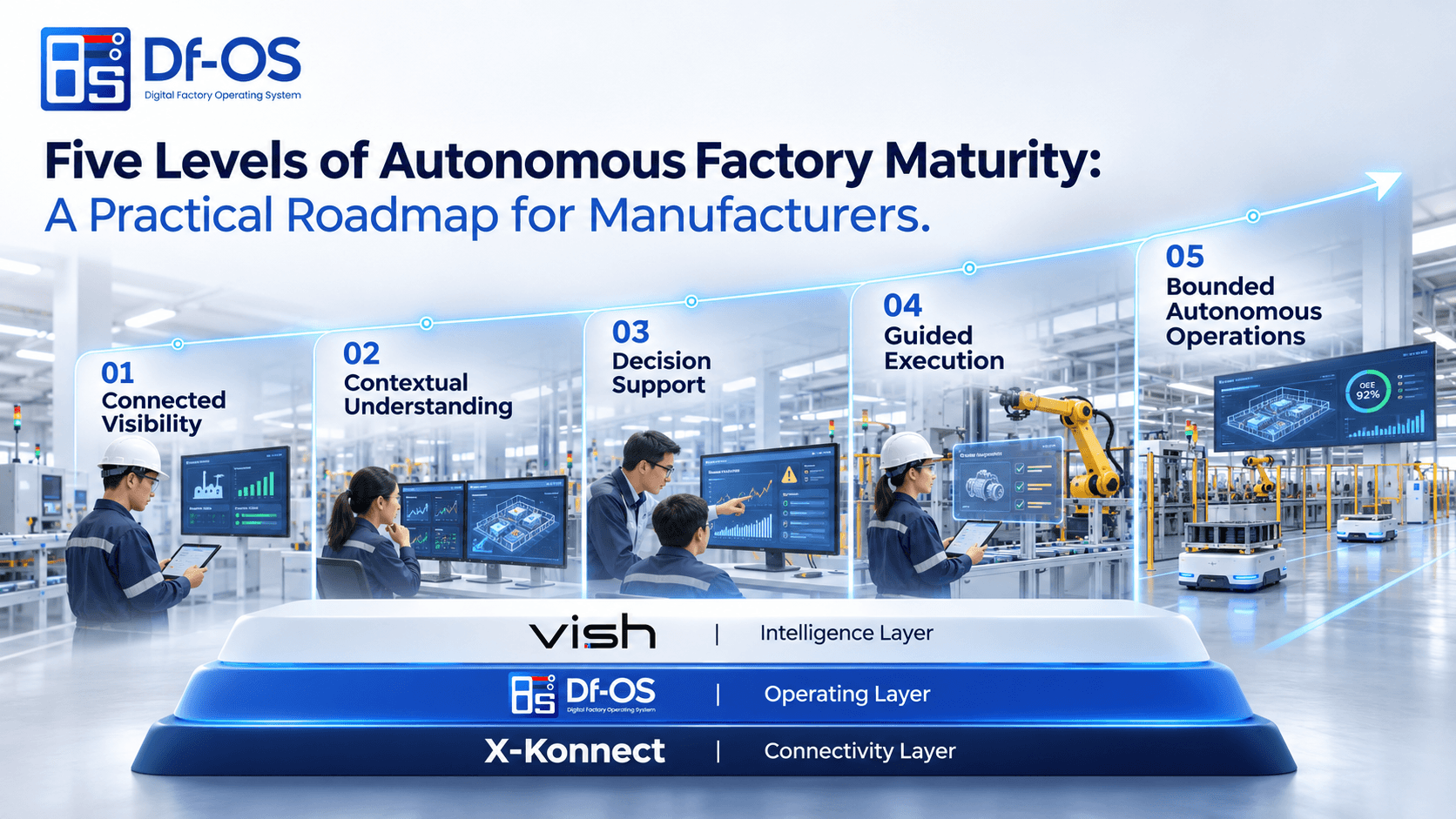
Autonomous Factory maturity progresses through five practical levels: connected visibility, contextual understanding, decision support, guided execution and bounded autonomous operations. Manufacturers should assess maturity at the level of individual operating loops, using reliable sensing, context, decision rules, controlled execution and outcome verification rather than treating autonomy as a plant-wide technology label.
A factory becomes more autonomous when it can recognise an operating condition, understand its significance and complete a suitable response with less manual coordination. That progression takes place in stages. A plant may have automated equipment but still depend on supervisors to gather reports, identify causes and chase actions. Conversely, a plant with older equipment can automate selected operating decisions once its data, workflows and approval rules are reliable.
The useful question for manufacturing leaders is therefore not whether the entire plant is autonomous. It is which decisions can move from manual judgement to supported, guided and eventually bounded execution. This article presents a five-level maturity model for making that assessment.
Start with the operating decision, not the technology
Think of a packaging line that repeatedly stops during changeover. The machine controller records the stop. A supervisor records a reason. Maintenance checks the equipment. Production adjusts the schedule. Quality may hold finished goods if there is uncertainty about settings. Four teams touch the same event, but the decisions occur in separate systems and conversations.
More sensors may improve visibility. They do not automatically shorten the delay between detection, diagnosis and response. An autonomy programme has to connect the event to the responsible person, the approved procedure, the previous history and an observable outcome.
That is why maturity should be measured at the level of operating loops. A loop has a trigger, context, decision, action and verification. If any part is missing, further automation can make the problem harder to control.
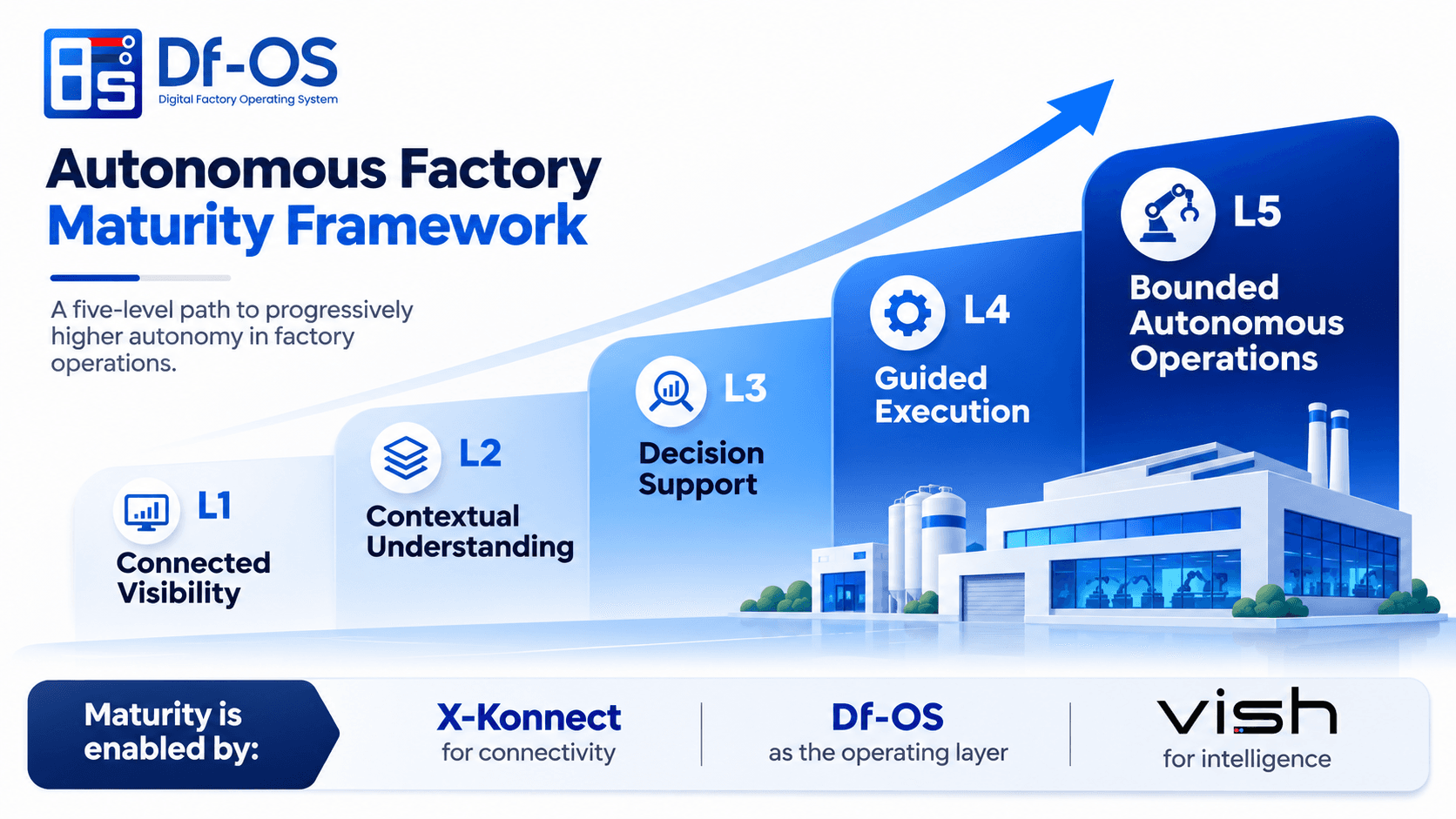
Level 1: Connected visibility
The first level answers a basic question: what is happening now? Machine states, production quantities, downtime, inspections and workflow statuses are available in a consistent operating view. People no longer need to reconstruct the plant position from several reports before a review.
At this stage, the factory is connected but decisions remain manual. A machine alarm may appear on a dashboard without creating an owned maintenance response. An overdue quality check may be visible without a defined escalation.
A useful Level 1 test is whether the same event has the same timestamp, identifier and meaning across the production, quality and maintenance records. Where definitions conflict, executives can see more data but still lack a dependable picture.
Level 2: Contextual understanding
Level 2 connects operating signals to their circumstances. The system knows which line, SKU, batch, shift, machine, material and procedure were involved. It preserves the response taken and its result. Df-OS describes this foundation as Factory Metadata & Memory.
Consider a motor test failure. A test value alone is incomplete. Investigators need component genealogy, equipment condition, operator sign-off, previous rework and the applicable test specification. When these relationships are searchable, teams can investigate faster and distinguish an isolated event from a repeating pattern.
At Level 2, reports become explanations. The factory can answer what changed, where it changed and what happened in similar circumstances before. It still relies on people to choose actions.
Level 3: Decision support
Level 3 helps the responsible person decide what should happen next. A system may prioritise a recurring fault, assemble evidence for a deviation investigation or suggest the relevant approved maintenance procedure. The recommendation must be traceable to operating records, with uncertainty made clear.
This is a suitable role for Vish AI, the intelligence layer in the Df-OS ecosystem. Vish AI is positioned to work across Factory Metadata & Memory to answer questions, explain deviations and recommend action. The quality of the result depends on the completeness of the underlying records and the implementation context.
A plant should assess decision support by its practical contribution. Did the supervisor recognise the issue earlier? Was the recommendation accepted? Did the system provide enough evidence for the engineer to trust it? A fluent answer is of little value if it cannot be checked.
Level 4: Guided execution
At Level 4, a recommendation is connected to a workflow. The system creates or routes a task, identifies the owner, applies a response deadline, records approval and follows the issue through to closure.
For example, an abnormal process condition might trigger an inspection, request a technician review and prevent a release until a qualified approver signs off. People retain authority, while the operating process becomes faster and more consistent.
Guided execution is frequently more valuable than ambitious automatic control. Many factories lose hours because a known action is not assigned, tracked or completed at the right moment. Solving that delay can produce meaningful value without granting software authority over equipment.
Level 5: Bounded autonomous operations
The final level applies to selected decisions that can be executed within explicit operating limits. Suitable cases tend to be frequent, well understood, measurable and reversible. The system recognises a condition, checks relevant rules, executes an authorised action and verifies the result. It pauses or escalates when conditions fall outside its approved boundary.
A bounded loop might change the priority of noncritical work orders according to established rules or trigger a validated inspection sequence after a defined event. Direct process setpoint changes require additional controls, engineering validation and system-specific safety assessment. They should never be presented as a generic capability of an AI platform.
Full autonomy across an entire plant is not required. A factory can have Level 5 capability for a narrow workflow while remaining at Level 2 elsewhere.
A maturity scorecard that avoids inflated claims
Assess each priority workflow on five questions:
- Sensing: Can the event be detected correctly and on time?
- Context: Is the event linked to the relevant 4M and workflow history?
- Decision: Is the response logic documented, understandable and reliable?
- Execution: Can the approved response reach the right person or system?
- Verification: Can the result be measured, challenged and audited?
Score each answer from zero to two. Zero means absent. One means partial or manual. Two means reliable and evidenced. A high score indicates a sound candidate for the next maturity level; it does not itself authorise automatic execution.
The scorecard should be completed jointly by operations, engineering, quality and IT or OT. One function alone cannot judge production risk, process safety and data readiness.
How Df-OS supports the progression
Df-OS provides the AI-native Digital Factory Operating System that structures shopfloor workflows and operational records. X-Konnect contributes machine and sensor connectivity. Factory Metadata & Memory connects conditions, actions and history. Vish AI can use that context to support explanations, priorities and guided decisions. Together, these capabilities create a practical foundation for selected autonomous operating loops.
Manufacturers should begin with one persistent operational problem. Define the current response, identify the missing information, agree on ownership and measure the baseline. Improve the loop before widening the scope. A successful autonomous factory programme is a sequence of dependable operating improvements, not a single technology purchase.
Ready to Modernize Your Factory Operating Layer?
Discover how Df-OS digitizes shopfloor workflows, connects brownfield machines, and creates Factory Metadata & Memory without rip-and-replace disruption.
Frequently Asked Questions
Not necessarily. Machine automation can run a process with little intervention while cross-functional decisions around quality, maintenance and schedule recovery remain manual. Factory autonomy concerns those broader operating decisions as well.
Stay Ahead of Manufacturing AI
Join 15,000+ plant managers and industrial leaders receiving our bi-weekly reports on AI agents, shopfloor data operations, and the future of smart factories.
Df-OS Editorial Board
Industry experts mapping the future of connected digital factory operating systems and manufacturing intelligence.
Related Insights & Guides
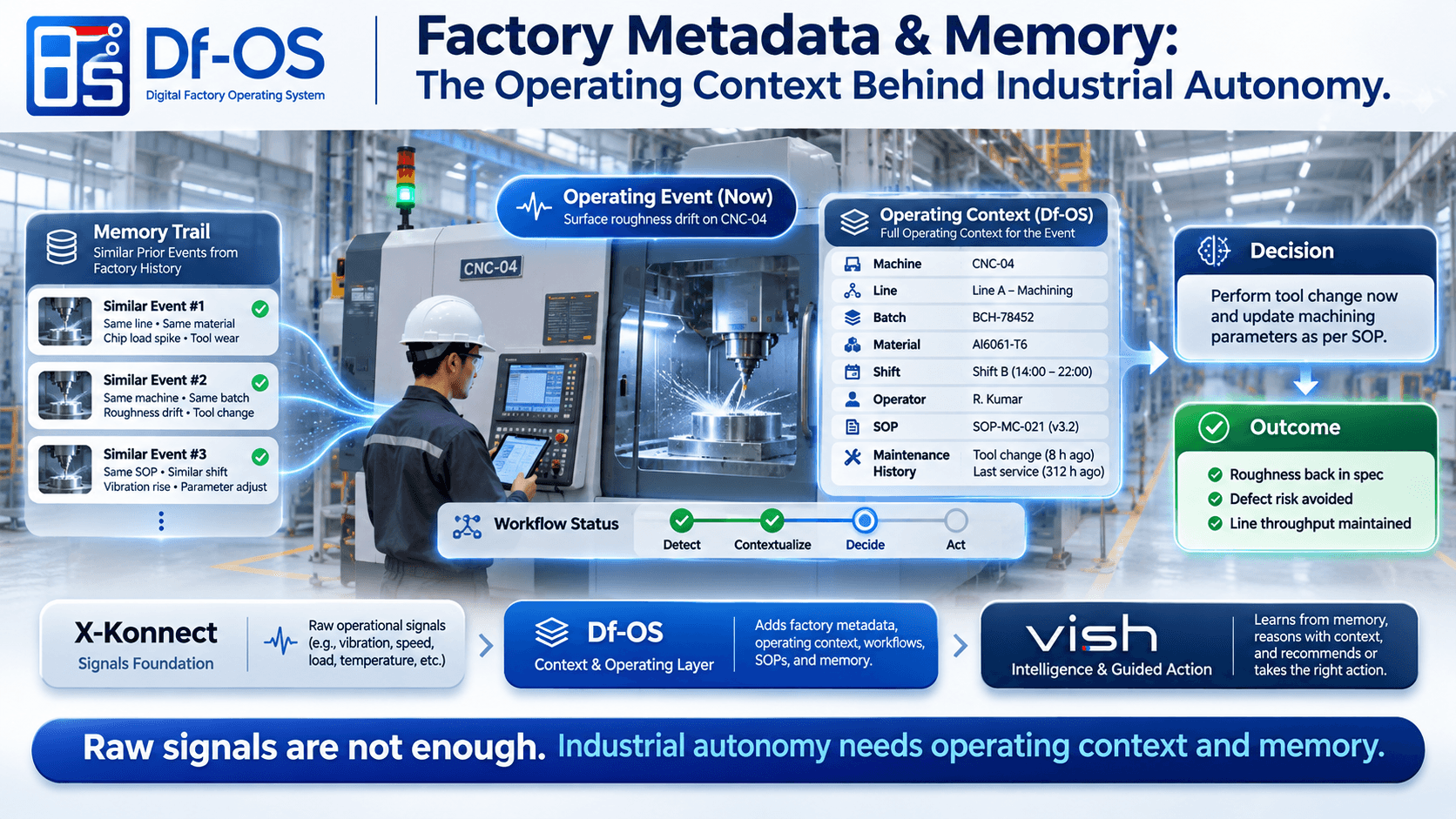
Factory Metadata & Memory: The Operating Context Behind Industrial Autonomy
Why industrial autonomy needs more than machine signals: Factory Metadata & Memory connects events to identities, conditions, workflows, decisions and verified outcomes.
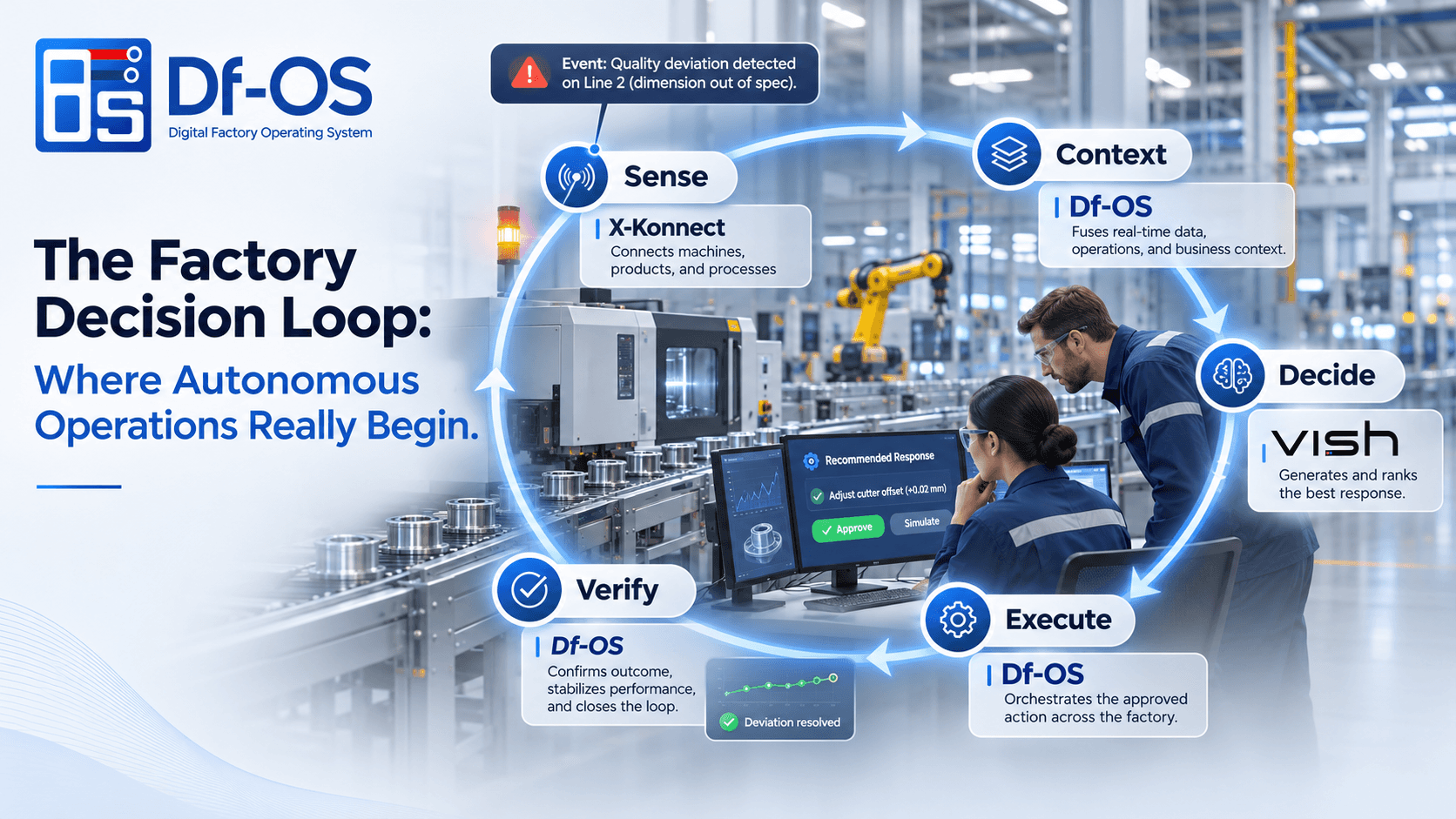
The Factory Decision Loop: Where Autonomous Operations Really Begin
Autonomous operations begin by making recurring factory decision loops dependable: detect the event, establish context, apply the authorised response, execute and verify the outcome.
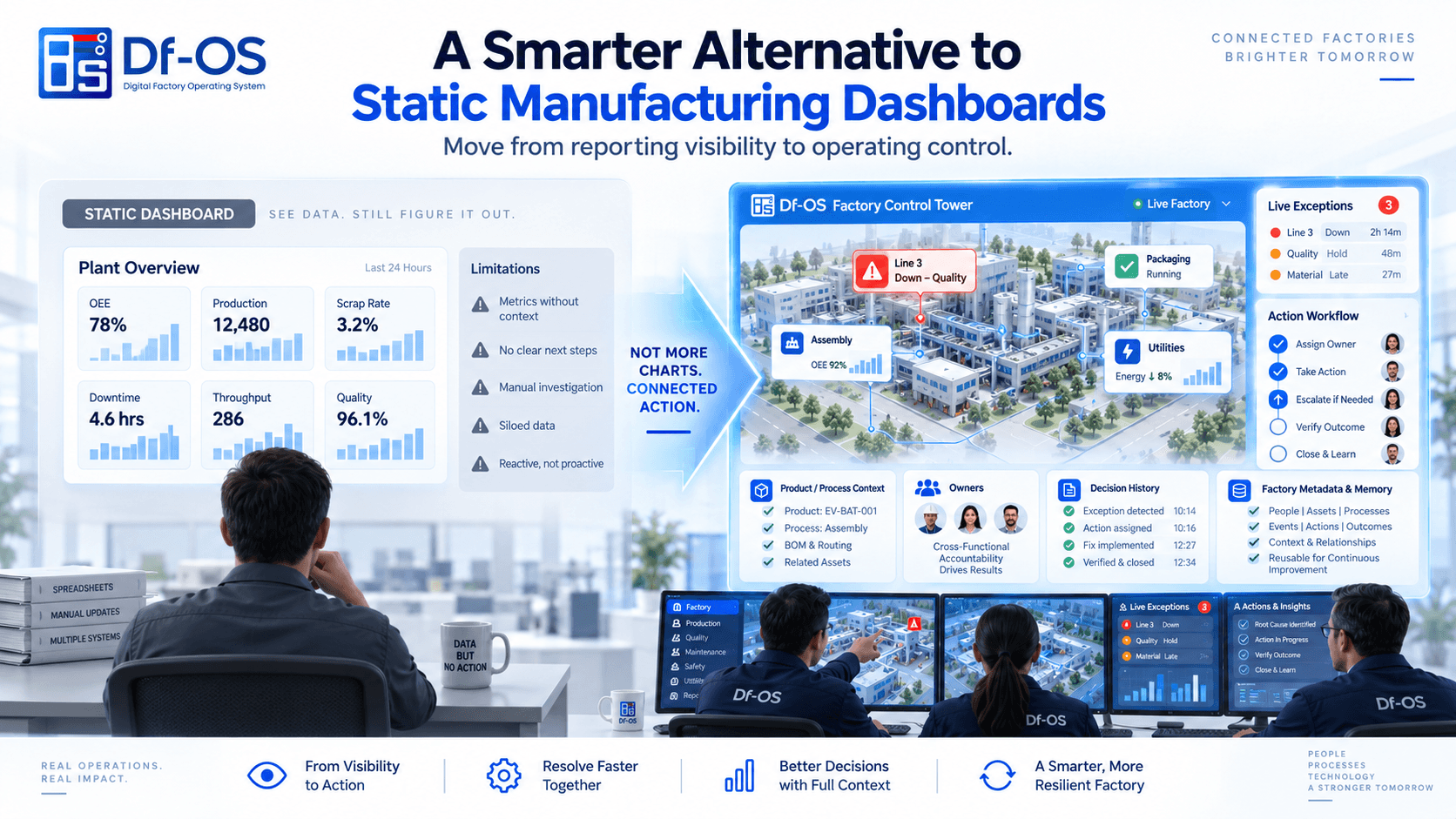
A Smarter Alternative to Static Manufacturing Dashboards
A comparison of static manufacturing dashboards and a connected Factory Control Tower that links metrics to live events, context, owners, workflows, escalation and verified closure.