
Deviation Management for Modern Manufacturing Plants
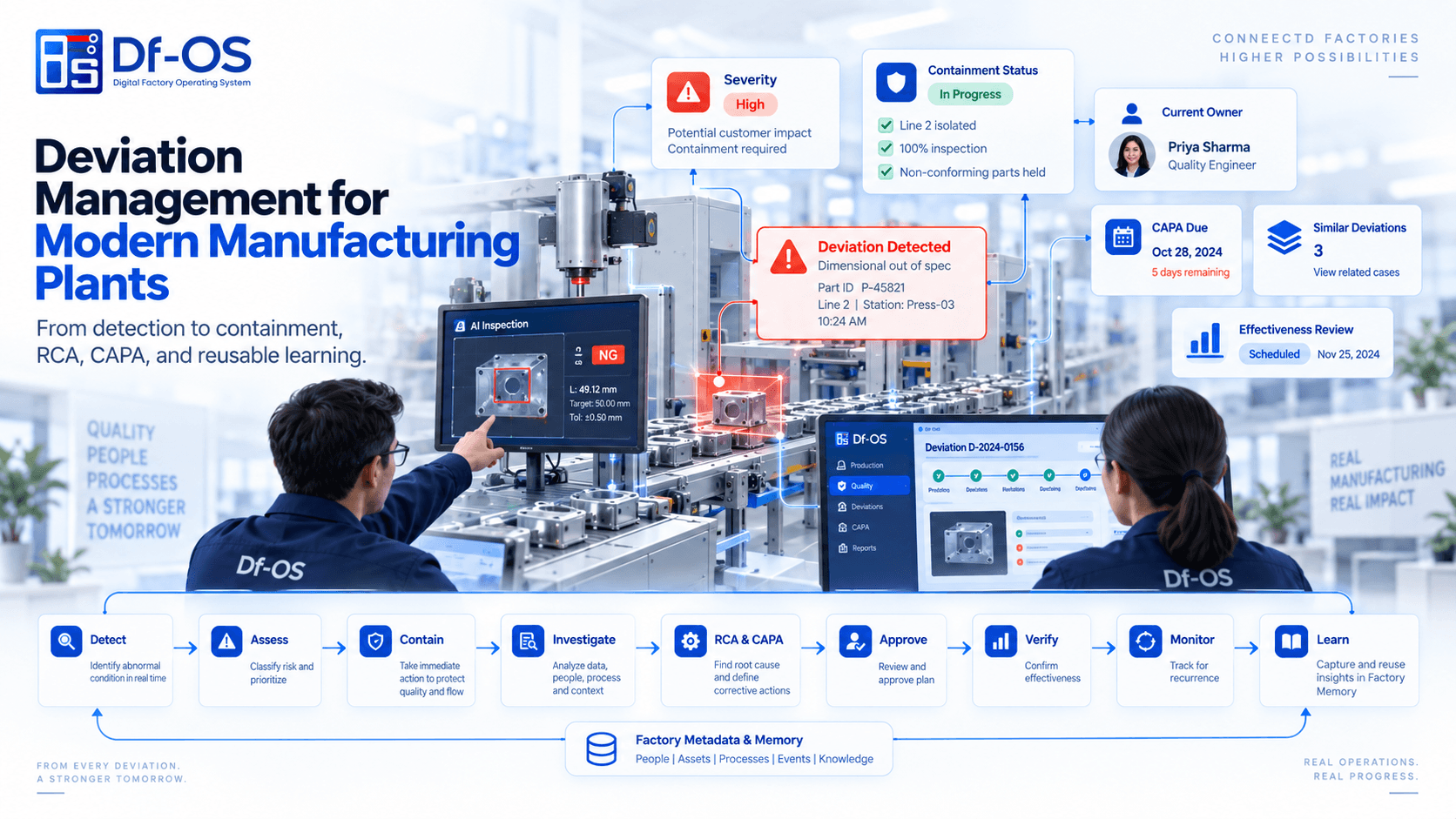
Modern deviation management connects detection, risk classification, containment, investigation, RCA, CAPA, approval, effectiveness review and recurrence monitoring in one traceable workflow. Machine, material, people and process context should remain linked to the event.
A deviation is not managed when it is entered into a form.
It is managed when the risk is contained, the cause is understood, the corrective action is verified and the learning is available when a similar event occurs again.
Many plants have formal deviation procedures and still struggle with delayed detection, weak context, long investigation cycles and repeated failure. The gap often sits between the quality record and the live operating process.
The complete deviation lifecycle
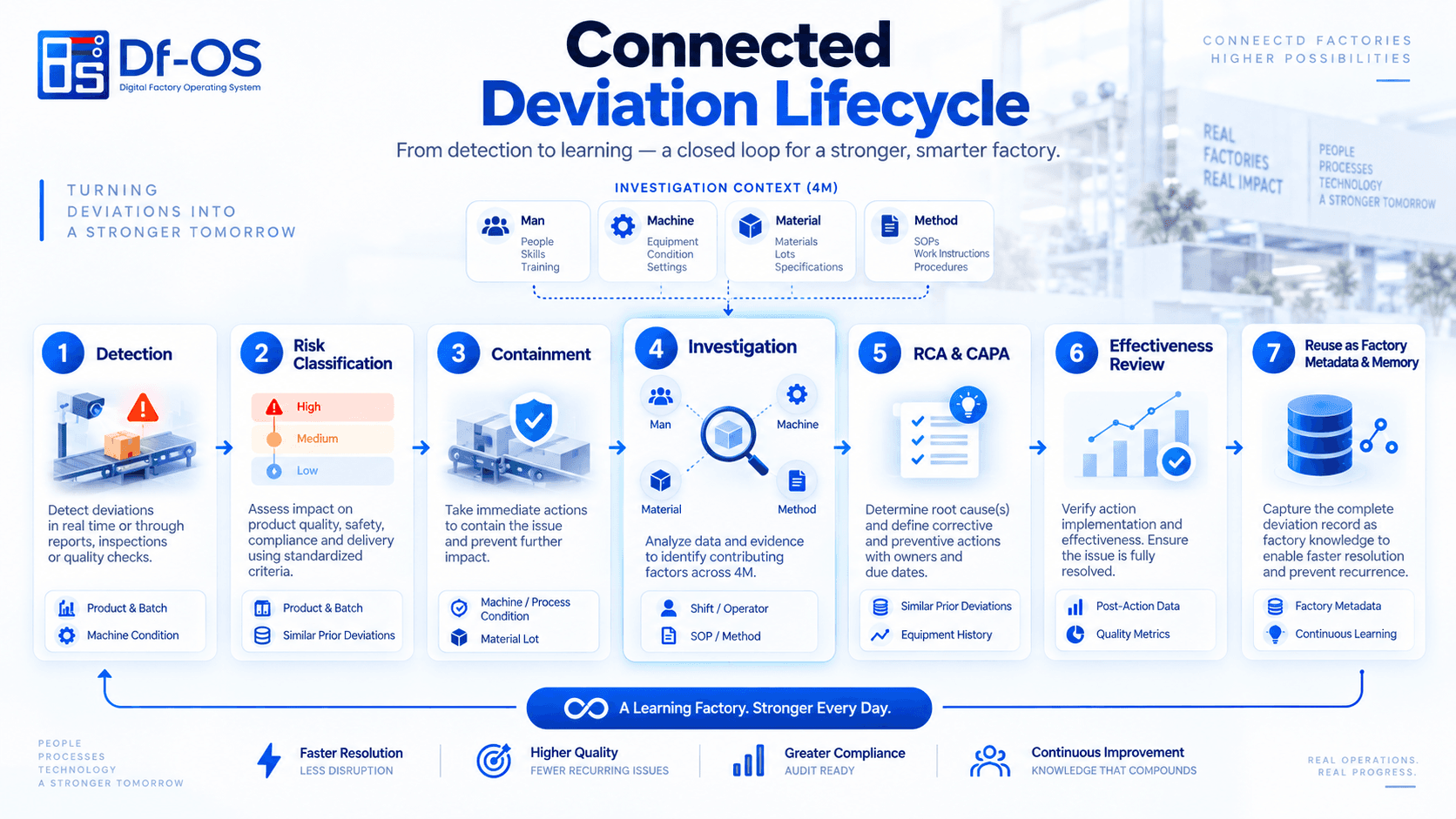
1. Detection
A deviation can be detected through:
- Operator observation
- Inspection
- Machine or process signal
- Laboratory result
- Audit
- Customer complaint
- System rule
The record should capture the condition at the time of detection, not only the final description.
2. Risk classification
The plant determines severity, scope and immediate response.
Risk classification should influence containment, notification, approval and escalation.
3. Containment
Containment protects product, process, people and customer while the investigation continues.
It may include:
- Stopping the process
- Holding material
- Segregating product
- Increasing inspection
- Applying a temporary control
- Restricting equipment
Containment should have a clear owner and expiry condition.
4. Investigation
The team connects the event to Factory Metadata & Memory across:
- Product and batch
- Machine and process condition
- Material lot
- Shift and operator observation
- Method and SOP
- Maintenance and change history
- Similar prior deviations
5. RCA and CAPA
The root cause should be supported by evidence. Corrective and preventive actions should be linked to ownership, due date, approval and affected process.
6. Effectiveness review
The factory verifies whether the action reduced recurrence and whether the process remains under control.
7. Reuse
The completed history becomes searchable operating memory for future events and other plants.
Why deviation systems become disconnected
A deviation application may be strong for document control but weakly connected to:
- Live process values
- Machine alarms
- Production order
- Maintenance work
- Shift handover
- Material genealogy
- Daily review
The quality team then spends time reconstructing the operating timeline.
A Digital Factory Operating System connects the quality workflow with the broader factory event.
The importance of 4M context
A deviation should be examined across Man, Machine, Material and Method.
The strength comes from relationships.
The system should show which operator, machine condition, material lot and method revision were present together. It should also show which factor changed relative to a successful run.
Deviation visibility in the Factory Control Tower
The Control Tower should provide:
- Active deviations by severity
- Containment status
- Affected product and process
- Current owner
- Investigation age
- CAPA due status
- Repeat event indicator
- Escalation
- Effectiveness review status
This gives plant leadership visibility without replacing quality authority.
How Vish AI can support deviation analysis
Vish AI can:
- Summarise the event timeline
- Surface similar deviations
- Compare operating conditions
- Present prior corrective actions
- Identify overdue workflow steps
- Highlight repeated cause relationships
The quality team remains responsible for cause verification, disposition and approval.
Deviation management and autonomous operations
Selected steps can become automated within approved rules:
- Detect an abnormal condition
- Create the deviation
- Identify affected records
- Start containment workflow
- Notify responsible roles
- Monitor due dates
- Check recurrence
High consequence decisions remain human governed.
This is how automation improves control without weakening accountability.
Common failure modes
The event is described too broadly
A generic description reduces future search and analysis value.
Containment has no expiry
Temporary controls remain in place without review.
RCA becomes a code selection
The category is recorded without evidence or reasoning.
CAPA closes before effectiveness
Completion is mistaken for result.
Similar events are not linked
The factory repeats the investigation.
A deviation management checklist
- Is the event captured at detection?
- Is risk classification consistent?
- Is containment owned and time bound?
- Are machine, material, people and method context linked?
- Is the cause supported by evidence?
- Is CAPA connected to the process change?
- Is effectiveness verified?
- Are repeat deviations visible?
- Does the history become Factory Metadata & Memory?
The Df-OS approach
Df-OS connects detection, containment, RCA, CAPA, approval and effectiveness in one workflow. X-Konnect can add machine and process context. The Factory Control Tower provides cross-functional visibility. Vish AI can support analysis using Factory Metadata & Memory.
Final perspective
Deviation management should protect the present and improve the future.
A connected lifecycle gives the factory faster containment, better investigation and stronger reuse of learning. That is the difference between a compliant record and an intelligent operating process.
Ready to Modernize Your Factory Operating Layer?
Discover how Df-OS digitizes shopfloor workflows, connects brownfield machines, and creates Factory Metadata & Memory without rip-and-replace disruption.
Frequently Asked Questions
Yes, where the condition and rule are defined. The workflow should still apply the required review and approval.
Stay Ahead of Manufacturing AI
Join 15,000+ plant managers and industrial leaders receiving our bi-weekly reports on AI agents, shopfloor data operations, and the future of smart factories.
Df-OS Editorial Board
Industry experts mapping the future of connected digital factory operating systems and manufacturing intelligence.
Related Insights & Guides
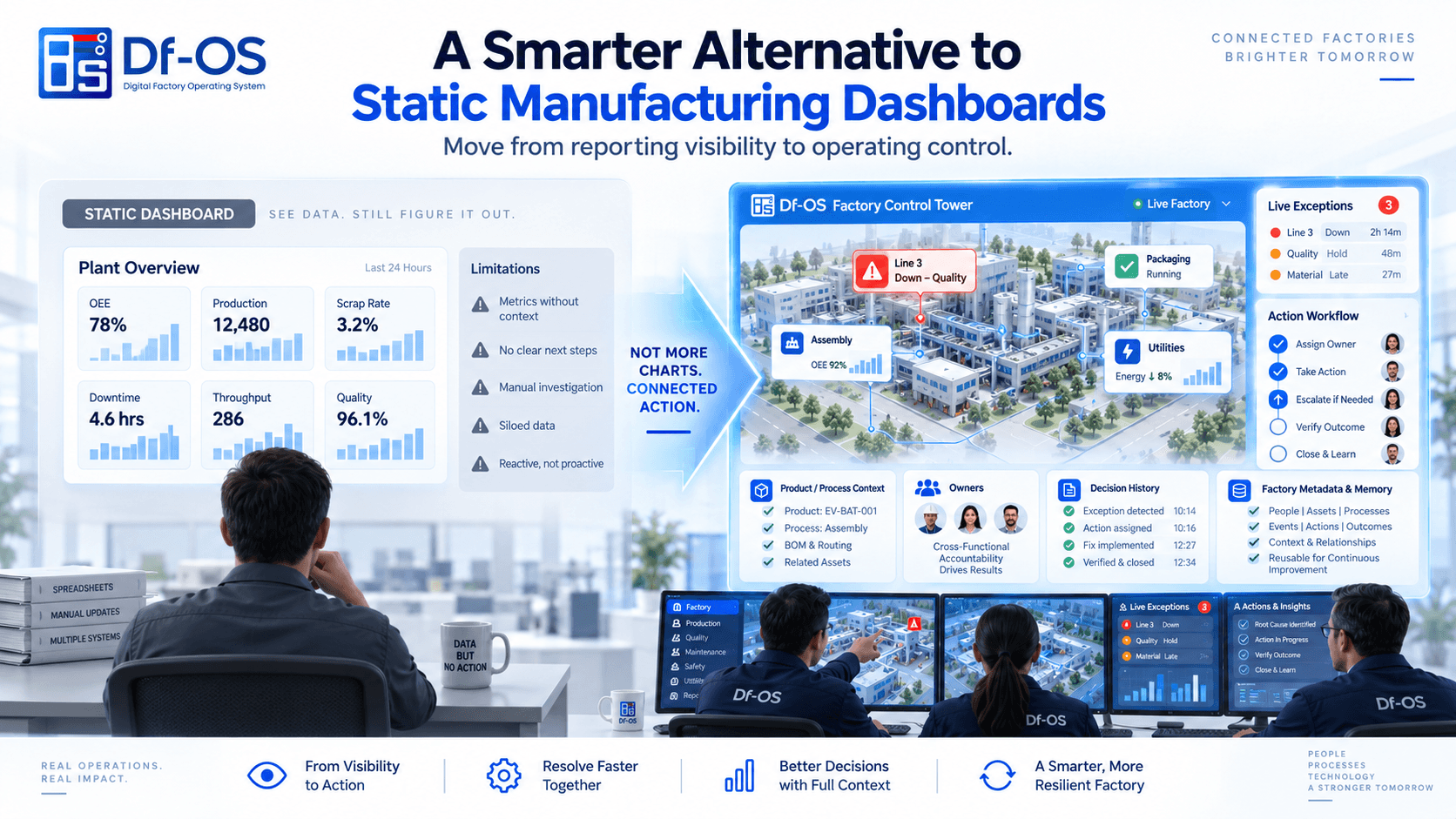
A Smarter Alternative to Static Manufacturing Dashboards
A comparison of static manufacturing dashboards and a connected Factory Control Tower that links metrics to live events, context, owners, workflows, escalation and verified closure.
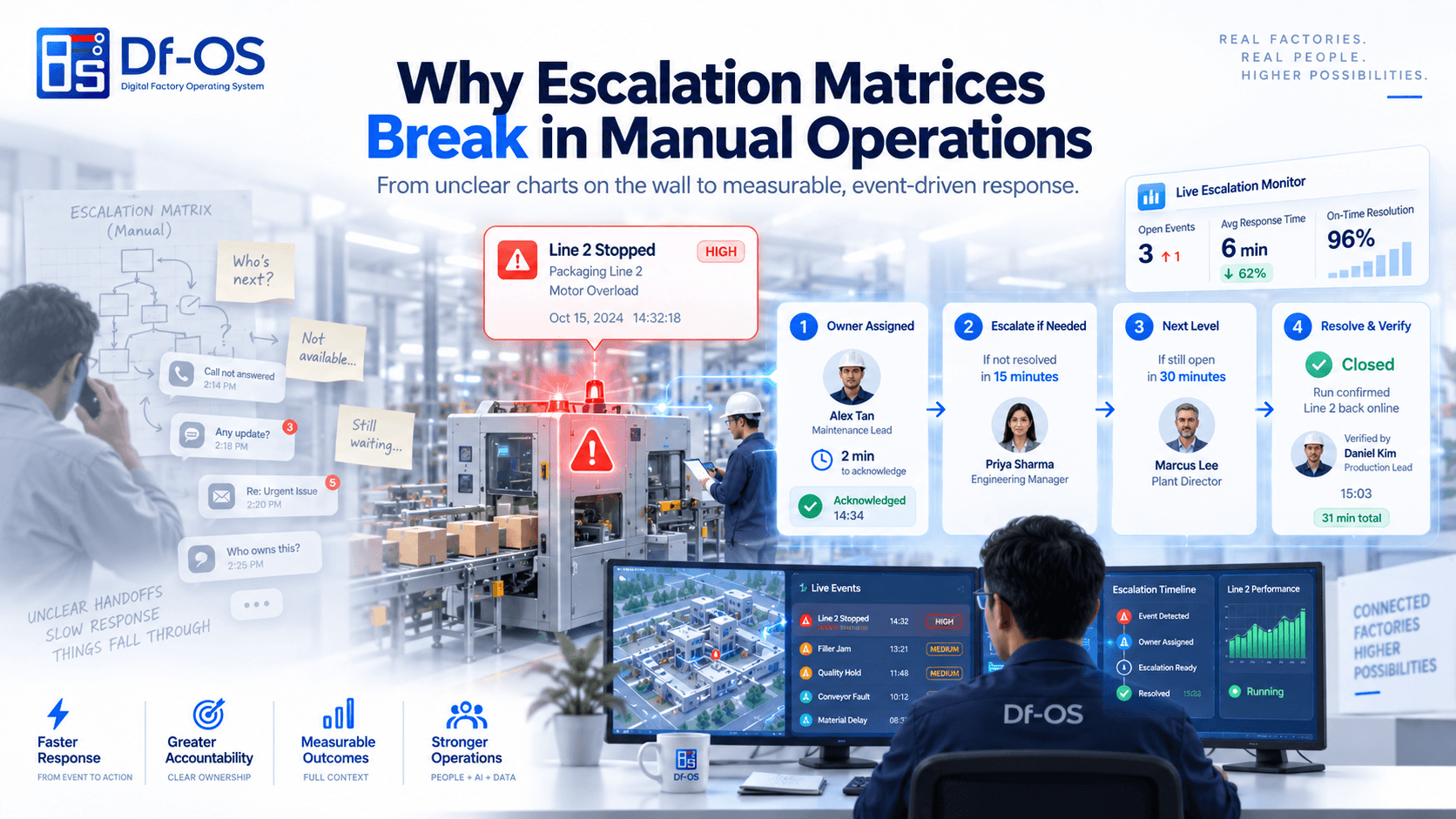
Why Escalation Matrices Break in Manual Operations
Why manual factory escalation matrices fail and how event-driven workflows connect measurable triggers, ownership, response time, escalation, closure evidence and learning.
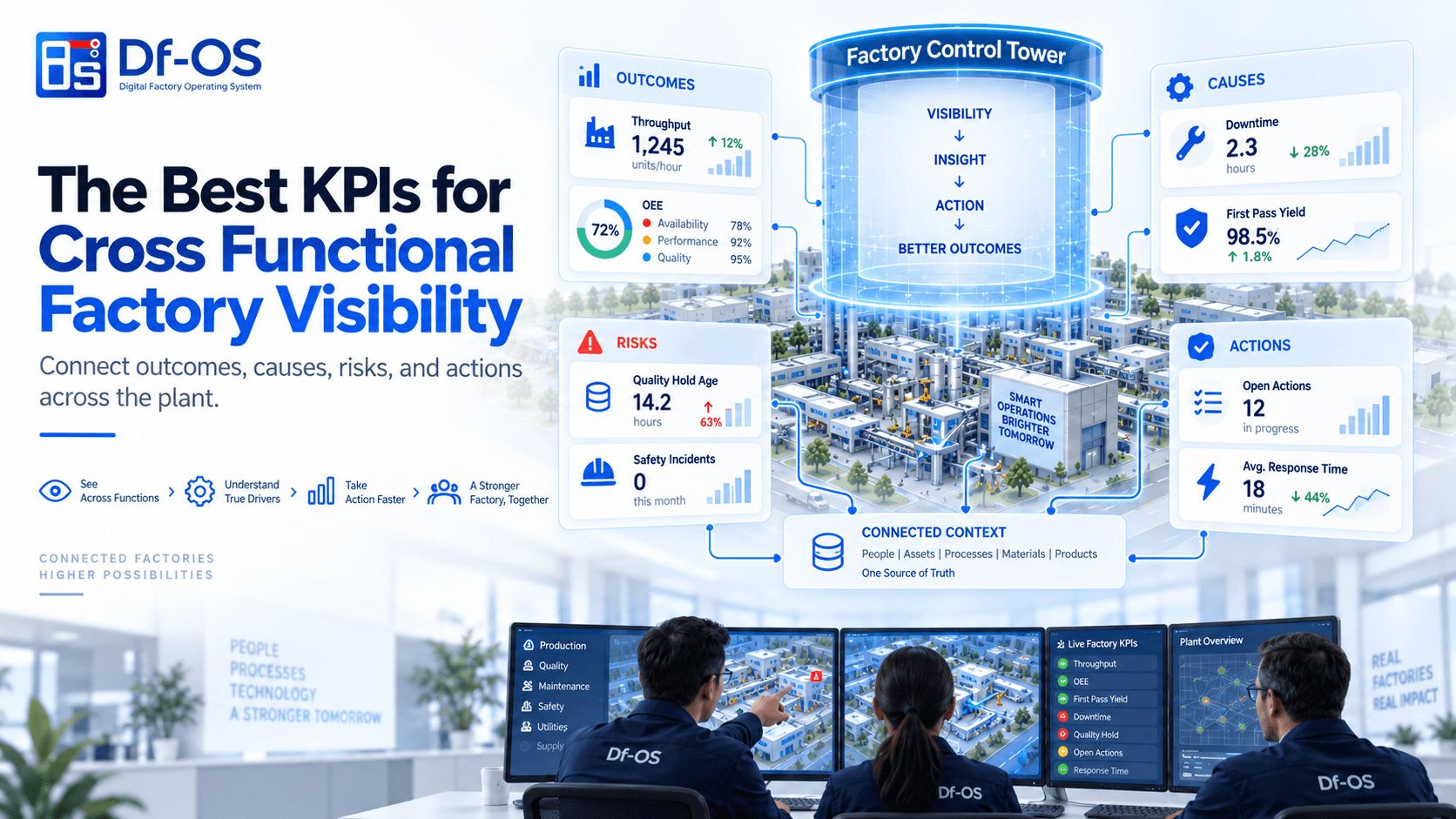
The Best KPIs for Cross Functional Factory Visibility
A four-level KPI framework connecting plant outcomes, operating causes, forward risks and action closure across production, quality, maintenance, safety and utilities.