
Factory Metadata & Memory Explained for Manufacturers

Factory Metadata & Memory is the structured operating record that connects what happened, where and when it happened, which people, machines, materials and methods were involved, what action was taken and what worked before. Metadata provides context. Memory preserves the history and outcome.
A machine alarm is data. The same alarm connected to the product, batch, shift, process condition, operator response, maintenance action and final outcome becomes operational context.
Factory Metadata & Memory is the structured operating record that preserves this context.
Metadata describes the relationships around an event. Memory preserves what happened, what the factory did and whether the response worked. Manufacturers need both because industrial intelligence and an AI-Native Digital Factory Operating System cannot reason reliably from disconnected values alone.
Why machine data is not the whole story
Factories generate large volumes of information through PLCs, sensors, SCADA systems, historians, ERP transactions, quality records, maintenance systems, logbooks and spreadsheets.
The challenge is rarely the absence of data. The challenge is that important relationships are missing.
A motor current increased. Was the machine producing the same SKU as yesterday? Was the line running after a changeover? Did the material grade change? Was a maintenance activity completed? Did the operator reduce the speed? Did quality observe a related defect?
Without these relationships, a system can show a trend but may not explain the event.
Factory Metadata & Memory connects the signal to the operating situation.
Metadata and memory perform different jobs

Factory metadata provides context
Metadata tells the system what an event belongs to and how it relates to other operating elements.
Typical metadata includes:
- Plant, area, line and machine
- Product, batch, work order and material lot
- Shift, operator, supervisor and role
- Process step, SOP and acceptable range
- Event type, severity and status
- Workflow, owner, approval and escalation
- Time, duration and sequence
Factory memory preserves history and learning
Memory preserves how the factory responded and what occurred as a result.
Typical memory includes:
- The event sequence
- The evidence collected
- The decision made
- The action assigned
- The response time
- The corrective action
- The verification result
- The final outcome
When this history is searchable and connected, the factory can reuse its own operating experience.
The six questions every operating record should answer
A useful Factory Metadata & Memory model should answer six questions.
1. What happened?
The event must be defined clearly. A generic entry such as machine issue is not enough. The record should capture the actual condition, deviation or exception.
2. Where did it happen?
The location should connect plant, line, asset and process step. This allows recurrence to be identified across similar equipment or areas.
3. When did it happen?
Time should capture more than a timestamp. Sequence, duration, shift and process phase often matter.
4. What conditions were present?
This includes product, batch, material, setpoints, recent changeovers, maintenance status and environmental conditions.
5. Who acted?
The record should show the responsible role, response, approval and escalation. This creates accountability without relying on personal recollection.
6. What worked before?
Past investigations, approved actions and verified outcomes should be available when a similar event occurs again.
A practical example: recurring downtime
Consider a filling line that stops repeatedly because of a sensor fault.
A basic system records the stop code and duration. A richer operating record connects:
- The exact sensor and machine
- The product and pack size
- The line speed
- The shift and operator
- The preceding alarm sequence
- The technician response
- The component replaced
- The time to restore production
- Whether the issue returned
After several events, the factory can see that the fault appears only after a particular changeover and at a specific line speed.
The value does not come from the stop code alone. It comes from the connected context and history.
Where Factory Metadata & Memory creates value
Root cause analysis
Investigators can compare current conditions with previous events rather than rebuilding the history manually.
CAPA effectiveness
The factory can see whether an approved corrective action prevented recurrence or merely closed the form.
Shift handover
Open risks, pending actions and recent changes are preserved for the incoming team.
Audit readiness
The organisation can retrieve the evidence, ownership, approval and closure history around a process.
Multi-plant standardisation
Plants can compare similar events using common definitions while preserving local operating context.
Industrial intelligence
Vish AI can use the connected record to answer questions, explain deviations, identify repeated patterns and recommend relevant actions.
Factory Metadata & Memory and the 4M model
Manufacturing problems are often examined through Man, Machine, Material and Method.
Factory Metadata & Memory turns this familiar model into a connected operating structure.
A quality deviation can be linked to:
- Man: training status, role and shift
- Machine: equipment condition, alarm and setpoint
- Material: lot, supplier and inspection result
- Method: SOP version, process step and control limit
This relationship model is more useful than storing four separate reports because it preserves how the factors interacted during the event.
Why this foundation matters for the Autonomous Factory
Autonomous operations require more than live data.
A system needs to know what condition it is observing, what the approved response should be, whether the current situation fits a known pattern and when a person must take control.
Factory Metadata & Memory provides this basis.
It supports the maturity path from:
- Visibility to explanation
- Explanation to recommendation
- Recommendation to guided action
- Guided action to bounded execution
Without context and memory, autonomy becomes guesswork. In manufacturing, guesswork is not an acceptable control strategy. Discover the complete Autonomous Factory maturity journey.
How Df-OS builds the context layer
Df-OS digitises daily factory workflows and connects events across production, quality, maintenance, safety and utilities. X-Konnect brings machine and process signals into the same operating context. Vish AI can then reason across the resulting Factory Metadata & Memory.
The objective is not to create one large data repository for its own sake. It is to create a useful operating record that improves decisions at the point of work.
A factory context checklist
Review one recurring issue and ask:
- Can we identify the exact asset, product, batch and shift?
- Can we see the conditions before the event?
- Can we find the response and approval history?
- Can we locate similar past events?
- Can we verify whether the previous action worked?
- Can a new supervisor understand the history without asking the same people?
If the answer is no, the factory has data but limited operating memory.
Final perspective
Factories learn through events, actions and outcomes. The learning is lost when those elements sit in different systems or remain in individual experience.
Factory Metadata & Memory gives the organisation a way to preserve that learning. It turns machine signals, workflow records and human actions into a connected history that supports traceability, decision quality and the progression toward the Autonomous Factory. Ready to see how Df-OS structures factory intelligence? Explore the Factory Metadata & Memory platform walkthrough with our industrial engineers.
Ready to Modernize Your Factory Operating Layer?
Discover how Df-OS digitizes shopfloor workflows, connects brownfield machines, and creates Factory Metadata & Memory without rip-and-replace disruption.
Frequently Asked Questions
No. A data lake stores data from many sources. Factory Metadata & Memory focuses on the operational relationships, actions and outcomes that give the data manufacturing meaning.
Stay Ahead of Manufacturing AI
Join 15,000+ plant managers and industrial leaders receiving our bi-weekly reports on AI agents, shopfloor data operations, and the future of smart factories.
Df-OS Editorial Board
Industry experts mapping the future of connected digital factory operating systems and manufacturing intelligence.
Related Insights & Guides
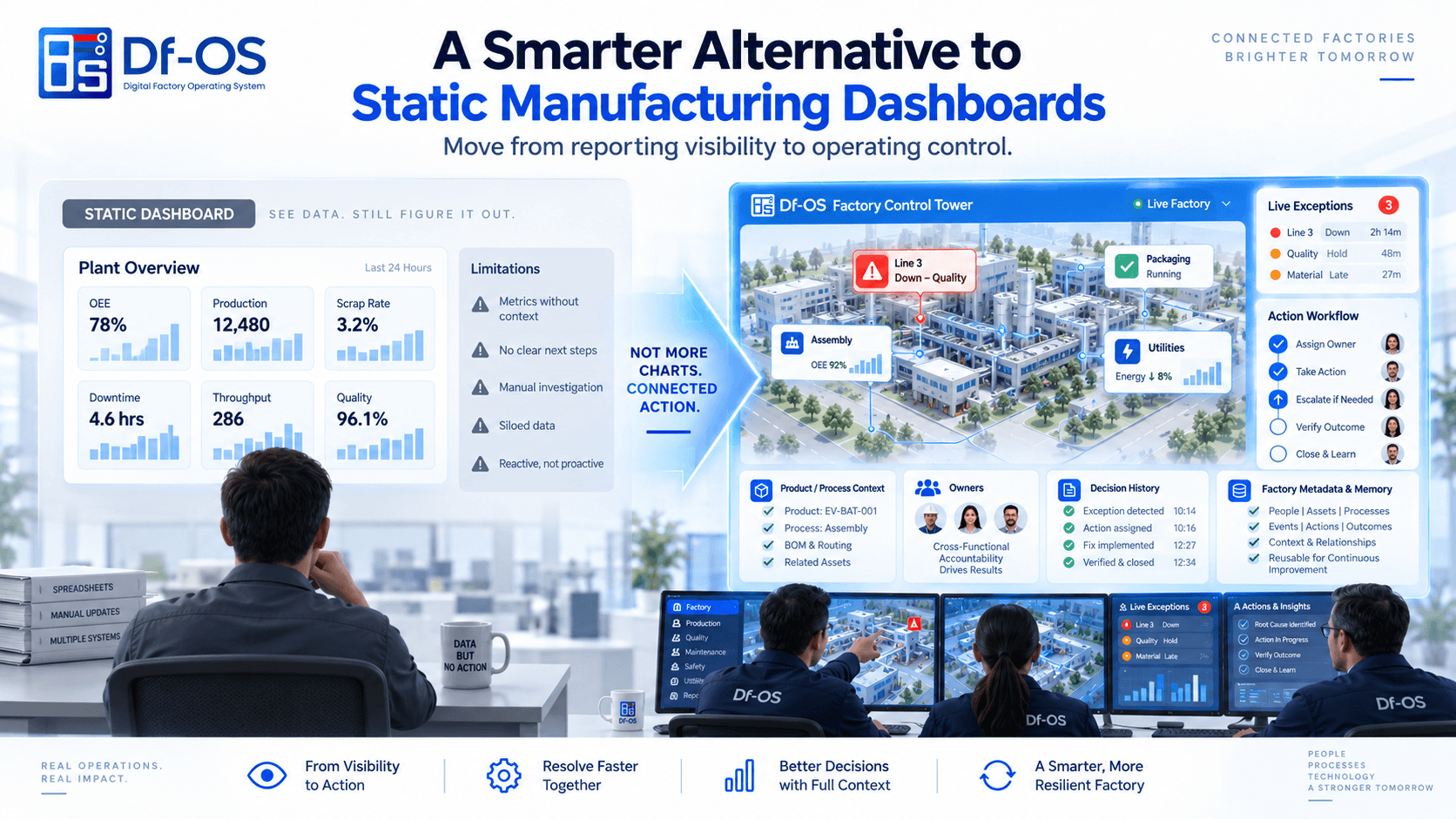
A Smarter Alternative to Static Manufacturing Dashboards
A comparison of static manufacturing dashboards and a connected Factory Control Tower that links metrics to live events, context, owners, workflows, escalation and verified closure.
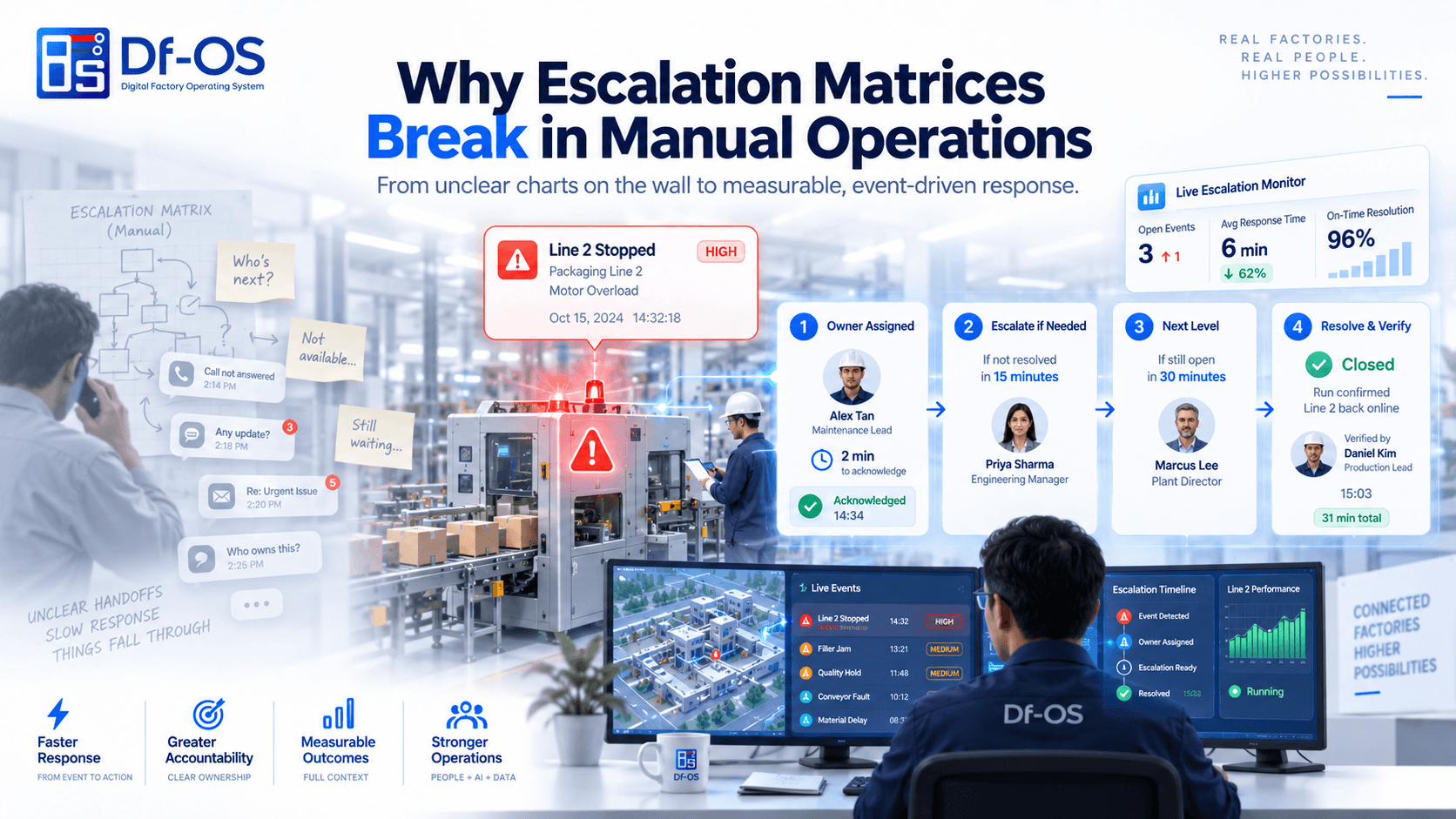
Why Escalation Matrices Break in Manual Operations
Why manual factory escalation matrices fail and how event-driven workflows connect measurable triggers, ownership, response time, escalation, closure evidence and learning.
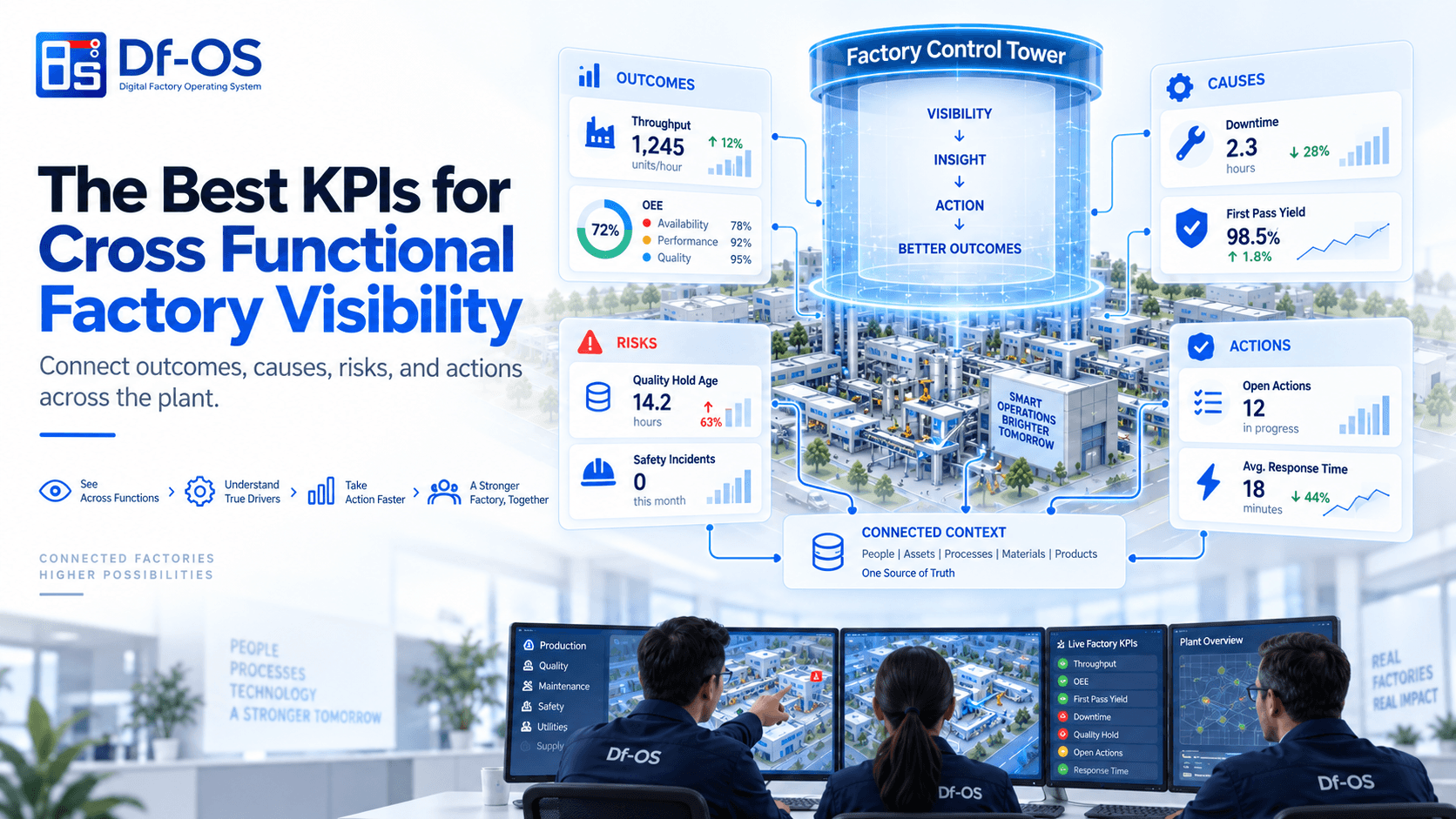
The Best KPIs for Cross Functional Factory Visibility
A four-level KPI framework connecting plant outcomes, operating causes, forward risks and action closure across production, quality, maintenance, safety and utilities.