
What Is an AI-Native Digital Factory Operating System?

An AI-Native Digital Factory Operating System is a connected operating layer that digitises factory workflows, links machines and enterprise systems, creates Factory Metadata & Memory and supports intelligent decisions across production, quality, maintenance, safety and utilities. It works with existing ERP, MES, PLC and SCADA systems rather than treating each process as a separate digital island.
It is not another screen placed above the shopfloor. It is the structure that connects what the factory senses, what people do, what workflows require and what the organisation decides.
That distinction matters because most factories already have software. They may have ERP for transactions, MES for production execution, PLC and SCADA systems for machine control, historians for time series data, quality applications, maintenance tools and a large collection of spreadsheets. Yet the daily work of the plant can still remain fragmented.
A supervisor notices a recurring stoppage. The alarm sits in one system. The technician records a repair elsewhere. The production loss is entered after the shift. A quality deviation is discussed in a meeting. The plant head sees the pattern only after several reports have been compiled.
The factory has data, but it does not have one connected operating record.
Why factories need an operating layer
Factories do not run as a collection of independent departments. Production affects quality. Quality affects release. Maintenance affects output. Utility conditions affect process performance. Material variation affects machine settings. Safety controls affect how and when work can be executed.
The systems supporting those functions, however, are often purchased at different times for different purposes. Each system may perform its assigned role well, but the relationships between systems are left to people, meetings, emails, calls and spreadsheets.
An operating layer addresses that gap. It does not try to turn every system into the same system. It creates a shared execution model across them.
A useful factory operating layer should answer five questions continuously:
- 1. What is happening now?
- 2. What operating context explains it?
- 3. Who owns the next action?
- 4. What happened in similar situations before?
- 5. What can be standardised, recommended or safely automated next?
When these questions can be answered from one connected operating environment, the factory moves beyond digital reporting. It starts to operate as a digital system.
What makes the platform AI-native
The term AI-native is often used too loosely. Adding a chatbot to a dashboard does not make a manufacturing platform AI-native.
A factory platform becomes AI-native when its architecture is designed to create the context that industrial intelligence needs. A model cannot understand a production loss from a machine tag alone. As outlined in the NIST 2026 Roadmap on Artificial Intelligence for Smart Manufacturing, industrial AI models require deep domain context: product, batch, line, shift, process condition, alarm history, operator response, maintenance action and resulting outcome.
This is where Factory Metadata & Memory becomes important.
Within Factory Metadata & Memory, metadata describes the operating relationships around an event. The memory component preserves the event, the response and the result so that the organisation can learn from it later.
Together, Factory Metadata & Memory can connect:
- A machine alarm to a specific line and product
- A quality deviation to process conditions and material lots
- A breakdown to the maintenance response and corrective action
- A shift handover to open risks and pending decisions
The five layers of an AI-Native Digital Factory Operating System
An AI-Native Digital Factory Operating System connects the factory across five functional layers, aligned with modern smart manufacturing frameworks like the NIST Smart Manufacturing Systems Design Program:

1. Workflow execution
The first layer digitises daily factory workflows and captures human inputs at the source.
This includes production logbooks, shift handovers, line clearance, quality inspections, deviations, RCA, CAPA, autonomous maintenance, permit to work, LOTO and safety checklists. When these activities move into structured workflows, the factory removes paper delay and gains reliable execution records.
2. Machine and system connectivity
The second layer connects machines, sensors, PLCs, edge devices and plant systems via X-Konnect IIoT middleware.
It captures operating status, runtime, alarms, parameters, energy consumption and production counts. Instead of leaving machine data inside isolated vendor software, this layer brings machine signals directly into operational workflows.
3. Factory Metadata & Memory
The third layer creates a connected history of factory execution.
Every event gains context. Every action gains an owner. Every decision gains a trace. Over time, this becomes a reliable operational memory that can be searched, compared and used during future events.
This layer is especially valuable for recurring downtime, deviation management, RCA, CAPA, cross-functional batch and material traceability, audit readiness and multi-plant standardisation.
4. Operational visibility and control
The fourth layer provides live visibility across functions through a Factory Control Tower, going much further than a static dashboard.
A factory leader should be able to see the issue, the impact, the owner, the response time, the current action and the unresolved risk. Visibility is useful when it improves action, not when it simply adds more charts.
5. Decision intelligence and bounded autonomy
The fifth layer uses the connected operating record to support decisions via Vish AI.
Vish AI can work across Factory Metadata & Memory to answer operational questions, explain deviations, identify recurring patterns, prioritise attention and recommend actions. As confidence, governance and process maturity improve, selected actions can move from recommendation to guided execution and then to bounded closed loop operation.
The word bounded is important. Industrial autonomy should operate within approved rules, safety controls and accountability. The objective is not to remove people from the factory. It is to remove avoidable delay and inconsistency from routine decisions.
How it differs from ERP, MES and dashboards
ERP remains essential for planning, procurement, finance, inventory and enterprise transactions. MES remains important for production execution, work orders, recipes, genealogy and batch records. PLC and SCADA systems remain responsible for machine control and supervision.
A Digital Factory Operating System connects the wider daily operating reality around these systems.
- ERP: Enterprise planning and transactions — Typical boundary: Limited detail on live shopfloor execution
- MES: Production execution and manufacturing records — Typical boundary: Often centred on production rather than every cross-functional workflow
- PLC and SCADA: Machine control and supervision — Typical boundary: Machine signals may remain disconnected from people and workflow actions
- Dashboard: Reporting and visualisation — Typical boundary: Often shows status without owning response or closure
- Digital Factory Operating System: Connected factory execution and operational context — Typical boundary: Brings workflows, systems, signals and decisions into one operating model
This is why the operating system category should not be positioned as a simple replacement claim. In most factories, the better question is how the operating layer can make the existing technology estate work as one connected environment.
The connection to the Autonomous Factory
An Autonomous Factory cannot be created by automation alone.
A factory must first be able to sense conditions reliably. It must then understand context, assign ownership, learn from prior events and act within defined rules. Only then can selected decisions be progressively automated.
The practical maturity path is:
- 1. Connected visibility
- 2. Contextual understanding
- 3. Decision support
- 4. Guided action
- 5. Bounded closed loop execution
An AI-Native Digital Factory Operating System provides the foundation for this progression because it connects the physical and operational sides of the plant. Learn more about the four stages of autonomous manufacturing maturity in our complete guide.
A readiness checklist for manufacturers
A plant is ready to benefit from an operating layer when several of these conditions are present:
- Critical workflows still depend on paper, spreadsheets or informal messages
- Machine events are visible but not connected to action workflows
- Daily reviews require manual report compilation
- RCA and CAPA records are difficult to reuse
- Shift handovers lose context
- Plant leaders receive information after the decision window has passed
- Different plants use different definitions and review practices
- Intelligence pilots lack reliable operating context
The starting point does not need to be an enterprise wide programme. A manufacturer can begin with one recurring problem, one line or one cross-functional workflow. The objective is to create a connected operating loop that can be measured and expanded.
The Df-OS operating model
Df-OS brings together three connected layers:
- Df-OS structures shopfloor workflows and daily factory execution
- X-Konnect connects machines, sensors, PLCs and legacy assets
- Vish AI turns Factory Metadata & Memory into explanations, recommendations, priorities and guided action
Together, these layers help manufacturers move from fragmented operations to connected intelligence without forcing a complete replacement of existing systems.
Final perspective
Factories do not become intelligent because they install more software. They become intelligent when information, context, action and learning are connected.
That is the role of an AI-Native Digital Factory Operating System. It gives the factory a digital operating structure, preserves Factory Metadata & Memory and creates the pathway from visibility to progressively autonomous operations. Ready to see Df-OS in action? Schedule a technical consultation and platform demo with our manufacturing engineers.
Ready to Modernize Your Factory Operating Layer?
Discover how Df-OS digitizes shopfloor workflows, connects brownfield machines, and creates Factory Metadata & Memory without rip-and-replace disruption.
Frequently Asked Questions
No. MES usually focuses on production execution and manufacturing records. A Digital Factory Operating System connects broader workflows, machine context, departments and decision history across the plant. The two can work together.
Stay Ahead of Manufacturing AI
Join 15,000+ plant managers and industrial leaders receiving our bi-weekly reports on AI agents, shopfloor data operations, and the future of smart factories.
Df-OS Editorial Board
Industry experts mapping the future of connected digital factory operating systems and manufacturing intelligence.
Related Insights & Guides
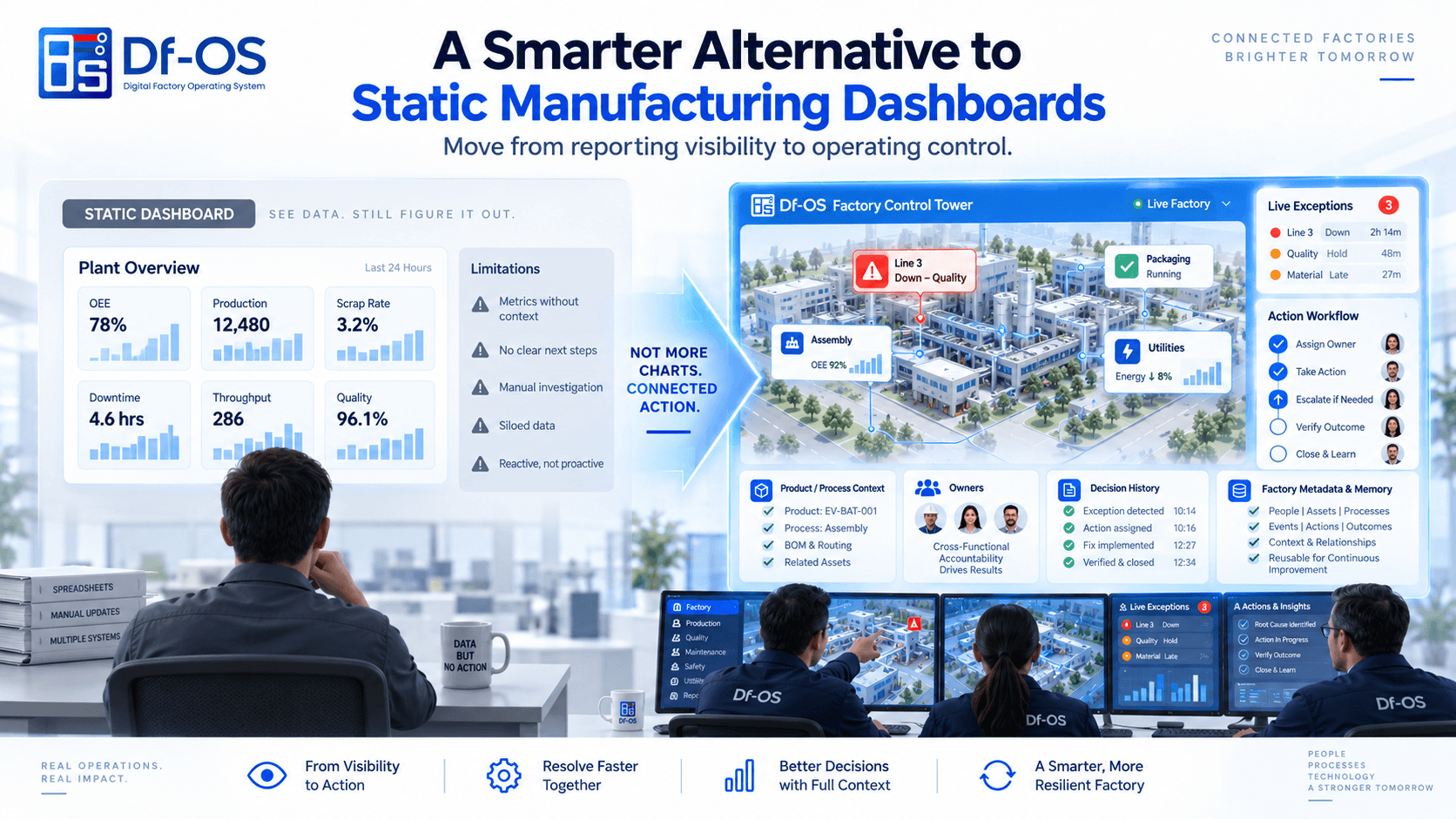
A Smarter Alternative to Static Manufacturing Dashboards
A comparison of static manufacturing dashboards and a connected Factory Control Tower that links metrics to live events, context, owners, workflows, escalation and verified closure.
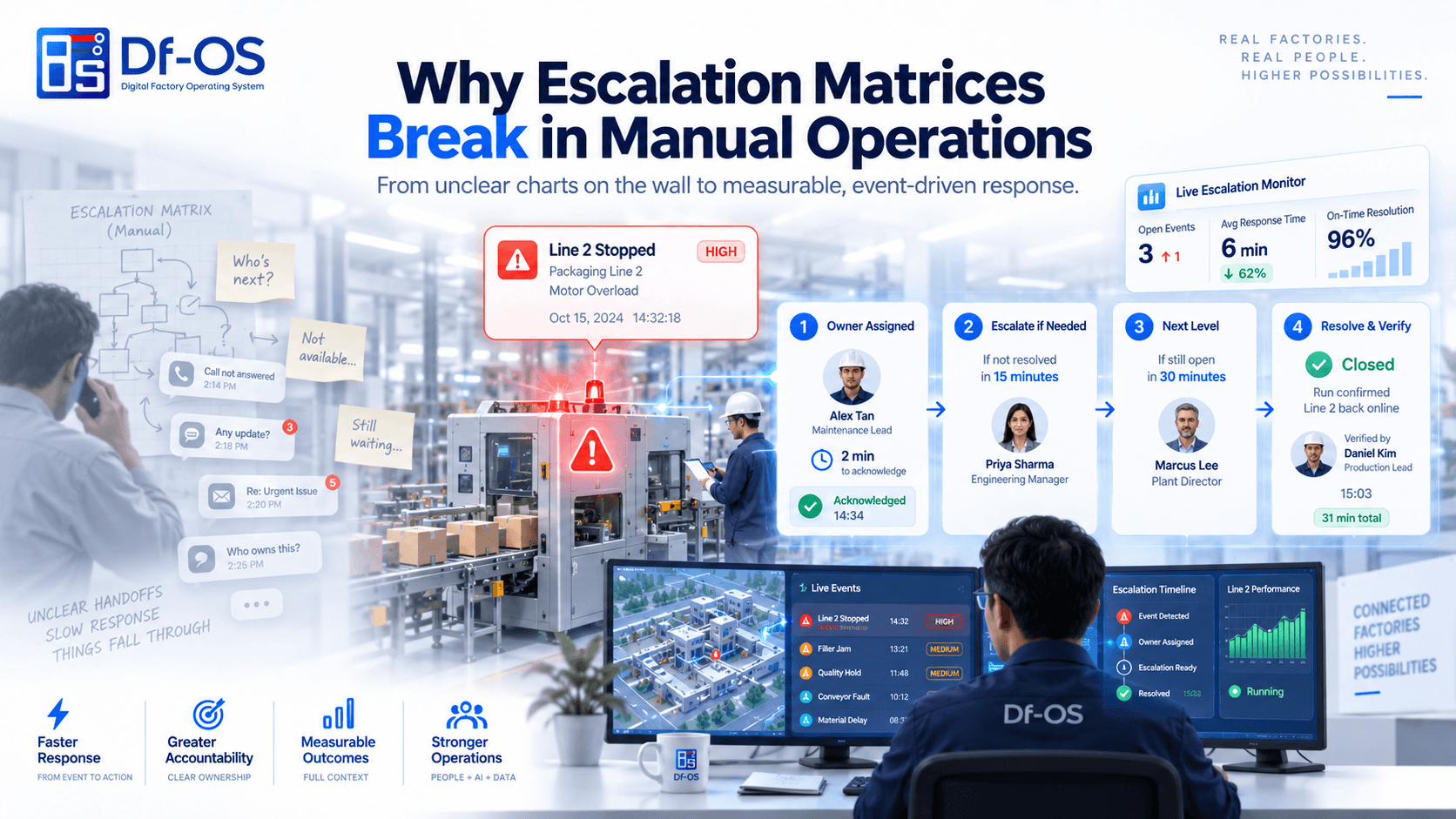
Why Escalation Matrices Break in Manual Operations
Why manual factory escalation matrices fail and how event-driven workflows connect measurable triggers, ownership, response time, escalation, closure evidence and learning.
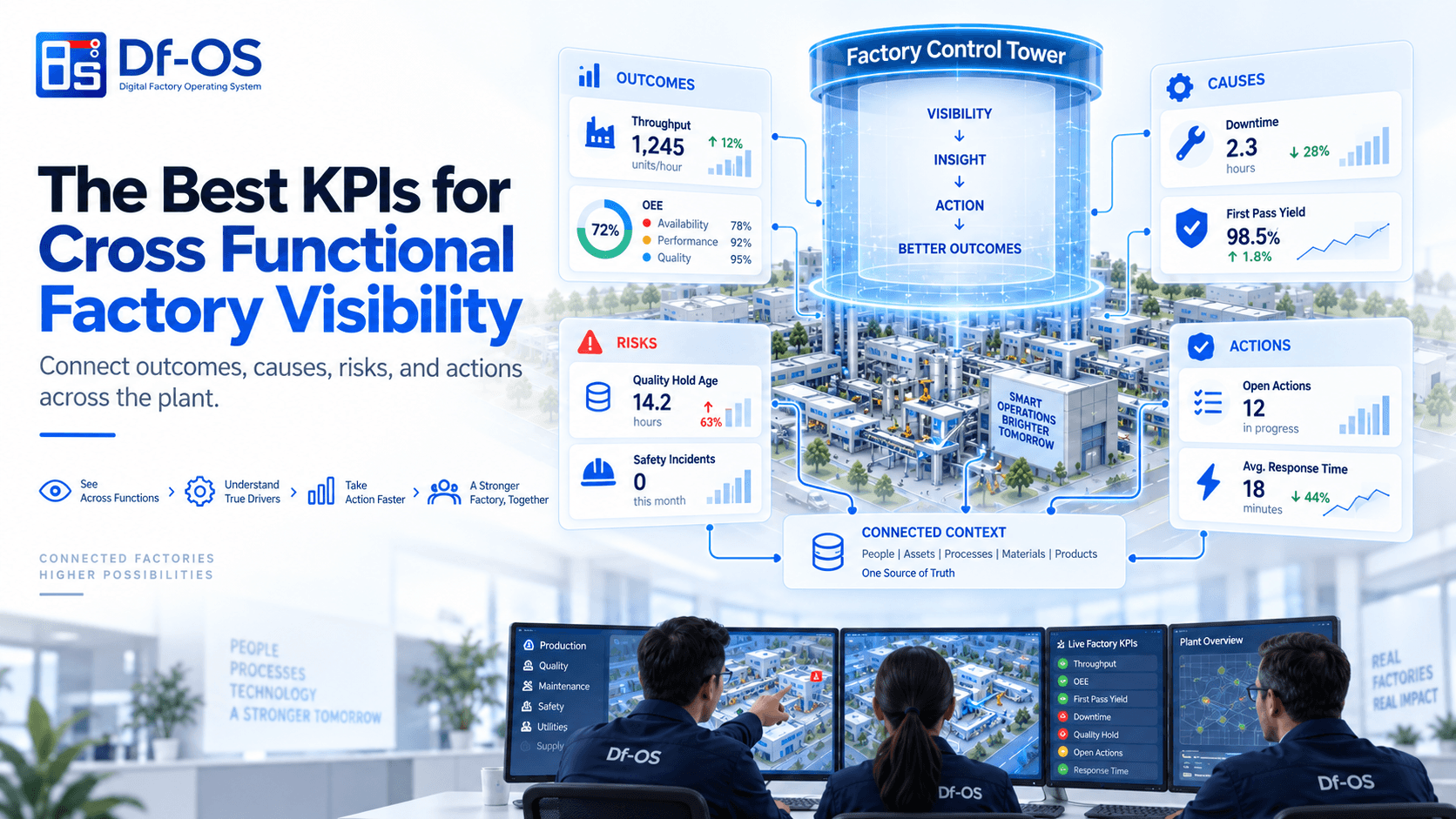
The Best KPIs for Cross Functional Factory Visibility
A four-level KPI framework connecting plant outcomes, operating causes, forward risks and action closure across production, quality, maintenance, safety and utilities.