
The Factory Decision Loop: Where Autonomous Operations Really Begin
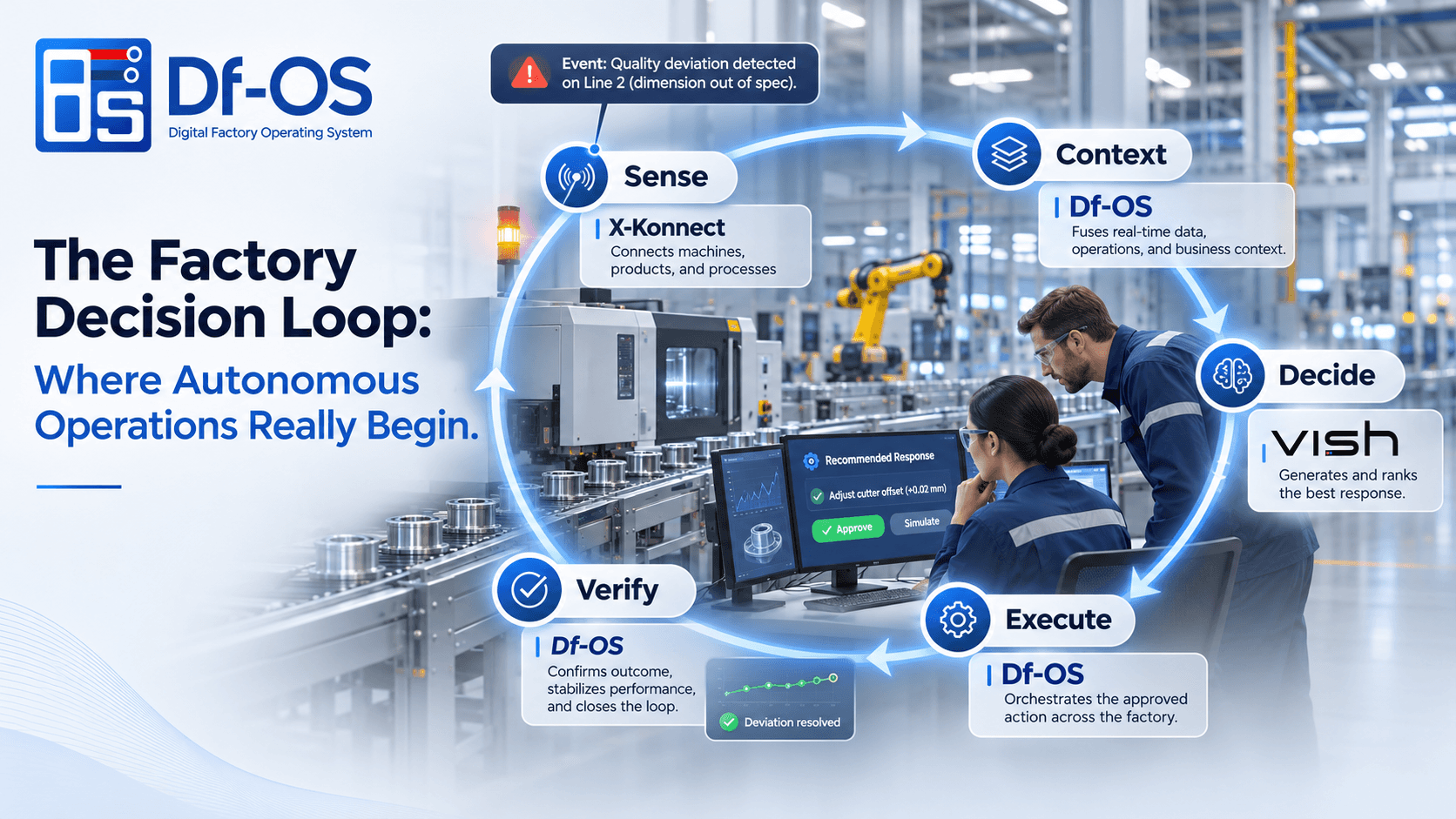
A factory decision loop is the controlled path from an operating event to a verified response. It includes sensing the condition, establishing context, determining the authorised response, executing or coordinating the action, and verifying the outcome. Autonomous operations begin when these loops become reliable, measurable and progressively less dependent on manual coordination.
In a factory, an event becomes expensive when the right response arrives too late. The issue may be a brief machine stop, an overdue inspection, an abnormal utility reading or a material shortage. In each case, someone must notice the change, understand the context, decide what to do, assign the action and confirm that the problem is resolved.
Autonomous operations begin by improving this decision loop. Manufacturing leaders can achieve useful levels of autonomy long before they have self-running production lines. The first opportunity is often to remove avoidable delays from decisions that already have an agreed and repeatable response.
The unnoticed delay between information and action
A production supervisor opens a performance dashboard at 11 a.m. and sees that output is behind plan. The shortfall began before the first break. During that interval, the line had repeated minor stops, a maintenance technician was occupied elsewhere and the shift team used a messaging group to coordinate. The dashboard correctly reported the loss, but the system did not connect the loss to the action required.
This distinction matters. A reporting system can be accurate yet operationally passive. Factory autonomy requires a controlled path from an observed condition to a verified response.
In a normal shift, dozens of such paths already exist. The factory decides when to escalate a downtime event, quarantine a suspect lot, inspect a machine after a failed check, replenish a material or investigate an energy anomaly. Many are governed by SOPs and escalation matrices. The difficulty is that those rules are scattered between documents, applications and the experience of individual employees.
The five steps of a dependable operating loop
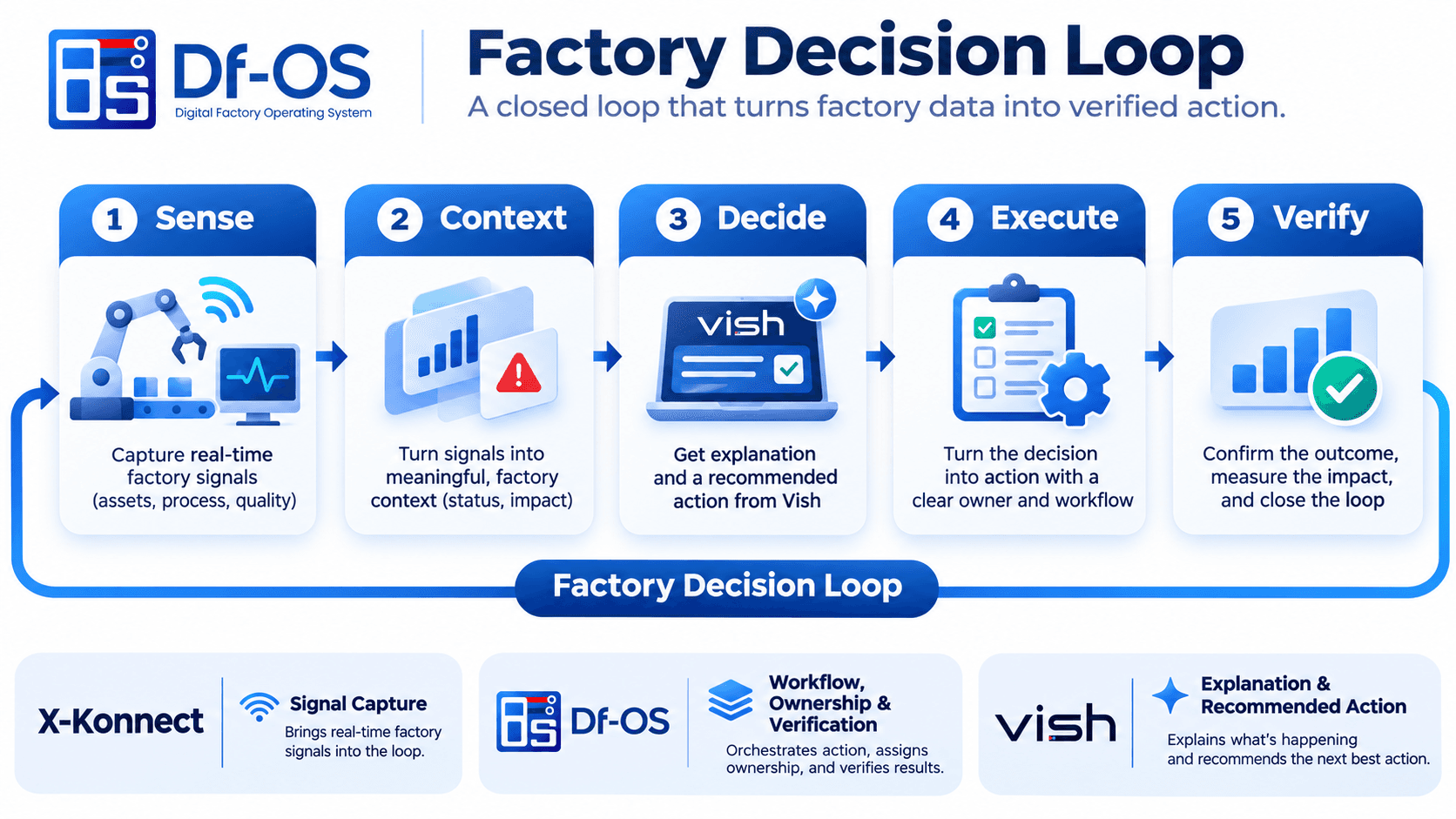
1. Sense the condition
The loop begins with a trusted event. This might come from a PLC, sensor, operator entry, quality inspection, barcode scan or workflow deadline. Detection must be timely and sufficiently precise to avoid overwhelming teams with false alarms.
An alarm code by itself rarely explains what should happen. The first task is to decide which events matter and what constitutes an exception.
2. Establish context
The same alarm can have different implications depending on line, SKU, shift, tool condition or product batch. Factory Metadata & Memory brings these relationships and past responses into one operating record.
For a quality hold, context may include the supplier lot, machine settings, affected serial numbers, test result and last approved intervention. Without these links, a recommendation risks being generic or wrong.
3. Determine the authorised response
The decision rule might be straightforward: if a scheduled inspection is overdue, route a task and notify the supervisor. Other decisions require engineering judgement. The system must distinguish between those situations.
For every candidate loop, document the available actions, evidence required, approval rights, safety conditions and stop rules. Rules that are vague in a procedure will remain vague when translated into software.
4. Execute and coordinate
An action should enter the normal workflow, not disappear into another alert. The system assigns an owner, defines the deadline and records the work performed. In more advanced settings, approved low-risk actions may execute automatically within a defined boundary.
A maintenance escalation that reaches the technician but cannot confirm attendance is incomplete. A lot hold that is raised but not enforced in downstream movement is equally incomplete.
5. Verify the outcome and learn
The loop closes only when the condition is retested and the result recorded. If output returns to plan, was the root cause addressed or did the symptom simply disappear? If a defect is contained, did the investigation establish the affected scope? These details become part of the next decision.
Verification is the step most easily overlooked in digital transformation programmes. It is also what turns one successful response into a reusable operating capability.
Choosing a first use case
A good first autonomous operations candidate has four qualities. The event occurs often enough to measure. The response process is well understood. The possible harm from an incorrect response is limited or controllable. The result can be independently verified.
Consider overdue preventive maintenance. The system can identify a missed task, check machine criticality, notify the assigned planner, create an escalation and record completion. Some routing can be automatic even when the maintenance work itself remains manual.
Contrast that with changing a production setpoint on the basis of an inferred quality risk. The potential consequences are wider. Engineering validation, process constraints, safety logic, human approval and controlled testing are essential. The same autonomy method should not be applied indiscriminately.
A practical decision register for plant leaders
Before starting a pilot, create a decision register containing these fields:
Field | What to document
- Trigger: The measurable event or condition
- Context: The records required to interpret it
- Owner: The role accountable for the decision
- Approved action: What may happen and under which conditions
- Escalation: When the system must hand control to a person
- Verification: Evidence that the response worked
- Performance: Response time, repeat rate and operational effect
A register of ten decisions often teaches more about factory readiness than a large catalogue of disconnected use cases.
How the Df-OS operating layer fits
Df-OS digitises the workflow around a factory event. X-Konnect can supply relevant machine signals. Factory Metadata & Memory preserves the context and prior response. Vish AI can help explain a deviation, assemble related evidence and recommend the next action. Human governance remains central, particularly for high-consequence decisions.
This approach leads naturally to the Autonomous Factory. As the quality of sensing, context and verification improves, selected loops can move from manual coordination to decision support, guided action and bounded execution.
Measure what changed, not how many alerts were generated
For each loop, measure the elapsed time from event to recognition, recognition to assignment, assignment to action and action to verified closure. Track repeat events and interventions that required escalation. A reduction in these delays is a more meaningful signal of operating maturity than the number of dashboards or notifications deployed.
An Autonomous Factory is built through accountable decisions that improve over time. Start with one loop the team already understands and make it reliable.
Ready to Modernize Your Factory Operating Layer?
Discover how Df-OS digitizes shopfloor workflows, connects brownfield machines, and creates Factory Metadata & Memory without rip-and-replace disruption.
Frequently Asked Questions
No. A closed operating loop can include a person approving or performing the action. What matters is that an event leads to a controlled response and verified result.
Stay Ahead of Manufacturing AI
Join 15,000+ plant managers and industrial leaders receiving our bi-weekly reports on AI agents, shopfloor data operations, and the future of smart factories.
Df-OS Editorial Board
Industry experts mapping the future of connected digital factory operating systems and manufacturing intelligence.
Related Insights & Guides
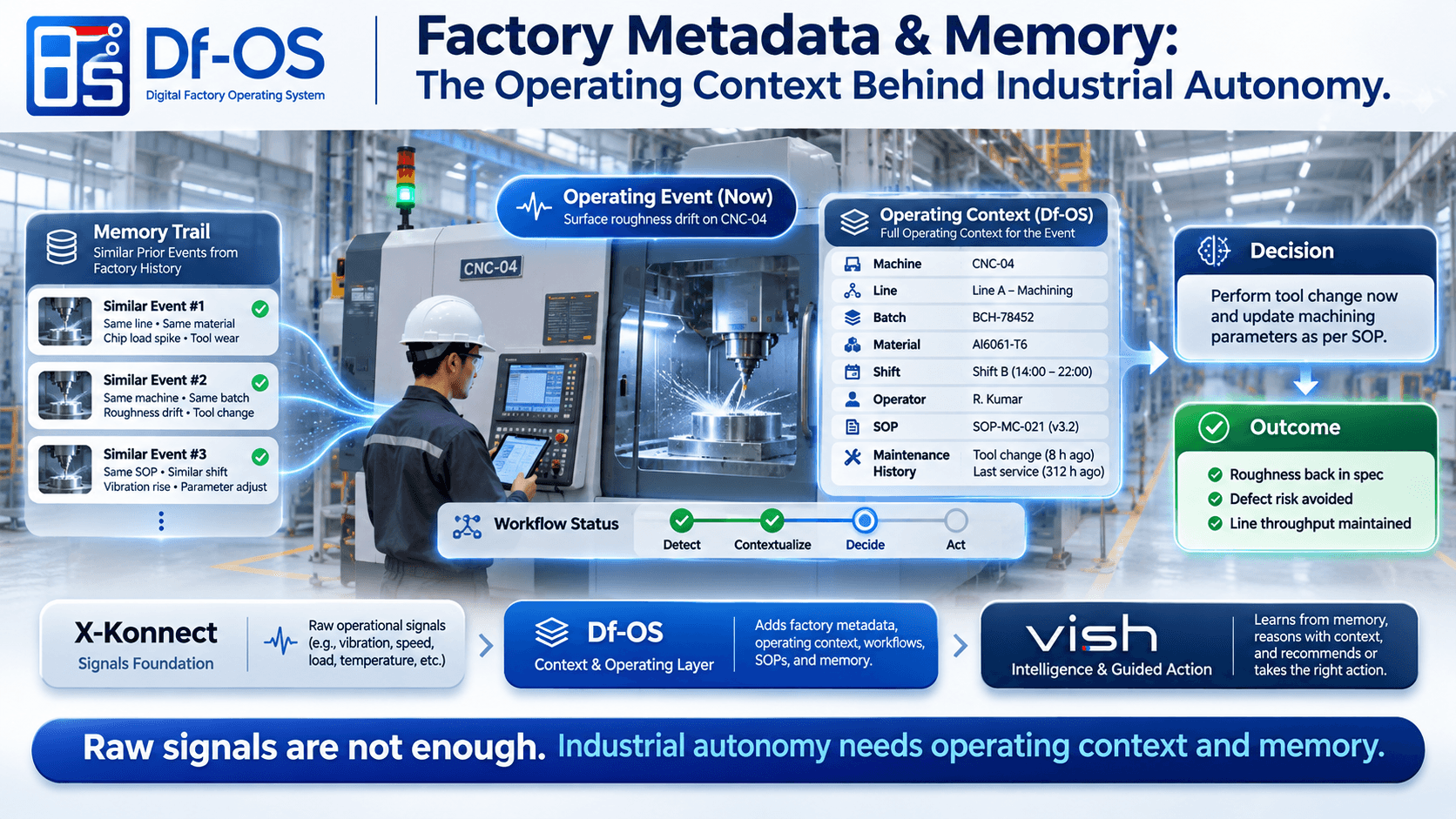
Factory Metadata & Memory: The Operating Context Behind Industrial Autonomy
Why industrial autonomy needs more than machine signals: Factory Metadata & Memory connects events to identities, conditions, workflows, decisions and verified outcomes.
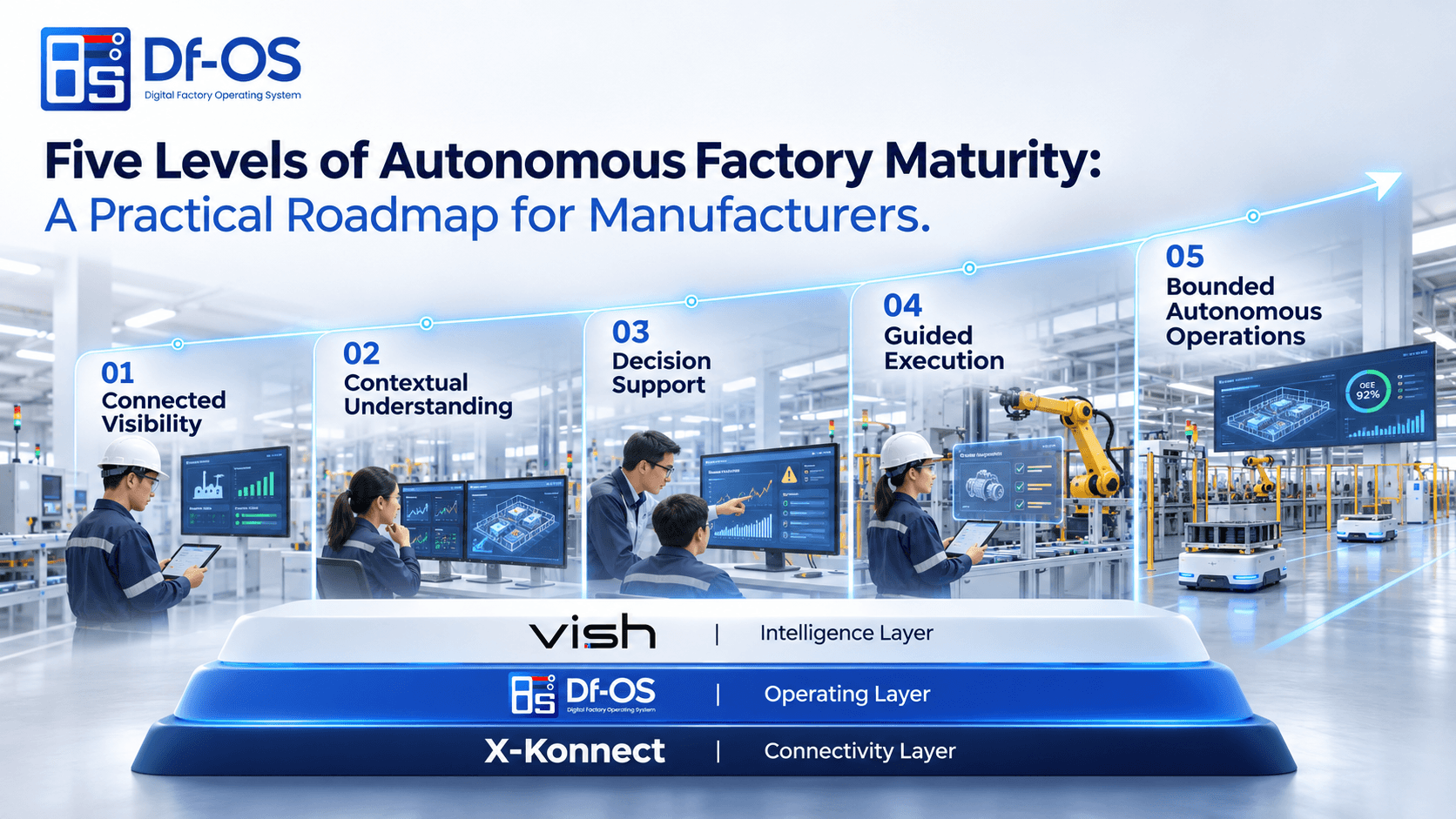
Five Levels of Autonomous Factory Maturity: A Practical Roadmap for Manufacturers
A practical roadmap for assessing factory autonomy at the level of operating decisions, from connected visibility and context to guided and bounded execution.
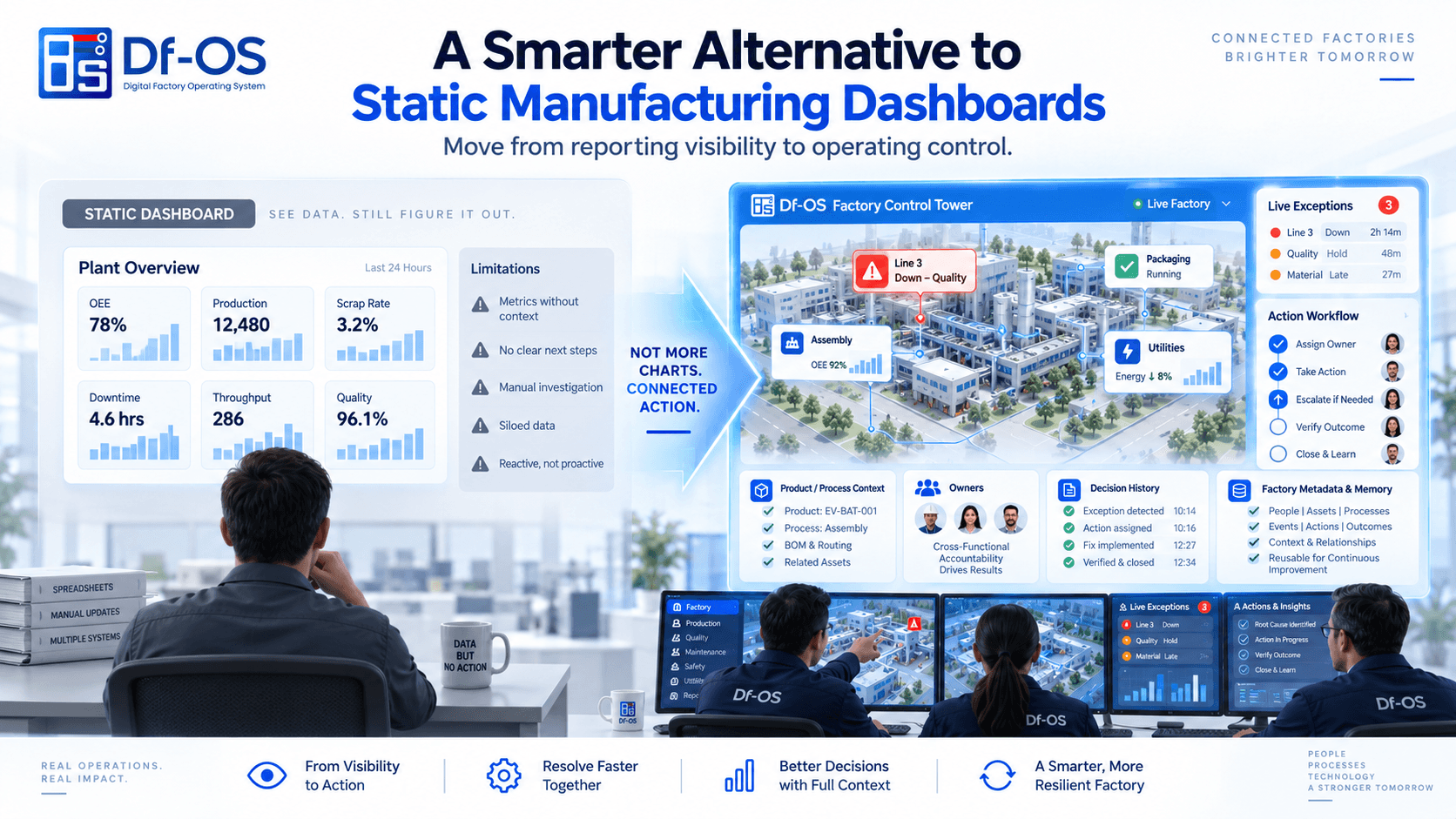
A Smarter Alternative to Static Manufacturing Dashboards
A comparison of static manufacturing dashboards and a connected Factory Control Tower that links metrics to live events, context, owners, workflows, escalation and verified closure.