

An Autonomous Factory is a manufacturing operation where connected systems continuously sense conditions, understand operating context, recommend or execute defined actions and improve performance through closed feedback loops. Human governance, safety controls and clear accountability remain central.
This definition is more useful than the popular image of a dark plant filled with robots and no people. Some highly automated environments may operate with limited human presence, but that is not the only form of factory autonomy and it is not the most relevant goal for many manufacturers.
For most plants, autonomy is a progression. It begins when the factory can see its operating condition reliably through an AI-Native Digital Factory Operating System. It advances when the plant can explain what is happening, recommend the right response and execute selected actions within approved limits.
Automation and autonomy are not the same
Automation follows predetermined instructions. A conveyor starts when a sensor is triggered. A controller maintains pressure within a set range. A robot performs a repeatable motion.
Autonomy adds context, judgement and feedback.
An autonomous operating loop can detect that a line is losing speed, connect the loss to the current product and recent micro stops, identify a likely cause, recommend an approved response and verify whether the response restored performance.
The difference is not simply more automation. It is the ability to sense, understand, act and learn as one connected loop.
The four stages of Autonomous Factory maturity

Stage 1: Connected visibility
At the first stage, critical signals and workflows become visible in one operating view via a Factory Control Tower.
The plant can see production status, quality events, downtime, maintenance actions, utilities and open escalations without waiting for manual reports. This stage reduces information delay, but decisions still depend heavily on individual interpretation.
Stage 2: Decision support
At the second stage, the system begins to provide context.
It can connect an event to the line, product, batch, shift, material, process condition and previous incidents. Factory teams can ask why a deviation occurred, whether the event has happened before and which actions were effective.
Vish AI fits into this stage by using Factory Metadata & Memory to explain conditions, identify patterns and recommend attention.
Stage 3: Guided action
At the third stage, the system recommends or initiates a defined workflow.
A downtime event can create a maintenance task. A quality deviation can trigger containment and TraceMaster investigation. An abnormal utility pattern can notify the responsible role. A shift review can prioritise unresolved exceptions.
People remain responsible for approval and execution, but the path from detection to action becomes faster and more consistent.
Stage 4: Bounded closed loop execution
At the fourth stage, selected actions can be executed automatically within clear operating boundaries.
The system may adjust a permitted setpoint, change a schedule within approved constraints, route work automatically or initiate a standard corrective sequence. It must also verify the result and return control to people when the condition falls outside its approved scope.
This is bounded autonomy. The system is autonomous within a defined operating envelope, not free to act without accountability.
What an Autonomous Factory needs before autonomy
Factory autonomy depends on several foundations that are often overlooked.
Reliable sensing
The plant needs trustworthy signals from machines, processes and workflows through reliable X-Konnect IIoT integration. A poor signal cannot support a safe decision.
Operational context
A temperature value means little without the product, process step, equipment condition and acceptable range. Context turns data into an operating fact.
Factory Metadata & Memory
The factory must preserve what happened, who acted, what decision was made and whether the action worked. This history gives industrial intelligence a basis for comparison.
Clear workflow ownership
Autonomy cannot compensate for an undefined process. The plant must know which role owns detection, approval, response and closure.
Governance and safety
Every automated action needs a defined scope, permission level, fallback and audit trail. High impact actions require stronger controls than routine administrative steps.
Learning and verification
A closed loop is incomplete until the plant verifies the outcome. The system must know whether the action corrected the condition or created a new risk.
What autonomy looks like in daily operations
Autonomous operations can appear in many forms before a plant reaches broad enterprise autonomy.
Production
The system can identify a developing speed loss, compare it with similar runs and recommend the most likely operating check.
Maintenance
A machine condition can trigger inspection, prioritise the work based on production risk and suggest relevant past repair history.
Quality
A process deviation can initiate containment, connect affected material and present similar investigations to the quality team.
Utilities
An unusual energy or water pattern can be detected against the operating schedule, helping the team distinguish production demand from waste.
Daily management
The plant review can be prepared automatically around the most important exceptions, unresolved actions and repeat issues.
These are practical forms of autonomy because they reduce delay and improve consistency around defined decisions.
The role of people in an Autonomous Factory
The role of people does not disappear. It changes.
Operators move from recording routine information to handling exceptions and improving processes. Supervisors spend less time chasing reports and more time resolving constraints. Engineers gain a connected record of operating behaviour. Leaders receive clearer evidence for decisions.
The European Commission Industry 5.0 framework reinforces this human-centred view, framing the future of industry around human centricity, sustainability and resilience, not automation alone.
A credible Autonomous Factory programme should therefore answer:
- Which decisions remain human?
- Which decisions can be recommended?
- Which actions can be automated safely?
- How can a person understand why the system acted?
- How can the plant stop, reverse or override an action?
- Who remains accountable for the outcome?
Autonomy without these answers is not operational maturity. It is unmanaged risk.
Autonomous Factory versus lights-out manufacturing
- Main idea: Autonomous Factory: Connected sensing, context, decisions and feedback | Lights-out manufacturing: Production with minimal human presence
- Suitable environment: Autonomous Factory: Process and discrete factories at different maturity levels | Lights-out manufacturing: Highly standardised and heavily automated environments
- Role of people: Autonomous Factory: Governance, exceptions, improvement and complex judgement | Lights-out manufacturing: Limited direct production involvement
- Progression: Autonomous Factory: Can be achieved use case by use case | Lights-out manufacturing: Usually requires extensive automation from the start
- Core requirement: Autonomous Factory: Operating context and closed loops | Lights-out manufacturing: Physical automation and process stability
As documented by the World Economic Forum Global Lighthouse Network, leading plants achieve the greatest agility and productivity gains when digital operating models empower frontline workforces rather than attempting full workforce elimination.
The Df-OS pathway to autonomy
Df-OS supports the progression toward the Autonomous Factory through three connected capabilities.
Df-OS digitises workflows and creates a shared execution layer. X-Konnect connects machine and process signals. Vish AI uses Factory Metadata & Memory to explain conditions, prioritise actions and support guided decisions.
This creates a practical pathway:
- 1. Connect the factory
- 2. Digitise execution
- 3. Build Factory Metadata & Memory
- 4. Apply reliable decision intelligence
- 5. Automate selected actions within approved boundaries
A manufacturer does not need to begin with a fully autonomous target. It can begin with one decision loop that causes recurring loss or delay.
A practical autonomy readiness check
A factory is ready to progress when it can answer yes to most of these questions:
- Are critical machine and workflow events visible in time to act?
- Can events be linked to product, process, shift and ownership context?
- Is there a traceable history of actions and outcomes?
- Are response workflows defined and measured?
- Can similar past incidents be found quickly?
- Are approval limits and safety controls clear?
- Can the result of an action be verified automatically or consistently?
- Is there a defined human override?
If these foundations are weak, the next investment should strengthen the operating system before expanding autonomous execution.
Final perspective
The Autonomous Factory is not a single technology purchase. It is an operating maturity model.
The factory first learns to see. Then it learns to understand. Next it learns to guide action. Finally, selected decisions can be executed within clear boundaries.
Manufacturers that approach autonomy this way can create value without waiting for a distant lights-out future. They can improve one operating loop at a time while preserving the human judgement, safety and accountability that manufacturing requires. Ready to assess your plant's autonomy roadmap? Speak with the Df-OS industrial transformation team.
Ready to Modernize Your Factory Operating Layer?
Discover how Df-OS digitizes shopfloor workflows, connects brownfield machines, and creates Factory Metadata & Memory without rip-and-replace disruption.
Frequently Asked Questions
Yes. Brownfield plants can build autonomy in stages by connecting priority assets, digitising workflows and creating Factory Metadata & Memory around selected use cases.
Stay Ahead of Manufacturing AI
Join 15,000+ plant managers and industrial leaders receiving our bi-weekly reports on AI agents, shopfloor data operations, and the future of smart factories.
Df-OS Editorial Board
Industry experts mapping the future of connected digital factory operating systems and manufacturing intelligence.
Related Insights & Guides
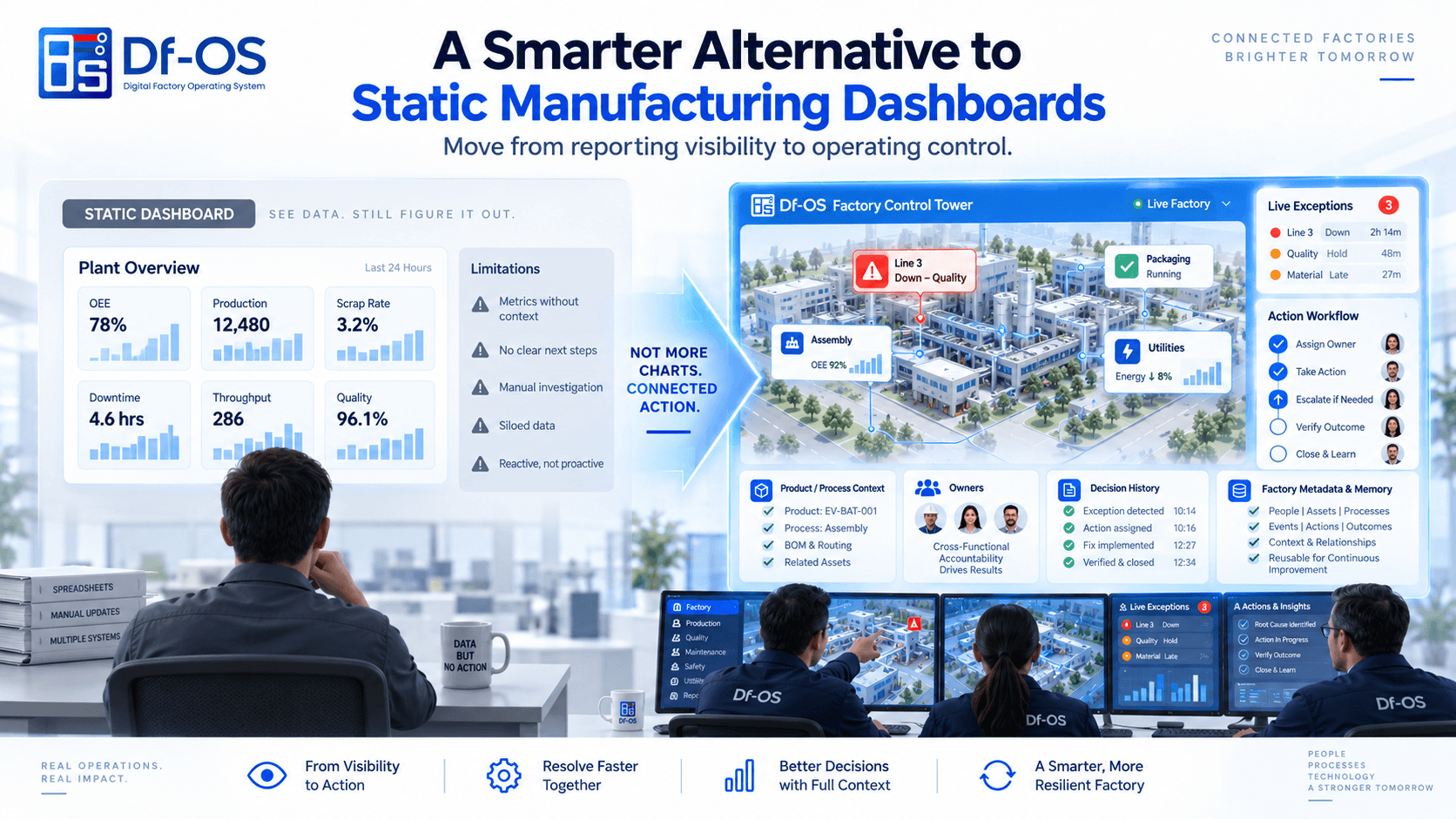
A Smarter Alternative to Static Manufacturing Dashboards
A comparison of static manufacturing dashboards and a connected Factory Control Tower that links metrics to live events, context, owners, workflows, escalation and verified closure.
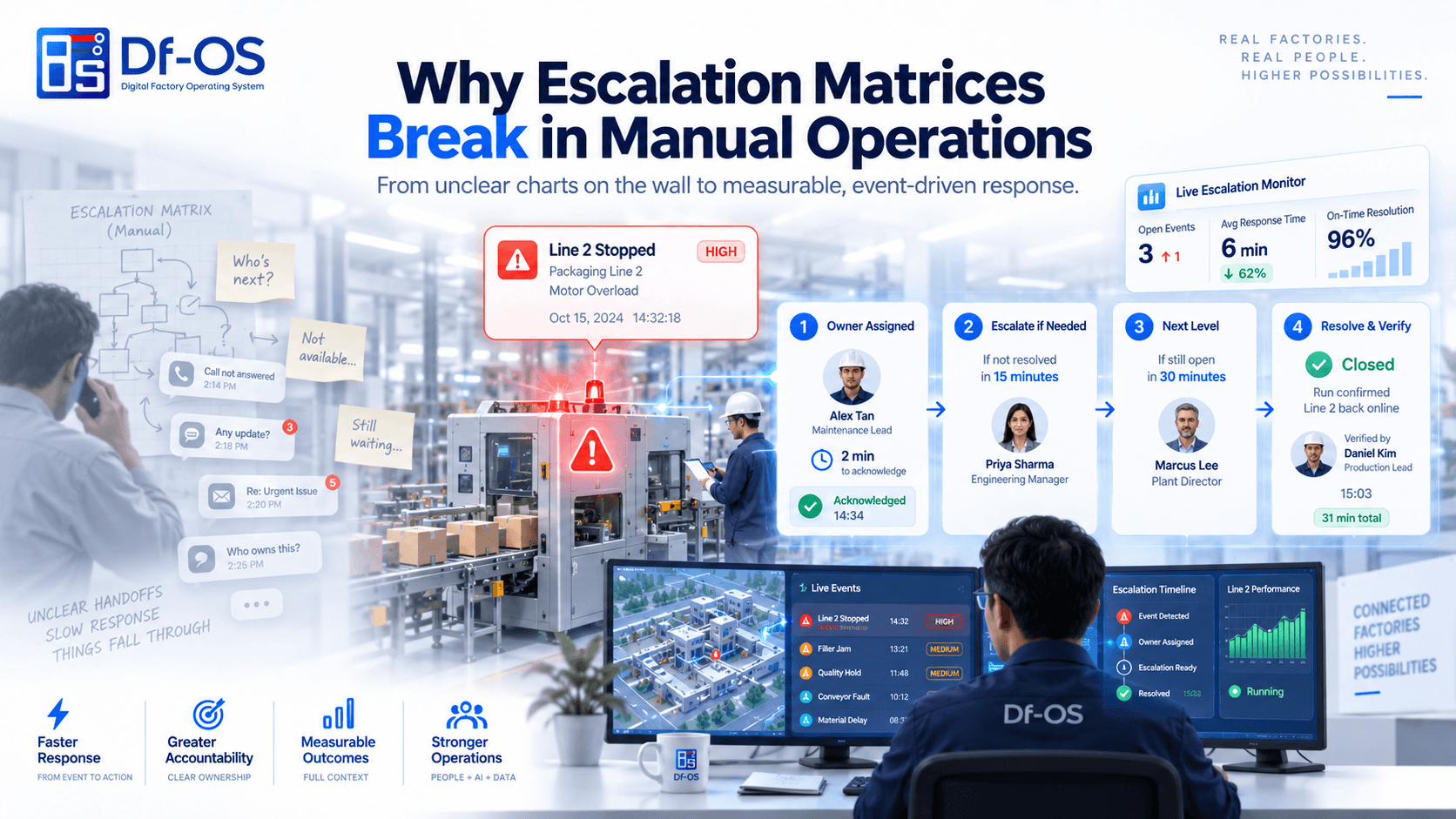
Why Escalation Matrices Break in Manual Operations
Why manual factory escalation matrices fail and how event-driven workflows connect measurable triggers, ownership, response time, escalation, closure evidence and learning.
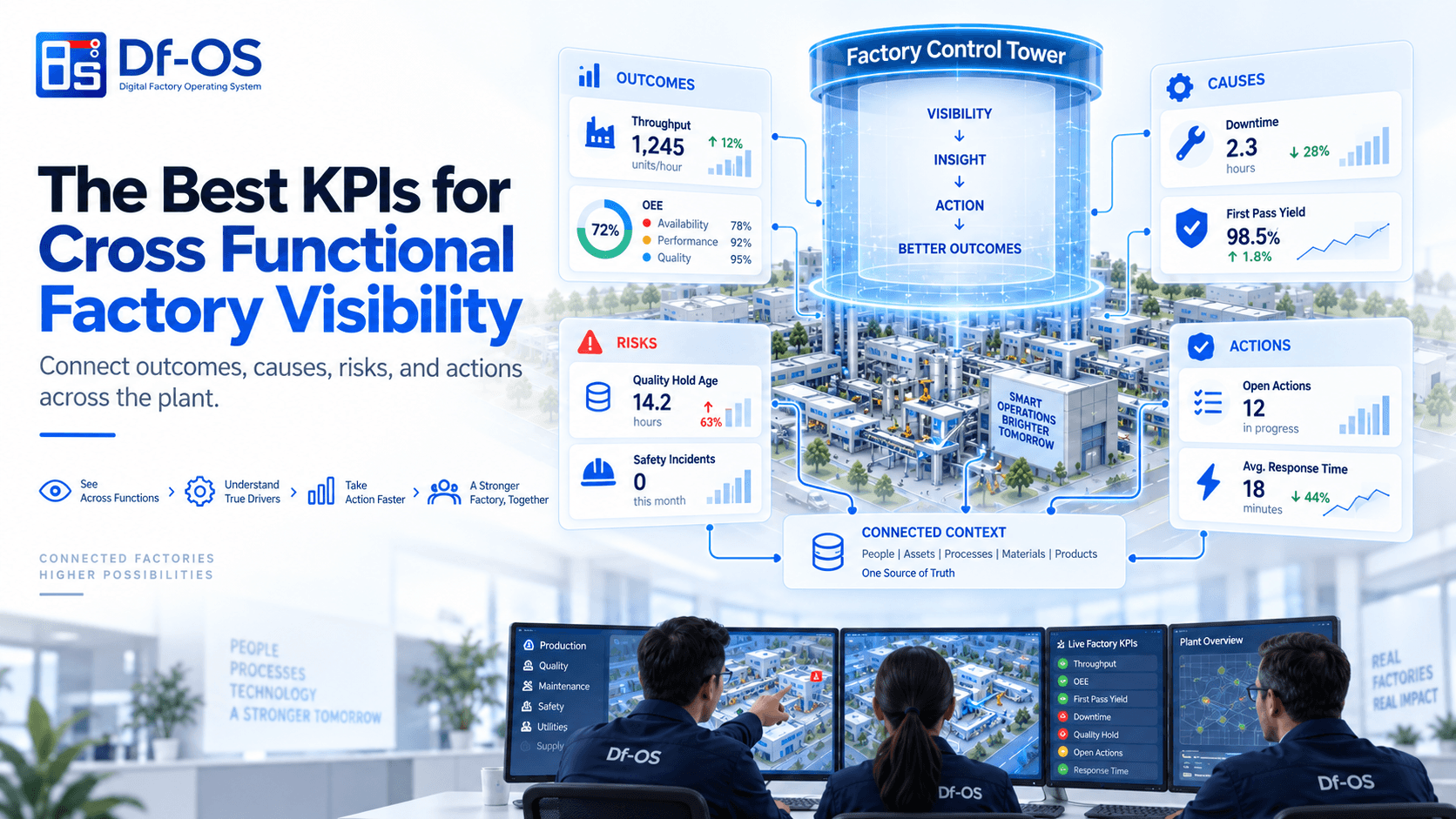
The Best KPIs for Cross Functional Factory Visibility
A four-level KPI framework connecting plant outcomes, operating causes, forward risks and action closure across production, quality, maintenance, safety and utilities.