
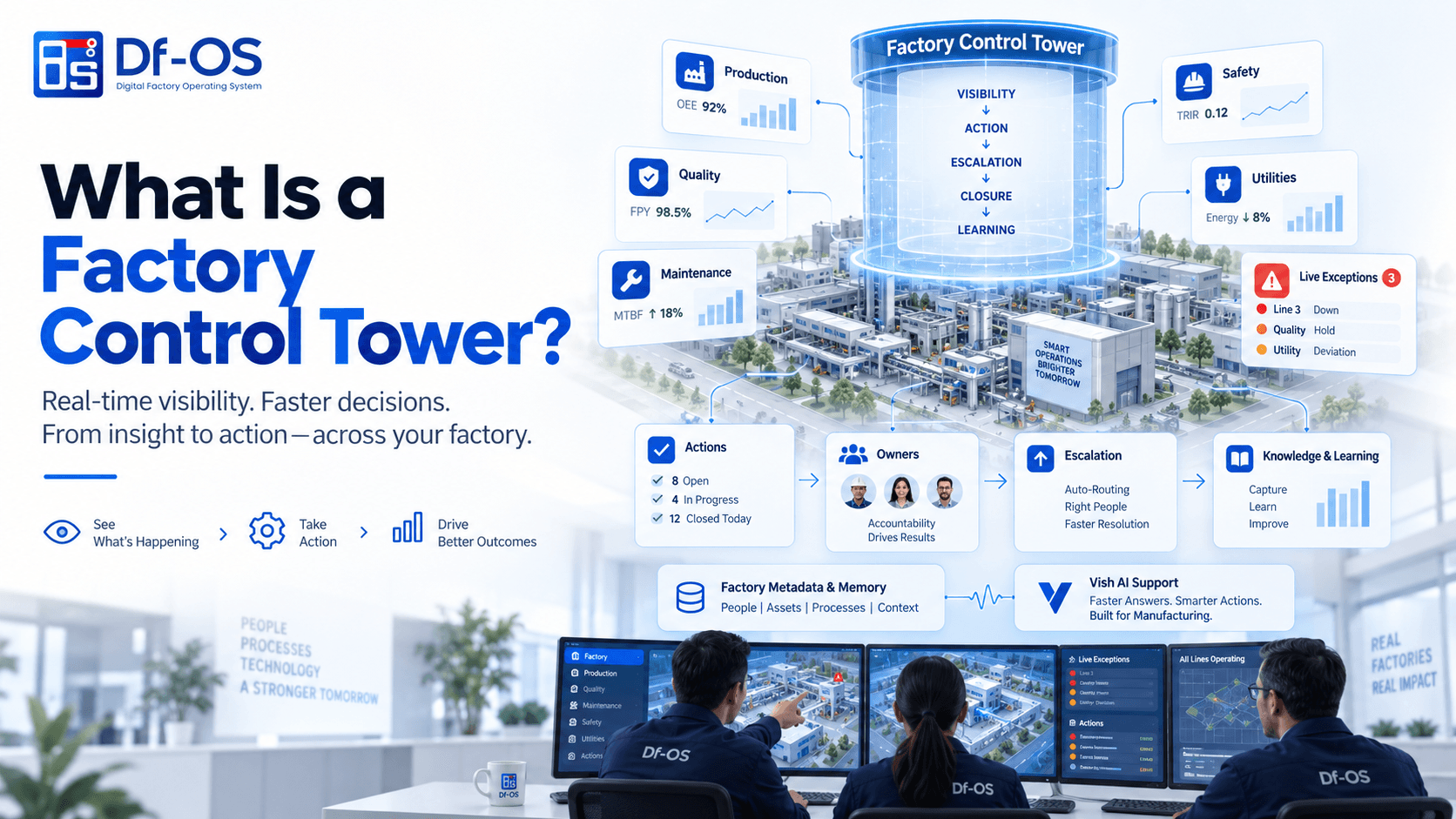
A Factory Control Tower is a connected operating view that brings together real time factory conditions, workflow status, exceptions, action ownership and decision context across production, quality, maintenance, safety and utilities. Its purpose is to improve response and control, not only visibility.
Its purpose is not to place more charts on a screen. Its purpose is to help the factory see what requires attention, understand why it matters and coordinate the next action.
A dashboard answers what is happening. A Factory Control Tower should also answer who owns the response, what is being done and whether the issue has been resolved.
Why factories need more than visibility
Most plants already produce reports.
They track output, OEE, downtime, defects, maintenance, energy and safety. The problem is that the information may arrive at different times, use different definitions and remain separated from the workflow that should act on it.
A plant head may see a red metric without knowing:
- Which event caused it
- Which product or shift was affected
- Whether the issue is still active
- Who owns the response
- Which action is overdue
- Whether the same problem occurred before
A Factory Control Tower connects these questions in one operating model.
The four jobs of a Factory Control Tower
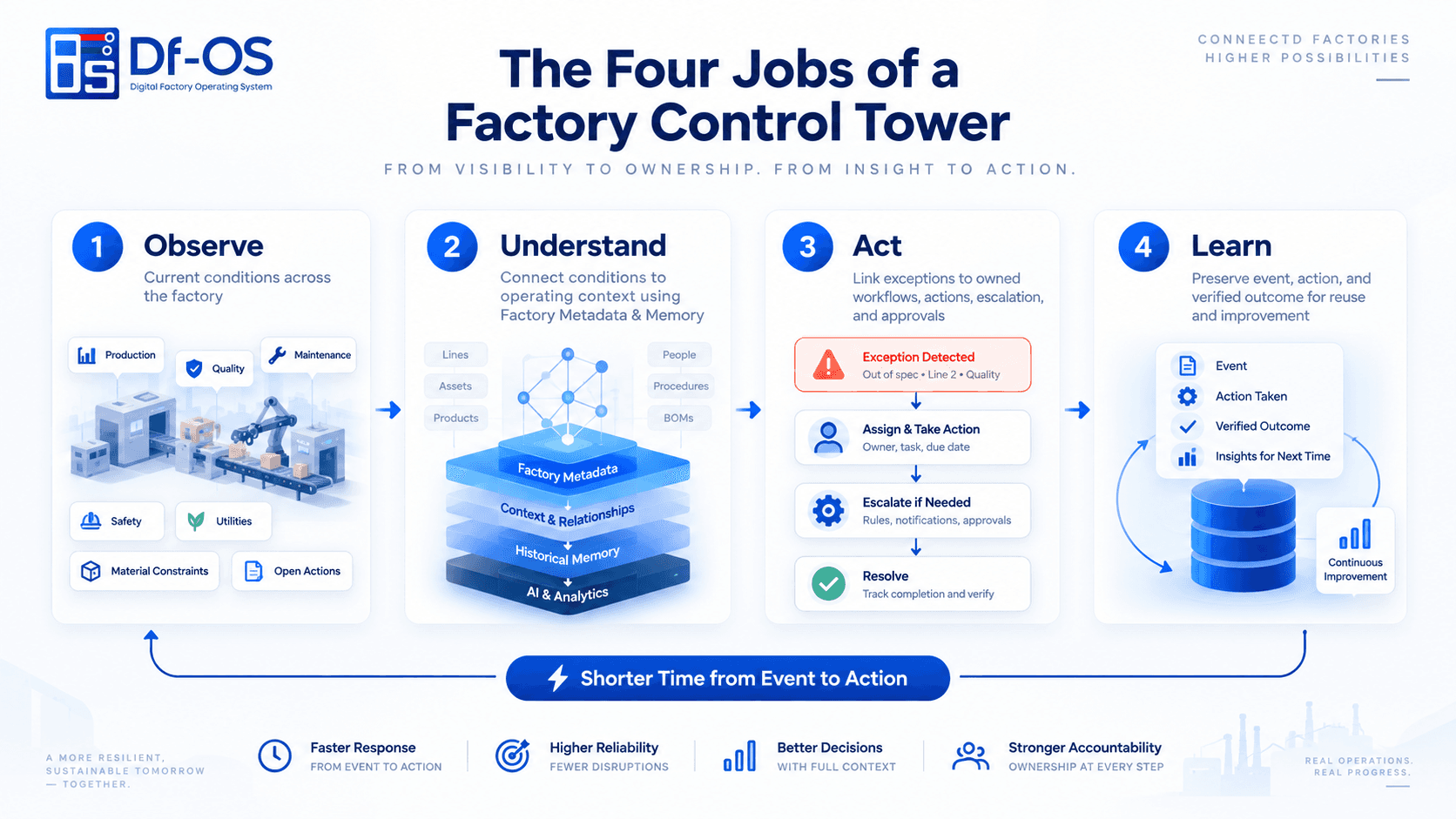
1. Observe
The Control Tower brings together current conditions across the plant.
This may include:
- Production plan and actual
- Line status
- OEE and major losses
- Quality deviations and holds
- Maintenance events and backlog
- Safety incidents and permits
- Utility conditions
- Material constraints
- Open actions
The information should be current enough to support action, not only reporting.
2. Understand
The Control Tower connects the condition to operating context.
A downtime event can be viewed with product, shift, alarm, operator observation and maintenance response. A quality hold can be connected to batch, process values and containment. An energy increase can be compared with output and operating schedule.
This context comes from Factory Metadata & Memory.
3. Act
The Control Tower should connect an exception to an owned workflow.
The system can assign a task, trigger an escalation, request approval, start an investigation or bring the issue into the next review.
This is the difference between viewing a problem and operating the response.
4. Learn
The factory should preserve the event, action and verified outcome.
Repeated issues can be compared. Corrective actions can be reused. Vish AI can help explain patterns and prioritise attention.
A Control Tower becomes more valuable as the factory's operating memory grows.
What belongs in the Control Tower
The answer depends on the decision level.
Shopfloor view
Operators need current status, work instructions, immediate exceptions and the next action.
Department view
Production, quality and maintenance leaders need performance, risks, actions and escalation within their functions.
Plant view
The plant manager needs cross-functional exceptions, major losses, ownership and decisions.
Enterprise view
Business and manufacturing excellence leaders need comparable plant performance, systemic risks and transformation progress.
The same data should not be displayed identically to every role.
Factory Control Tower versus dashboard
Capability | Static dashboard | Factory Control Tower
- Shows metrics: Yes — Yes
- Shows live exceptions: Sometimes — Core capability
- Connects to workflow: Limited — Yes
- Shows action owner: Rarely — Yes
- Tracks escalation and closure: Limited — Yes
- Preserves decision history: Limited — Through Factory Metadata & Memory
- Supports explanation: Mainly visual analysis — Contextual analysis and Vish AI support
- Supports bounded action: No — Can support guided and controlled execution
A dashboard can be part of a Control Tower. It is not the complete operating model.
A real example: line performance loss
A line falls below the production plan.
A static dashboard turns the line red.
A Factory Control Tower can show:
- The exact period of loss
- The major downtime events
- The current product and changeover status
- The quality conditions affecting speed
- The maintenance response
- The open owner and due time
- Similar losses from previous shifts
- The action being taken
The plant review begins with the operating story, not with a search for the story.
The role of Factory Metadata & Memory
A Control Tower needs more than a live feed.
Factory Metadata & Memory links each event to:
- Asset and process
- Product and batch
- Shift and people
- Material and method
- Workflow and ownership
- Decision and outcome
This allows the Control Tower to move between current state and relevant history.
The role of Vish AI
Vish AI can use the connected operating record to support questions such as:
- Why did OEE fall on this line?
- Which downtime issue repeated across shifts?
- Which quality deviations remain unresolved?
- Which actions are likely to affect today's plan?
- Which plant requires leadership attention?
The answer should be traceable to the underlying factory records. People remain responsible for the decision.
How the Control Tower supports the Autonomous Factory
The Control Tower is a step in the maturity path from visibility to autonomy.
It provides:
- Connected sensing
- Contextual understanding
- Exception prioritisation
- Workflow action
- Outcome verification
Once these loops are reliable, selected actions can progress from manual response to guided action and bounded execution.
The Control Tower should therefore be designed as an operating capability, not as the final screen of a reporting project.
A practical implementation sequence
Begin with one management problem
Examples include daily production review, downtime response or quality deviation visibility.
Define the decisions
Identify what the user must decide and which context is required.
Connect workflows before adding more visuals
Every major exception should have an owner, action and closure path.
Add machine and system data
Use X-Konnect and integrations to reduce manual entry and improve timeliness.
Build Factory Metadata & Memory
Preserve events, actions and outcomes.
Add Vish AI where context is sufficient
Use intelligence to explain, prioritise and recommend, not to cover weak process design.
A Control Tower readiness checklist
- Are the major operating decisions defined?
- Can the plant see critical events in time to act?
- Are metrics linked to their causes?
- Does every exception have an owner?
- Are response time and closure visible?
- Can users move from a metric to the event history?
- Are similar past events searchable?
- Can the view scale from line to plant to enterprise?
- Are access and action permissions clear?
The Df-OS Control Tower model
Df-OS connects production, quality, maintenance, safety, utility and other factory workflows in one operating layer. X-Konnect brings machine and process signals into the same context. Factory Metadata & Memory preserves the operating history. Vish AI supports explanation and decision guidance.
This allows the Factory Control Tower to connect visibility with execution.
Final perspective
The value of a Factory Control Tower is not the size of the screen or the number of metrics.
Its value is the reduction in time between event, understanding, ownership and action.
A good Control Tower helps the factory operate the present and learn from the past. That makes it an important foundation for the Autonomous Factory.
Ready to Modernize Your Factory Operating Layer?
Discover how Df-OS digitizes shopfloor workflows, connects brownfield machines, and creates Factory Metadata & Memory without rip-and-replace disruption.
Frequently Asked Questions
No. A dashboard visualises information. A Factory Control Tower connects information to workflow, ownership, escalation, action and operating history.
Stay Ahead of Manufacturing AI
Join 15,000+ plant managers and industrial leaders receiving our bi-weekly reports on AI agents, shopfloor data operations, and the future of smart factories.
Df-OS Editorial Board
Industry experts mapping the future of connected digital factory operating systems and manufacturing intelligence.
Related Insights & Guides
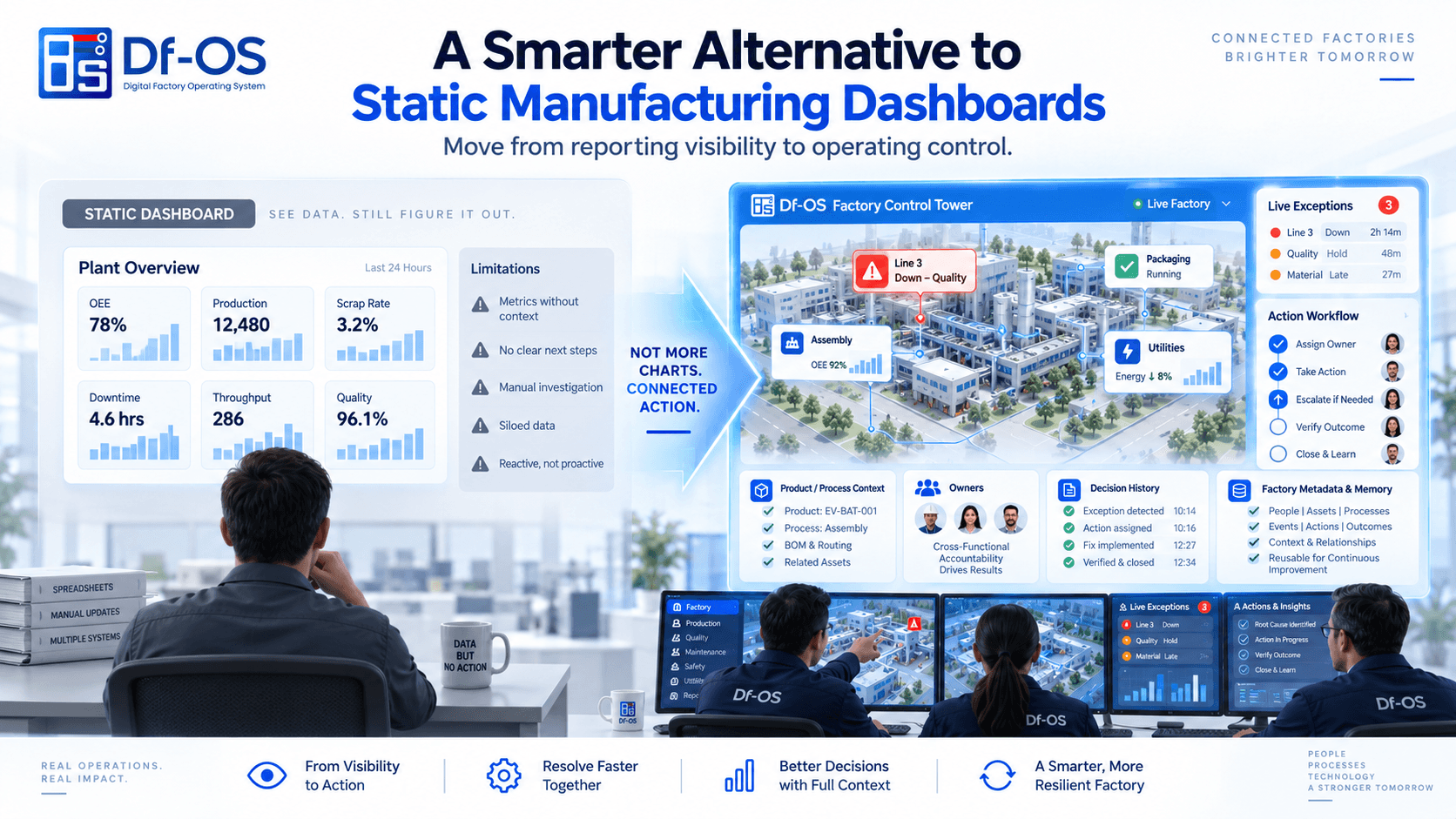
A Smarter Alternative to Static Manufacturing Dashboards
A comparison of static manufacturing dashboards and a connected Factory Control Tower that links metrics to live events, context, owners, workflows, escalation and verified closure.
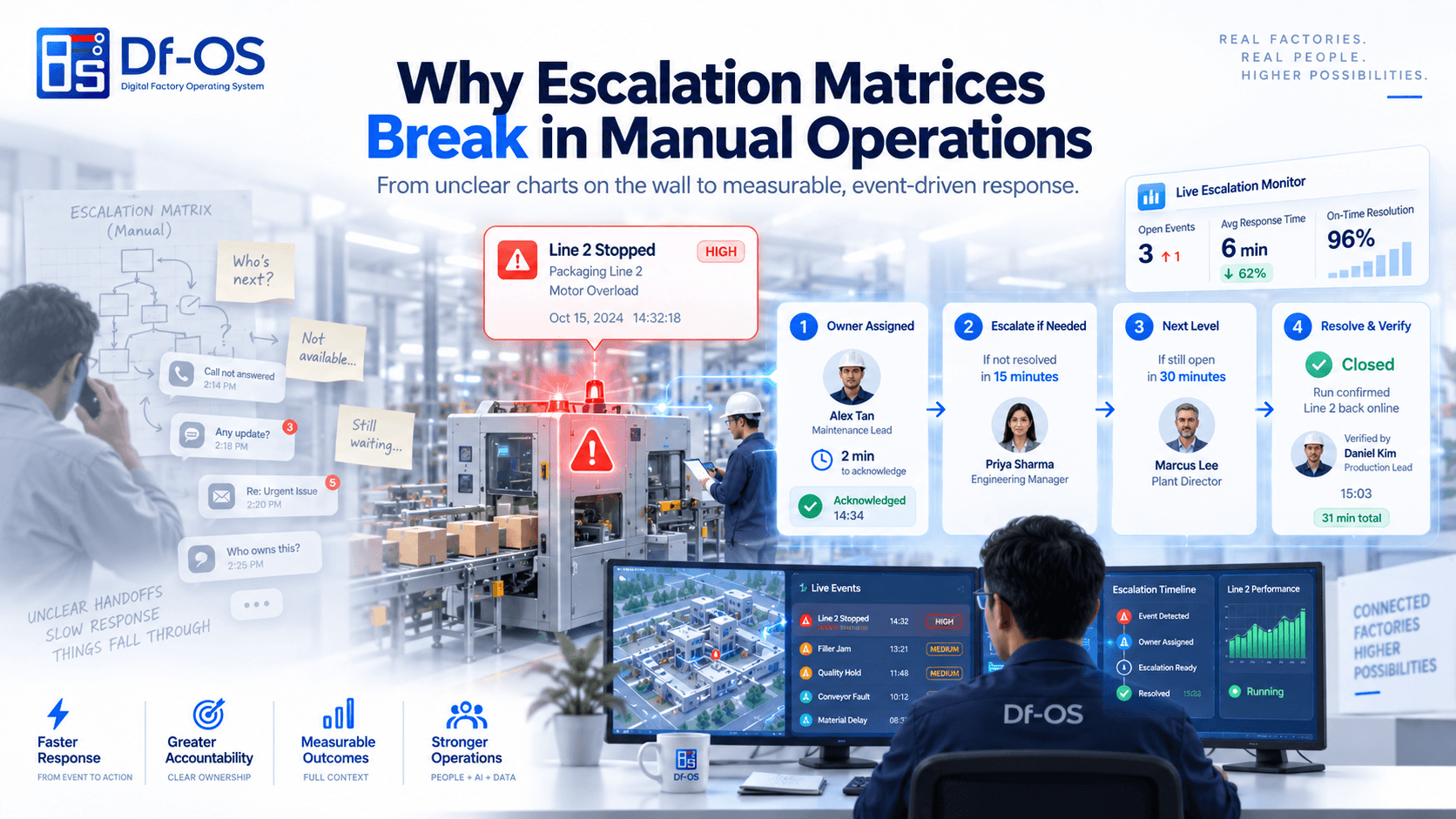
Why Escalation Matrices Break in Manual Operations
Why manual factory escalation matrices fail and how event-driven workflows connect measurable triggers, ownership, response time, escalation, closure evidence and learning.
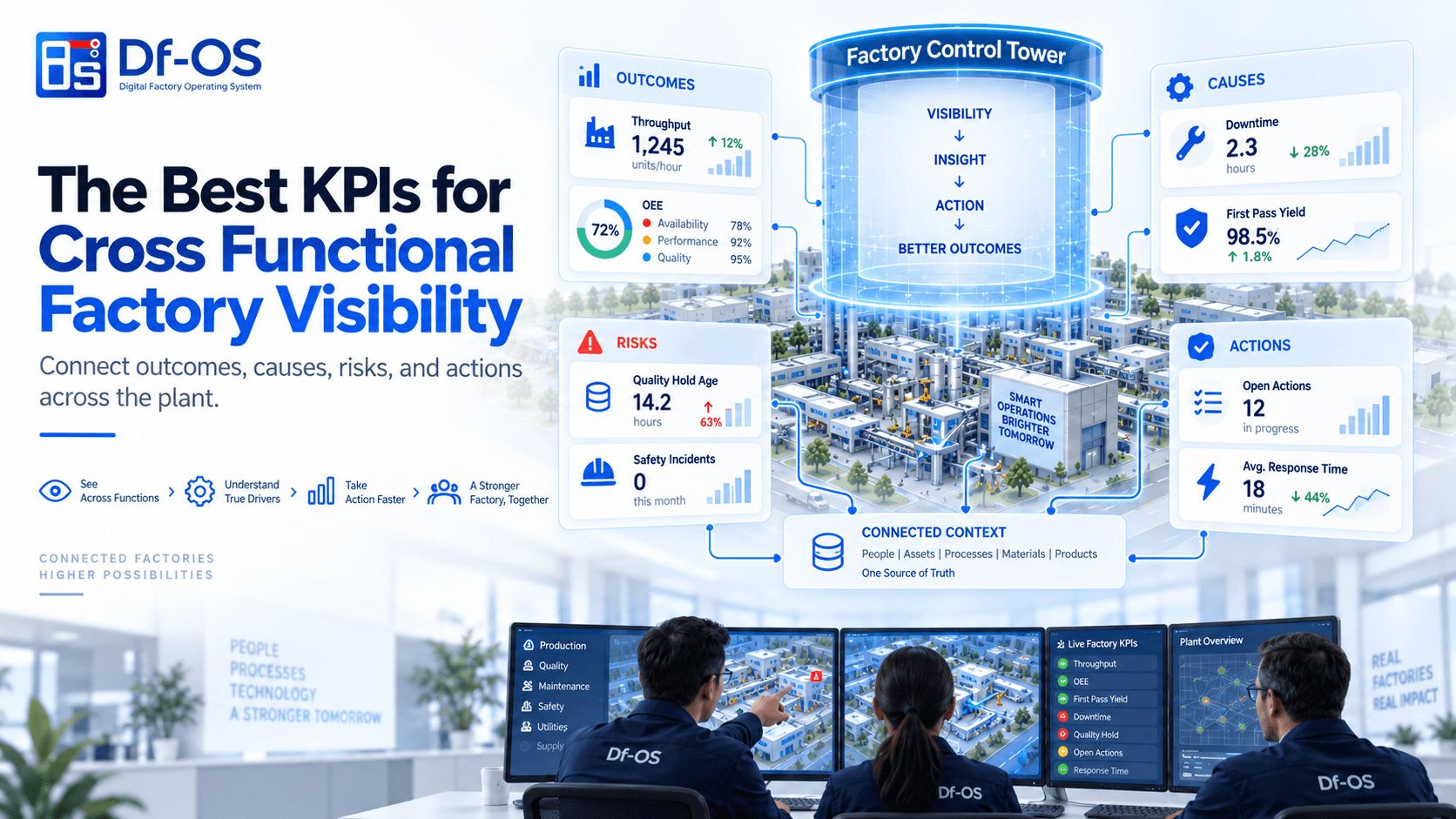
The Best KPIs for Cross Functional Factory Visibility
A four-level KPI framework connecting plant outcomes, operating causes, forward risks and action closure across production, quality, maintenance, safety and utilities.