
Downtime Root Cause Analysis in Real Time
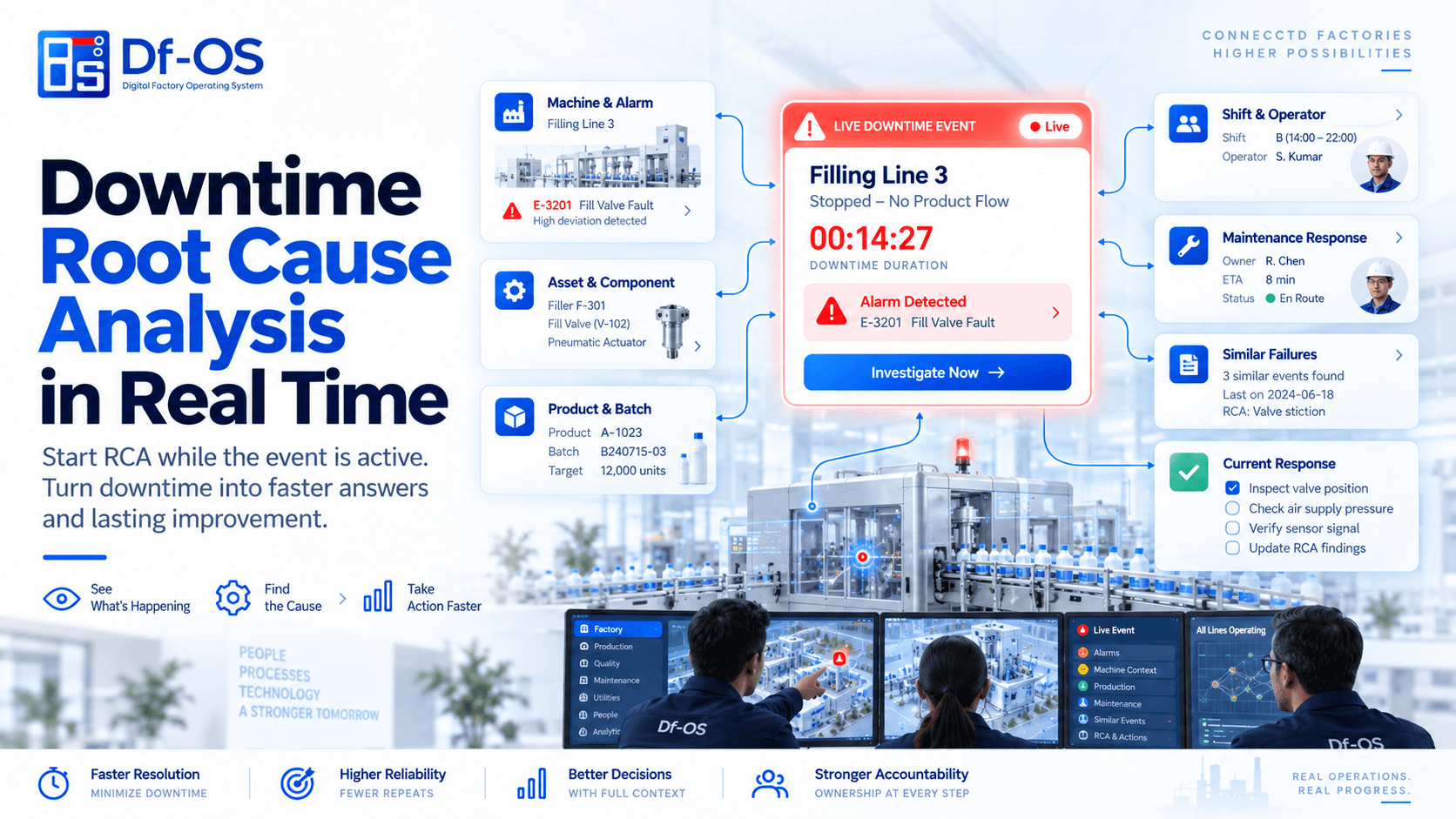
Real time downtime root cause analysis begins when the stop is detected and connects the machine alarm, product, shift, operator observation, maintenance response and prior failure history in one event record. The goal is faster diagnosis, clearer ownership and reusable learning.
Downtime analysis often begins too late.
The line stops during the shift. The operator calls maintenance. The technician restores the machine. The production loss is recorded later. The cause is discussed during the review.
By then, the event has lost detail. The alarm sequence is difficult to reconstruct. Temporary adjustments are forgotten. The people closest to the event have moved to the next problem.
Real time downtime root cause analysis begins when the stop occurs.
Reporting downtime and managing downtime are different
Downtime reporting answers:
- How long did the machine stop?
- Which loss code was selected?
- How much output was lost?
Downtime management also answers:
- What condition triggered the event?
- What was the machine producing?
- What happened before the stop?
- Who responded and how quickly?
- What action restored production?
- Has the issue happened before?
- Did the corrective action prevent recurrence?
The second set of questions requires connected workflow and history.
The five step real time loop
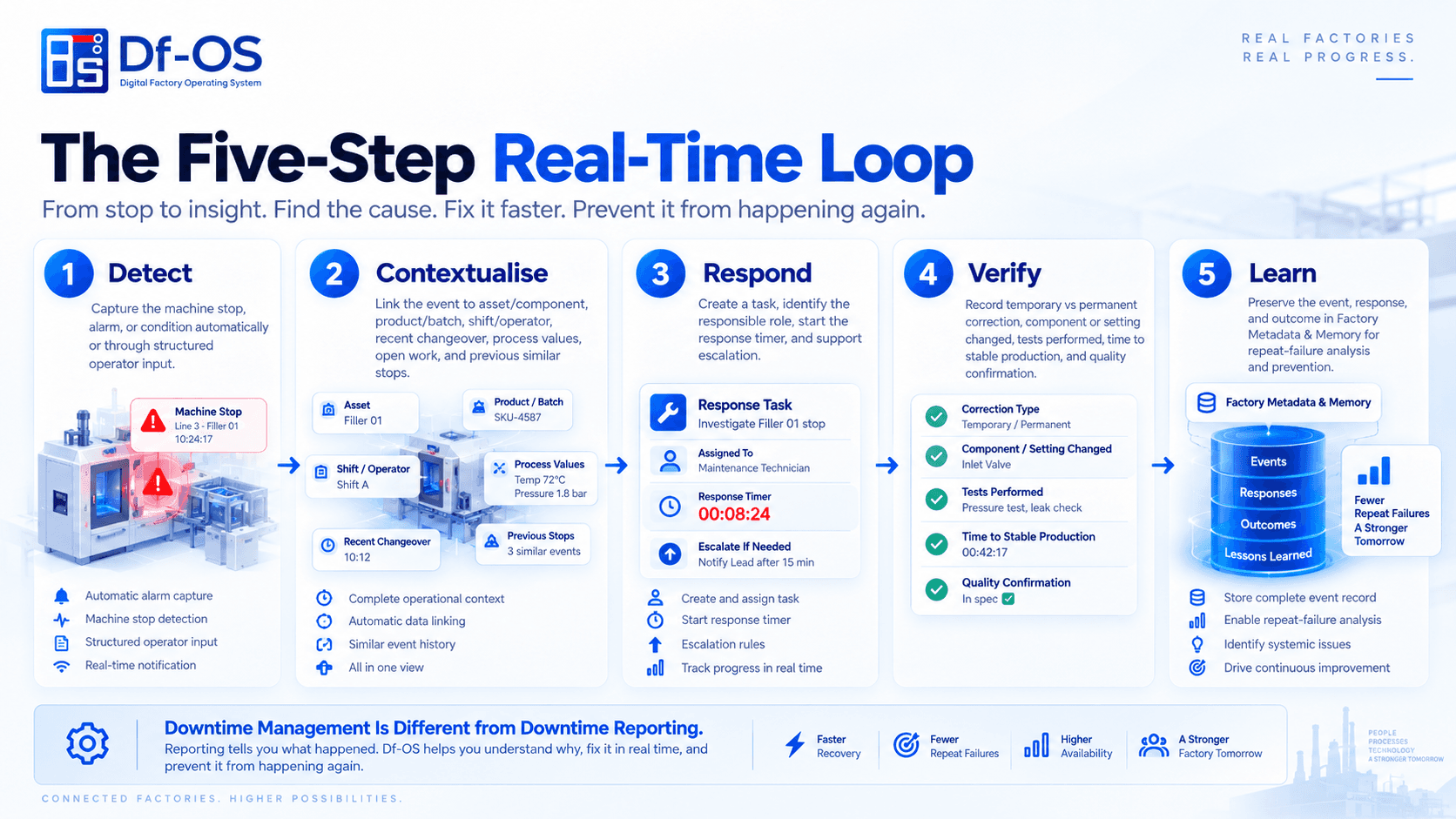
1. Detect
X-Konnect captures the machine stop, alarm or condition automatically where connectivity is available.
For manual or partially connected assets, the operator can create the event through a structured workflow.
The priority is timely and accurate detection.
2. Contextualise
Connect the event to:
- Asset and component
- Product and batch
- Shift and operator
- Recent changeover
- Process values
- Open maintenance work
- Previous similar stops
This context prevents the team from treating every stop as the same problem.
3. Respond
The event creates a task, identifies the responsible role and starts the response timer.
Escalation should depend on severity, asset criticality and response status.
The operator and technician can record observations while the condition is still fresh.
4. Verify
Restoring the line is not the same as resolving the cause.
The workflow should record:
- Temporary correction or permanent repair
- Component or setting changed
- Test performed
- Time to stable production
- Quality confirmation
- Follow-up required
5. Learn
The event, response and outcome become part of Factory Metadata & Memory.
The plant can identify repeat failures, compare response effectiveness and improve preventive action.
A real operating example
A cartoner stops intermittently with a product jam alarm.
The first few events are cleared by resetting the machine. The downtime report shows short stops under the same code.
A connected record reveals that the stops occur after a specific changeover, at the higher speed setting and with one carton supplier lot. Maintenance adjusts the guide. Quality verifies the material. The changeover checklist is updated.
The value came from connecting the stop to operating context, not from the alarm alone.
Why cause codes are not enough
Cause codes support reporting, but they can create false confidence.
A code may represent the symptom rather than the root cause. Different shifts may use the same code differently. Operators may select the quickest option.
A better record combines:
- Structured code
- Free observation
- Machine evidence
- 4M context
- Verified root cause
- Corrective action
- Effectiveness result
The role of the Factory Control Tower
The Control Tower should show more than current downtime.
It should show:
- Active event
- Duration and production impact
- Responsible owner
- Response status
- Escalation
- Similar history
- Open corrective action
- Recurrence after closure
This allows plant leadership to distinguish a normal response from a systemic reliability problem.
How Vish AI can support the investigation
Vish AI can use Factory Metadata & Memory to:
- Surface similar past events
- Compare conditions before the stop
- Summarise previous actions
- Identify repeated component or process relationships
- Prioritise events by risk and recurrence
The system should present evidence. Maintenance and production remain responsible for diagnosis and approval.
Downtime and autonomous operations
Selected parts of the loop can become progressively autonomous.
- Automatic stop detection
- Automatic workflow creation
- Priority based routing
- Recommendation from similar history
- Automated checks within defined limits
- Verification of stable running
High risk machine intervention remains controlled by approved safety and engineering rules.
A downtime maturity checklist
- Are stops detected automatically or immediately?
- Are micro stops included?
- Can events be linked to product and shift?
- Is response time measured?
- Can temporary and permanent corrections be separated?
- Are repeat failures visible?
- Is corrective action linked to recurrence?
- Can the plant compare performance across similar assets?
The Df-OS operating model
X-Konnect captures machine events. Df-OS creates and manages the downtime workflow. The Factory Control Tower shows current condition and ownership. Factory Metadata & Memory preserves the operating history. Vish AI supports explanation and guided action.
Final perspective
A factory should not wait until the review meeting to understand why it lost production.
The investigation should begin with the event, while the condition, evidence and people are still present. This creates faster response today and stronger reliability tomorrow.
Ready to Modernize Your Factory Operating Layer?
Discover how Df-OS digitizes shopfloor workflows, connects brownfield machines, and creates Factory Metadata & Memory without rip-and-replace disruption.
Frequently Asked Questions
No. The workflow should scale by severity, recurrence and business impact.
Stay Ahead of Manufacturing AI
Join 15,000+ plant managers and industrial leaders receiving our bi-weekly reports on AI agents, shopfloor data operations, and the future of smart factories.
Df-OS Editorial Board
Industry experts mapping the future of connected digital factory operating systems and manufacturing intelligence.
Related Insights & Guides
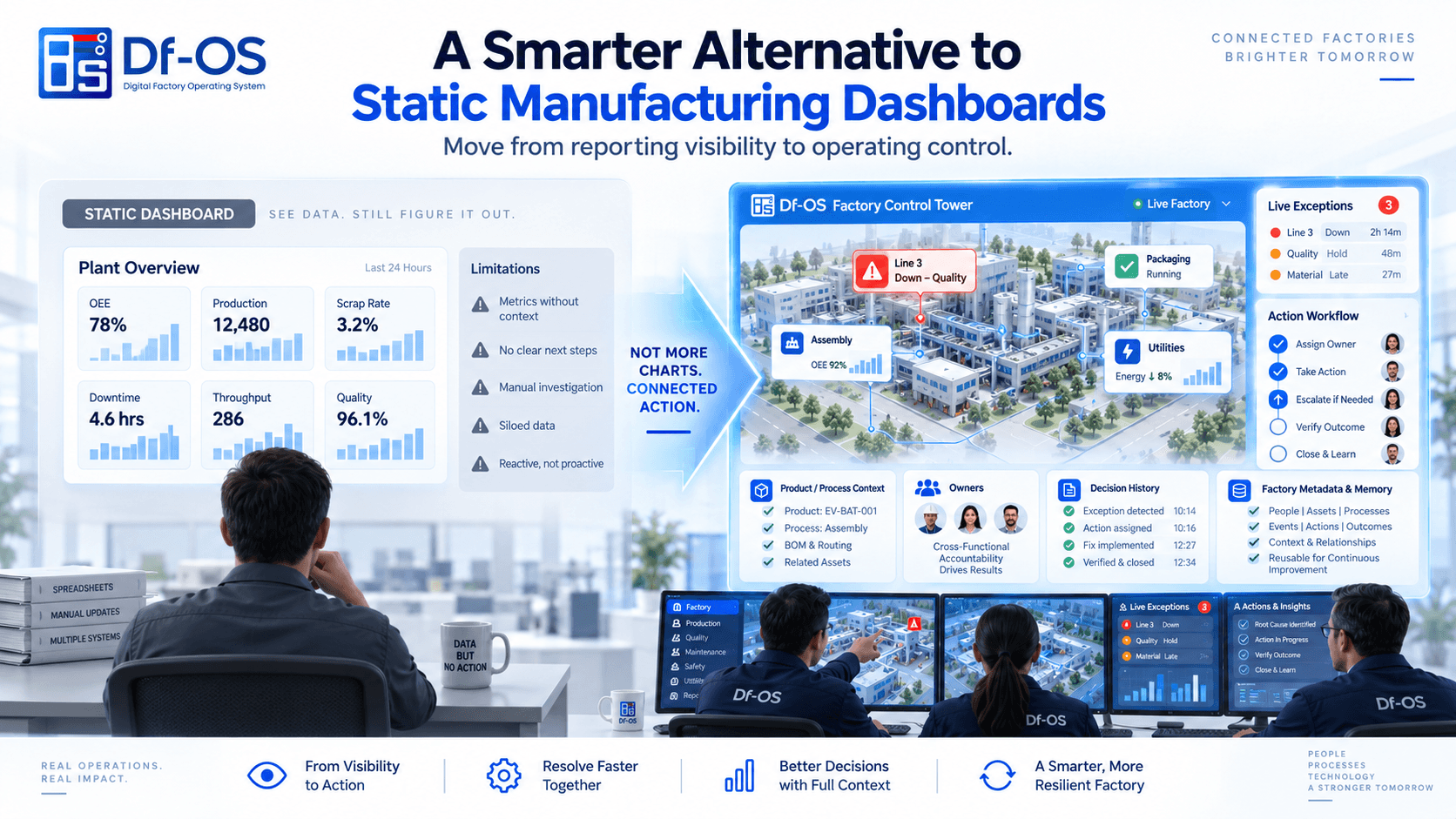
A Smarter Alternative to Static Manufacturing Dashboards
A comparison of static manufacturing dashboards and a connected Factory Control Tower that links metrics to live events, context, owners, workflows, escalation and verified closure.
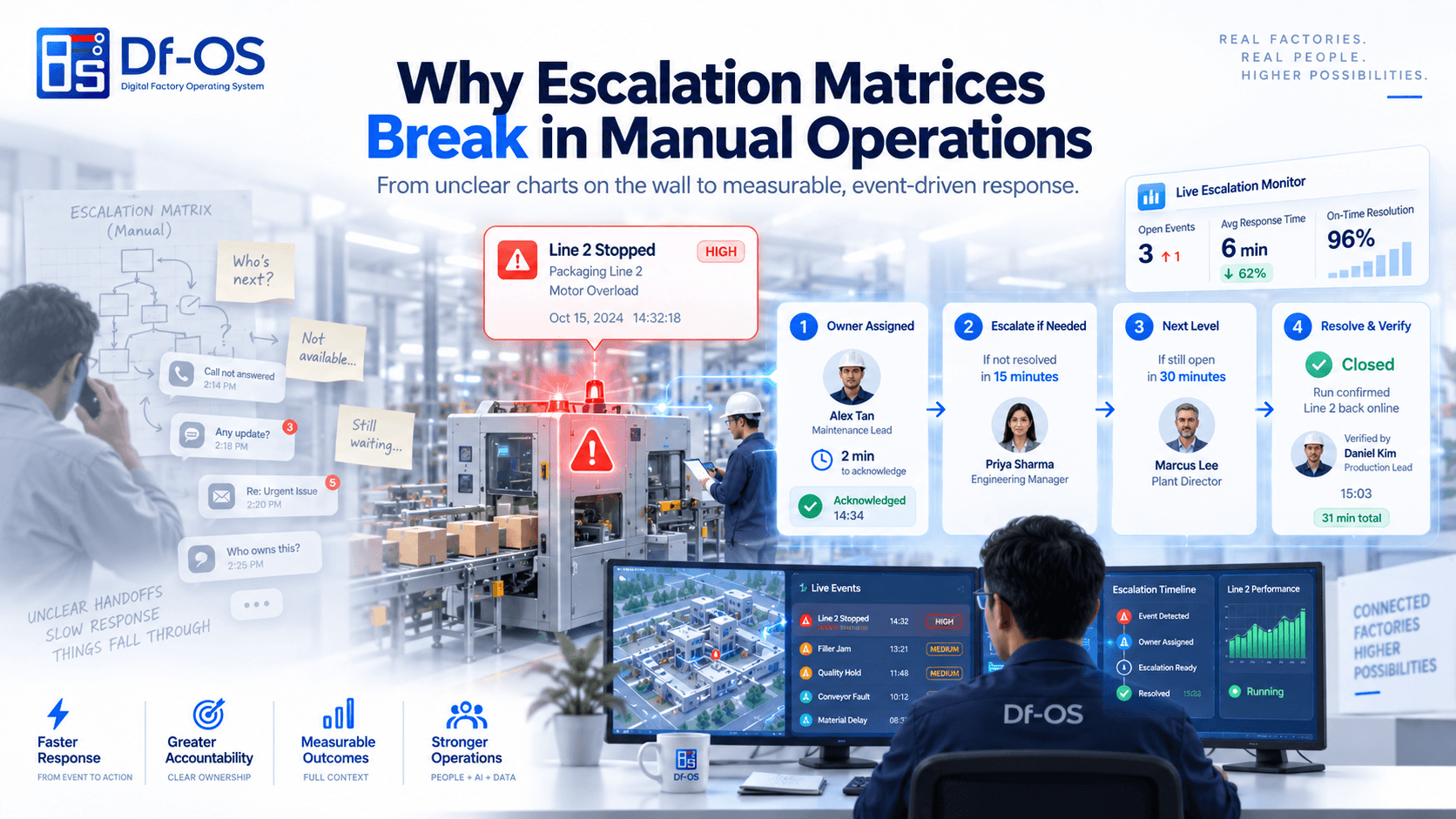
Why Escalation Matrices Break in Manual Operations
Why manual factory escalation matrices fail and how event-driven workflows connect measurable triggers, ownership, response time, escalation, closure evidence and learning.
The Best KPIs for Cross Functional Factory Visibility
A four-level KPI framework connecting plant outcomes, operating causes, forward risks and action closure across production, quality, maintenance, safety and utilities.