
Traceability as a Decision System: How TraceMaster Connects Product History to Action
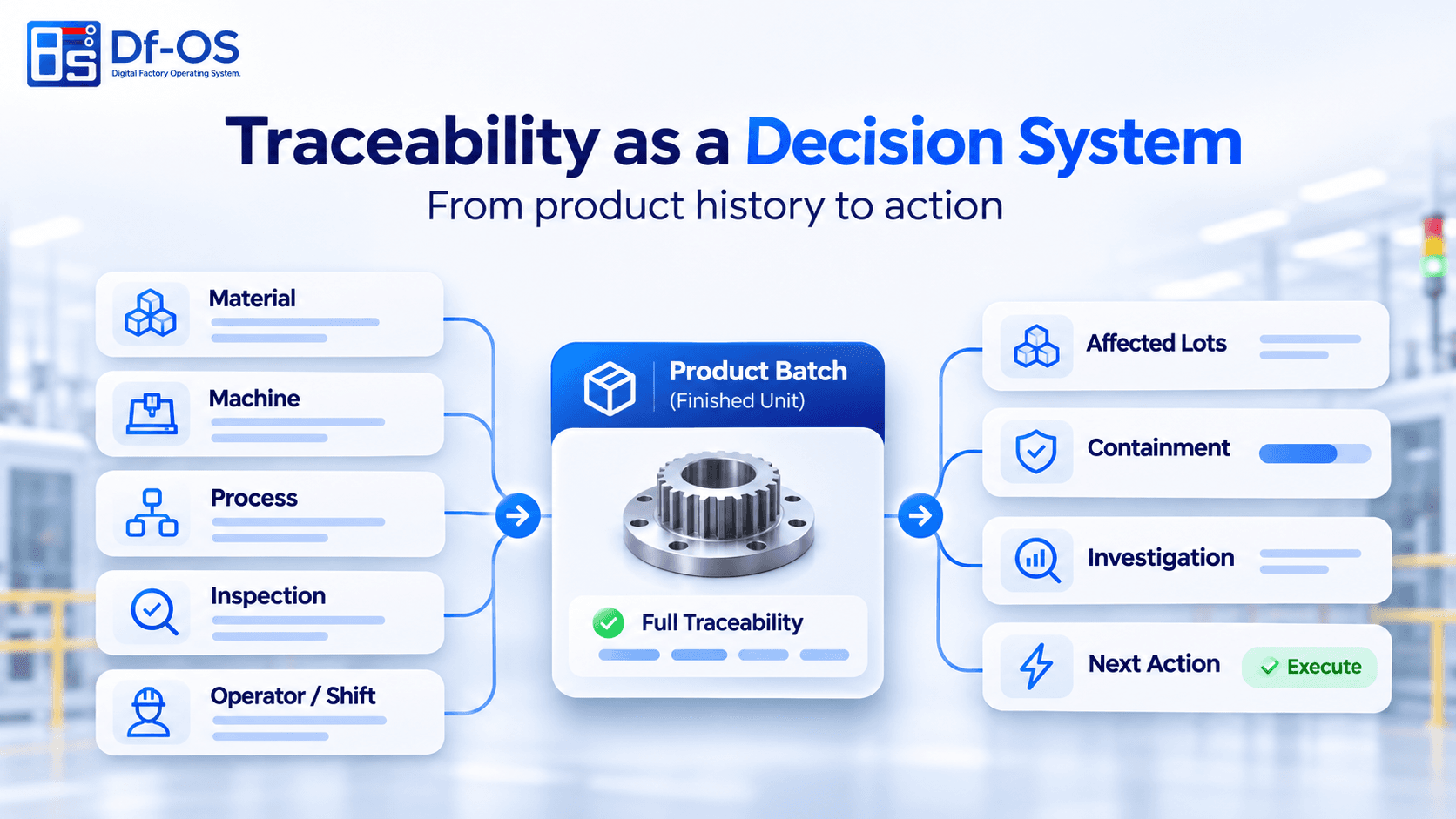
Manufacturing traceability becomes a decision system when product, material, process, machine, inspection and movement history can be reconstructed quickly enough to guide containment and investigation. TraceMaster is positioned to connect serial, batch or lot genealogy with execution checks and factory context so teams can trace backward to causes and forward to potentially affected product.
Most manufacturers can trace at least part of their production history. The real test arrives when something goes wrong. A customer reports a failed component. Quality needs to identify the affected units, production needs to locate relevant work in progress, supply chain needs to check shipments and plant leadership needs to make a containment decision. If these teams reconstruct the answer from different files, traceability exists in principle but struggles under pressure.
A connected traceability system links the product, material, process, machine, inspection and movement records needed for that decision. TraceMaster by Df-OS is designed around this operating problem. It helps manufacturers create searchable product and batch genealogy, apply execution checks and use the resulting history for more precise containment and investigation.
Product history has commercial value before a recall
Traceability is often treated as an audit requirement or a response to an occasional customer complaint. Its value is broader. Every product carries a series of decisions: which material was accepted, which station was completed, which test was passed, whether rework occurred and where the finished unit was shipped.
When these events are connected, manufacturers can address problems during production. An expired material lot can be identified before use. A missing process check can block progression at a controlled stage. A failed test can be connected to the exact WIP or serial identity instead of becoming an unstructured note.
This is the difference between recording a journey and controlling its critical gates.
Start with identity, then build the genealogy
For discrete manufacturing, the unit or component serial number often provides the best reference point. In process manufacturing, the relevant identity may be a batch, lot, recipe run or packaging aggregation. The design must reflect the way materials combine, split, move and change state.
A reliable genealogy should answer four questions:
- Which input materials and components were used?
- Which process stages, machines and people touched the product?
- Which checks, exceptions, approvals and rework actions occurred?
- Where is the product now, and which downstream identities are linked to it?
A trace that ends at finished goods may be enough for one plant objective. A wider lifecycle trace involving distributors, service centres or end-of-life returns needs additional systems and agreements. TraceMaster's public architecture distinguishes its core factory capabilities from Df-OS extensions and integration-dependent capabilities. Buyers should confirm the scope required for their implementation.
Backward and forward traceability serve different decisions
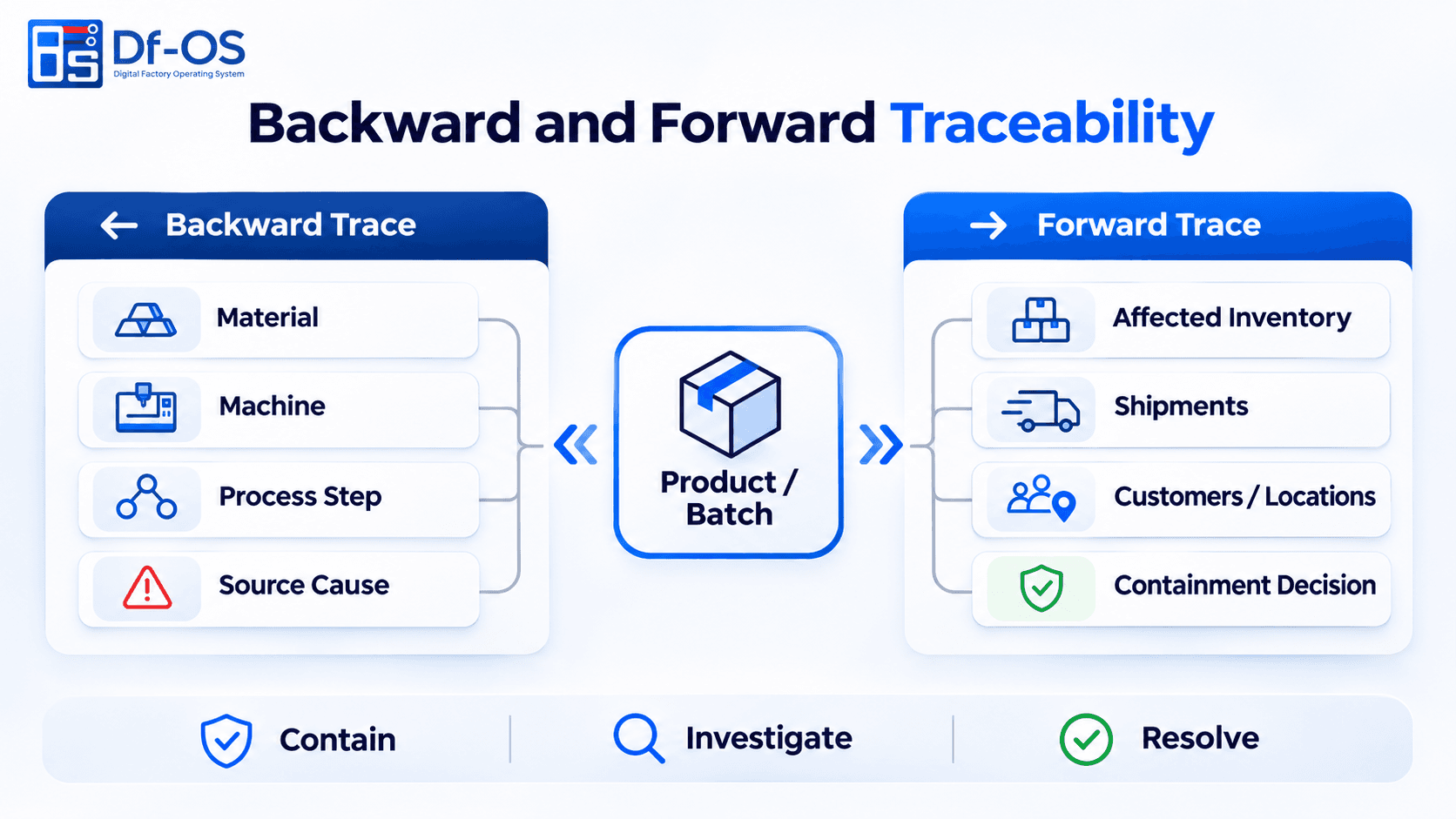
Backward traceability begins with a product or customer complaint and reconstructs the materials, operations and test history that created it. For example, an automotive component may fail during field service. The investigation searches the serial record to identify its component lot, production station, quality results and repair history.
Forward traceability begins with a suspect source, such as a supplier lot or abnormal process setting, and identifies everything potentially affected. The purpose is to determine which WIP units, finished products, cartons, pallets or shipments require attention.
Both directions matter. Backward tracing helps understand the cause. Forward tracing helps determine the exposure.
The containment decision should be based on evidence
Suppose a motor component from a particular supplier batch is found to be defective. The question is not only whether the batch was received. The plant needs to identify the serialized units where it was fitted, the units still in storage and any units already shipped.
If the evidence is incomplete, quality may need to hold a broader population as a precaution. When verified genealogy is complete, it may be possible to narrow the suspect scope. That can reduce unnecessary disruption, but the actual containment decision must follow the manufacturer's quality and safety requirements.
Avoid making universal claims about recall savings. The possible value depends on batch size, genealogy completeness, customer requirements, warehouse position and the seriousness of the defect. A business case should measure investigation time, suspect population, containment accuracy and avoided disruption using actual plant data.
Where execution control strengthens traceability
A database that records a missed step after production does not provide the same protection as a process gate that prevents the next step until the requirement is met. TraceMaster describes capabilities such as stage progression checks, serial and batch tracking, BOM or recipe verification, quality holds, rework records and electronic sign-offs.
The correct configuration depends on the manufacturing process and connected equipment. A barcode scan may be a suitable control for some stages. A critical parameter may require machine-level verification through X-Konnect or another qualified integration. Production and quality teams should agree where hard interlocks are justified and what happens during a system exception.
Traceability becomes part of Factory Metadata & Memory
A serialized product record is not merely a search result. When linked to process conditions, deviations, decisions and corrective action, it becomes a durable part of Factory Metadata & Memory.
This also strengthens the foundation for industrial intelligence. Vish AI may help authorised users investigate an exception or retrieve related history where the relevant integrations are available. It should not be assumed that every traceability event automatically produces an AI decision. The operating record and governance must come first.
A practical traceability readiness test
Choose a real finished unit and see whether the plant can reconstruct its complete genealogy within an agreed time. Then choose a suspect raw material lot and identify the affected finished products and shipments. Note every manual lookup, disconnected identifier and missing sign-off.
Repeat the exercise across two shifts and two product types. Many weaknesses emerge only when different operators, recipes or rework loops are involved.
Use the findings to define a bounded TraceMaster pilot. Start with the stages where identity errors, trace gaps or delayed investigation have the highest operational cost.
Run a Backward and Forward Traceability Test
Test product and batch genealogy reconstruction across shifts, identify trace gaps or decision delays, and scope a bounded TraceMaster pilot.
Frequently Asked Questions
Serialization assigns unique identities. Traceability connects those identities to materials, events, tests, movements and decisions. Serialization may be an important part of a traceability programme, but it is not sufficient on its own.
Stay Ahead of Manufacturing AI
Join 15,000+ plant managers and industrial leaders receiving our bi-weekly reports on AI agents, shopfloor data operations, and the future of smart factories.
Df-OS Editorial Board
Industry experts mapping the future of connected digital factory operating systems and manufacturing intelligence.
Related Insights & Guides

What the 2026 World Economic Forum Lighthouse Research Reveals About Manufacturing Autonomy
A careful reading of 2026 World Economic Forum Lighthouse research and what its evidence implies for manufacturers building repeatable operating capability and autonomy.

What Vish AI Can Tell a Plant Manager That a Dashboard Cannot
A plant-manager view of factory intelligence: what Vish AI can help explain beyond dashboards, how answers should remain traceable, and where human authority is required.
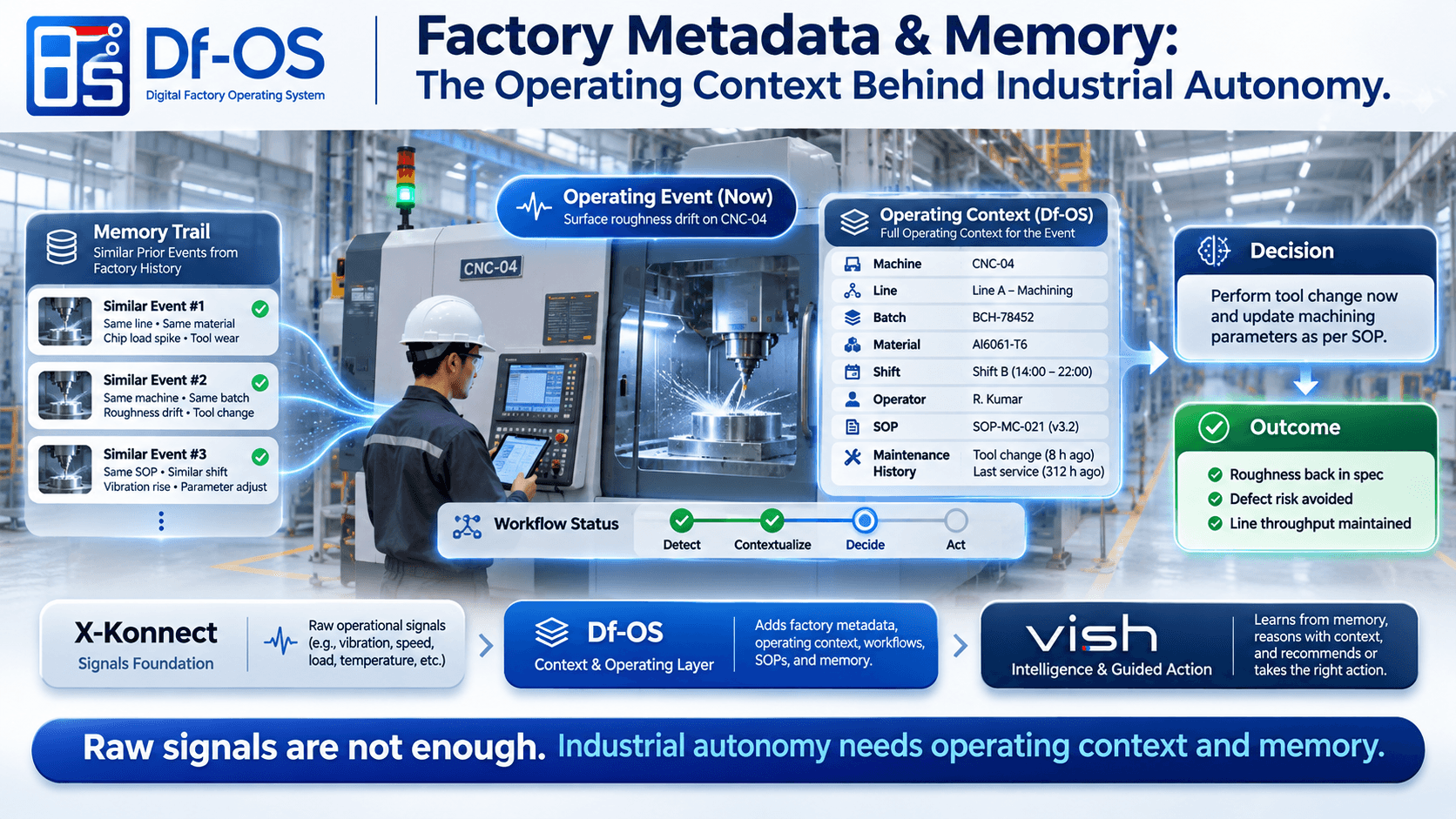
Factory Metadata & Memory: The Operating Context Behind Industrial Autonomy
Why industrial autonomy needs more than machine signals: Factory Metadata & Memory connects events to identities, conditions, workflows, decisions and verified outcomes.