
How RCA and CAPA Build Factory Metadata & Memory

A CAPA can be closed without the factory becoming any wiser.
The form is complete. The signatures are present. The action has a due date. Yet six months later, a similar deviation occurs and the new team begins the investigation from the beginning.
The problem is not always the quality of the original investigation. It is the way the learning was stored.
RCA and CAPA become reusable operational memory when the event, evidence, context, cause, action and verified result remain connected and searchable.
Closure and learning are different outcomes
A closed record proves that a process was followed. Operational learning proves that the factory can use the result again.
A reusable record should help a future team answer:
- Has this event happened before?
- Were the operating conditions similar?
- Which causes were considered?
- Which cause was verified?
- What action was approved?
- Did the action prevent recurrence?
- Is the action relevant to the current event?
If these questions require a manual search through documents and emails, the factory has records but limited memory.
The six part operating memory model
1. Event
Define the deviation clearly.
The record should include the actual condition, detection point, severity, affected product or process and immediate containment.
Generic descriptions reduce future search value.
2. Evidence
Preserve the data used during the investigation.
This may include machine signals, inspection results, photographs, samples, maintenance history, material records and operator observations.
Evidence should be linked to the event, not stored only as disconnected attachments.
3. Context
Connect the event across Man, Machine, Material and Method.
This allows the team to see:
- Who was involved and which training or role applied
- Which equipment and process condition were active
- Which material lot and supplier context were relevant
- Which SOP, setting and process step governed the work
4. Cause

Record the causes considered, the evidence supporting them and the method used to verify the selected root cause.
A dropdown root cause code may support reporting, but it should not replace reasoning.
5. Action
Connect corrective and preventive actions to:
- Owner
- Due date
- Approval
- Affected process
- Required change
- Risk
- Implementation evidence
6. Verification and reuse
The CAPA should remain open as a learning loop until the result is verified.
The factory should record whether the event recurred, whether the control changed and whether the action created unintended effects.
This verified result is what makes the record useful later.
A practical example
A packaging defect appears during final inspection.
The deviation record shows the defect and affected quantity. The investigation finds that a guide setting moved after changeover. A mechanical stop is added and the changeover checklist is updated.
Six months later, a similar defect appears on another line.
A reusable Factory Metadata & Memory record allows the quality team to find the prior event by defect type, product, process step, machine condition and action. The team can test the earlier hypothesis quickly instead of repeating the complete search.
This does not mean the old cause is automatically accepted. It means the factory begins with relevant experience.
Why traditional CAPA systems often fall short
Many quality systems are designed for compliance and document control. They may not connect deeply with live production, machine and maintenance context.
Common gaps include:
- Weak event descriptions
- Attachments without structured relationships
- Limited machine context
- No link to shift handover or maintenance action
- Cause codes without evidence
- Closure before effectiveness review
- Search based on document title rather than operating similarity
The result is a valid archive with low reuse value.
How Df-OS changes the operating flow
Df-OS can connect deviation, containment, investigation, RCA, CAPA, approval and effectiveness within one workflow.
X-Konnect can add machine and process context. Production and maintenance records can be linked to the quality event. The final history becomes part of Factory Metadata & Memory.
Vish AI can use this history to surface similar deviations, explain relevant patterns and present prior actions for review. Human approval remains responsible for the final quality decision.
RCA and CAPA in the Autonomous Factory
Autonomous operations do not remove quality governance.
They can improve the speed and consistency of defined steps:
- Detect an abnormal condition
- Create a deviation
- Identify affected product
- Start containment
- Route the workflow
- Surface similar history
- Monitor action due dates
- Verify recurrence
Higher consequence decisions, such as product disposition or root cause approval, remain governed by authorised people.
A quality memory checklist
Review the last ten CAPA records and ask:
- Can similar events be found by operating context?
- Is evidence connected to the cause?
- Are machine and material conditions available?
- Is the action linked to the process change?
- Was effectiveness verified?
- Can another plant understand and reuse the learning?
- Can the organisation identify repeat failure after closure?
Final perspective
The value of RCA and CAPA is not the number of records closed. It is the number of failures the factory does not have to relearn.
A connected operating record turns quality investigation into Factory Metadata & Memory. That is how compliance activity becomes operational intelligence.
Ready to Modernize Your Factory Operating Layer?
Discover how Df-OS digitizes shopfloor workflows, connects brownfield machines, and creates Factory Metadata & Memory without rip-and-replace disruption.
Frequently Asked Questions
No. The record should remain evidence based. Reuse means surfacing relevant history, not copying a conclusion without verification.
Stay Ahead of Manufacturing AI
Join 15,000+ plant managers and industrial leaders receiving our bi-weekly reports on AI agents, shopfloor data operations, and the future of smart factories.
Df-OS Editorial Board
Industry experts mapping the future of connected digital factory operating systems and manufacturing intelligence.
Related Insights & Guides
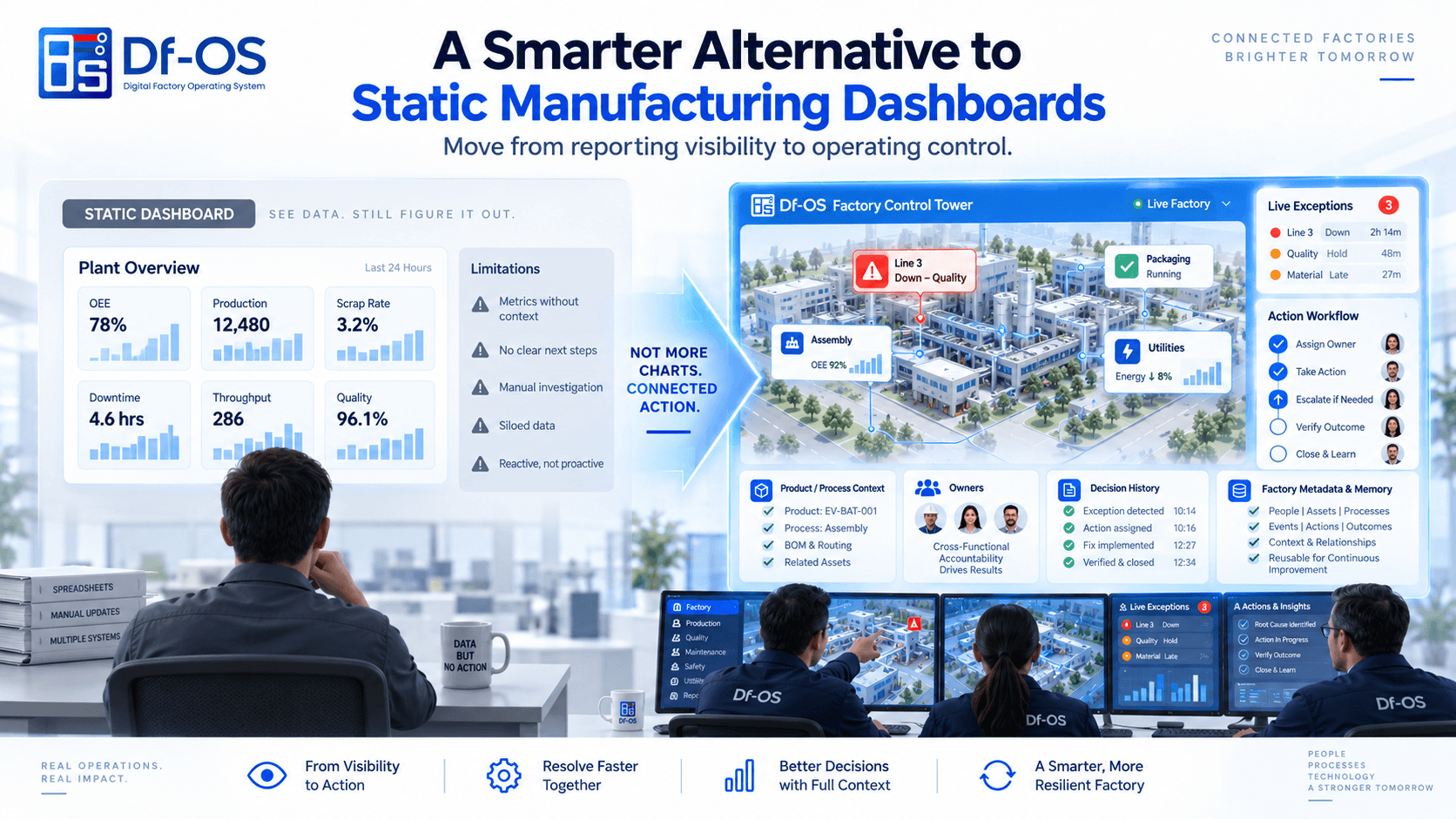
A Smarter Alternative to Static Manufacturing Dashboards
A comparison of static manufacturing dashboards and a connected Factory Control Tower that links metrics to live events, context, owners, workflows, escalation and verified closure.
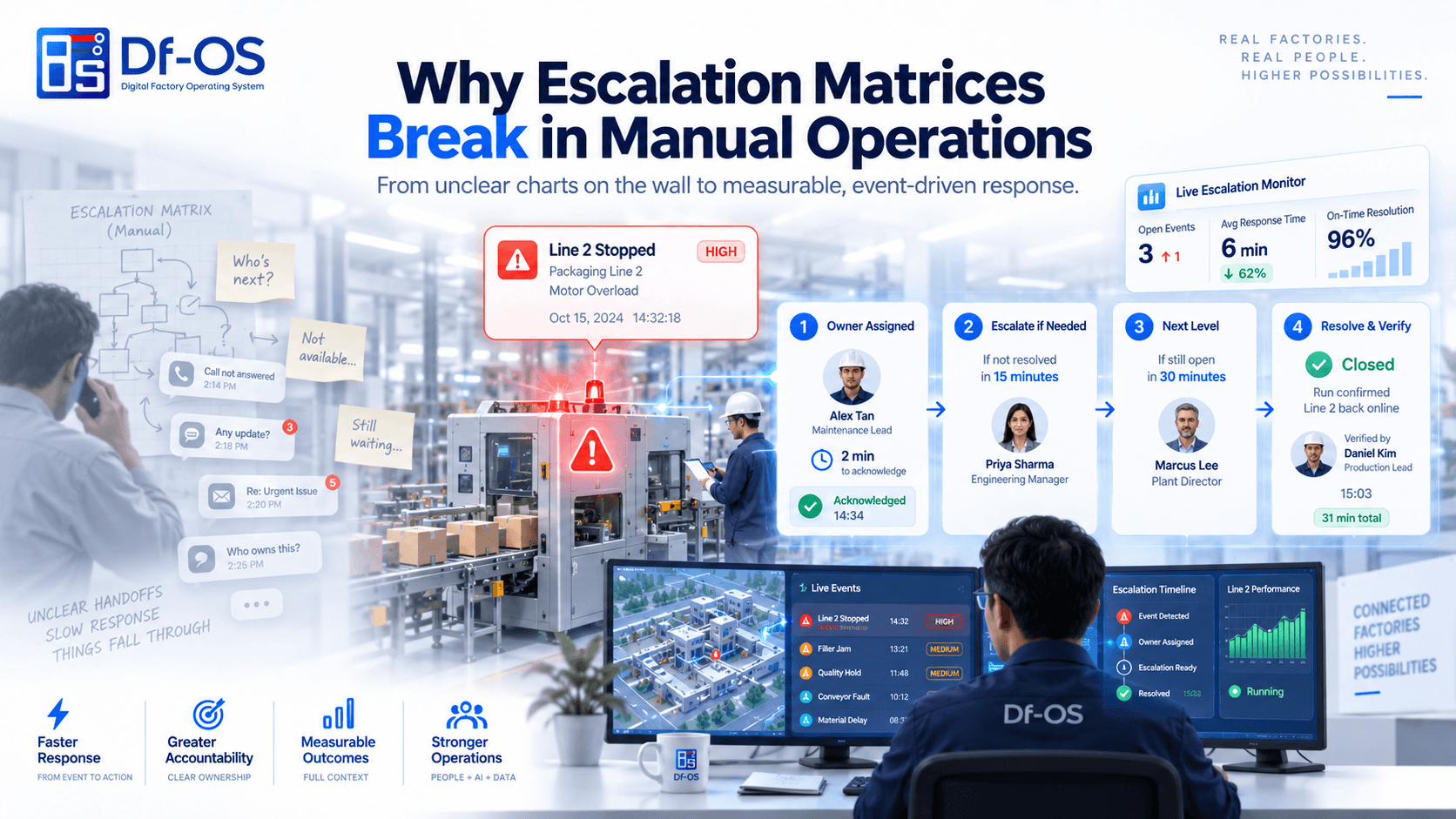
Why Escalation Matrices Break in Manual Operations
Why manual factory escalation matrices fail and how event-driven workflows connect measurable triggers, ownership, response time, escalation, closure evidence and learning.
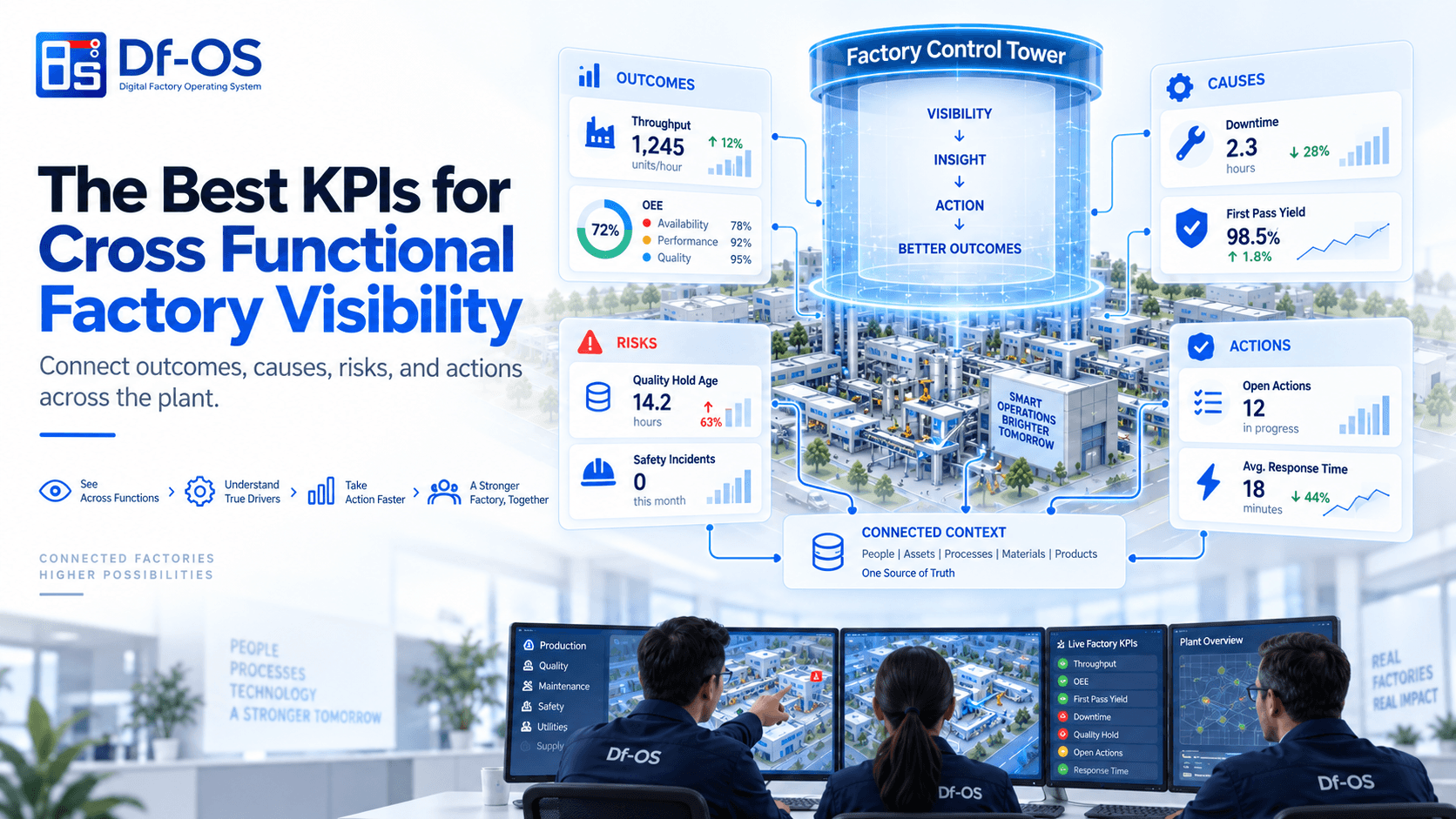
The Best KPIs for Cross Functional Factory Visibility
A four-level KPI framework connecting plant outcomes, operating causes, forward risks and action closure across production, quality, maintenance, safety and utilities.