
Df-OS vs MES: The Architectural Difference

MES primarily manages production execution, work orders, recipes, genealogy and manufacturing records. Df-OS acts as a broader factory operating layer that connects workflows, departments, machine signals, systems and decision history. In many plants, Df-OS complements MES rather than replacing it.
MES and Df-OS solve different parts of the manufacturing technology problem.
MES primarily manages production execution, work orders, recipes, genealogy and manufacturing records. Df-OS acts as a broader operating layer that connects daily workflows, departments, machine signals, existing systems and decision history across the factory.
The distinction is architectural, not promotional. In many plants, the right design may include both within an AI-Native Digital Factory Operating System foundation.
What MES is designed to do
Manufacturing Execution Systems were created to manage and document production between planning and control.
A typical MES may support:
- Production orders and dispatching
- Work in progress
- Batch and lot tracking
- Recipe and routing control
- Labour and resource tracking
- Production performance
- Genealogy and electronic records
- Integration with ERP and automation systems
MES is especially valuable where production execution must be controlled, recorded and traced with discipline.
The challenge is that a factory runs through more than production execution.
A quality deviation may require containment, approval, RCA and CAPA. A breakdown may require maintenance response, spare parts, production rescheduling and leadership escalation. A safety permit may determine whether work can begin. A shift review may depend on production, quality, maintenance and utility conditions at the same time.
These cross-functional operating relationships are where a Digital Factory Operating System has a different role.
What Df-OS is designed to do
Df-OS creates a connected operating layer across factory functions.
It digitises workflows such as logbooks, inspections, deviations, maintenance actions, safety processes, shift handovers and daily reviews. It connects machine events through X-Konnect and links factory activity into Factory Metadata & Memory. Vish AI can then use this context to explain conditions, identify patterns and support decisions.
The objective is not to rebuild every MES capability. It is to connect the wider operating environment around the plant.
Comparison by architectural role

- Primary purpose: MES: Manage production execution | Df-OS: Connect factory execution across functions
- Typical centre of gravity: MES: Production orders, recipes, batches and genealogy | Df-OS: Workflows, events, ownership, context and decisions
- Department coverage: MES: Mainly manufacturing execution, with extensions | Df-OS: Production, quality, maintenance, safety, utilities, workforce and reviews
- Workflow flexibility: MES: Often structured around configured production models | Df-OS: Designed for plant specific workflows, approvals and escalations
- Machine context: MES: Receives production and process data | Df-OS: Connects signals to workflows, roles and event history through X-Konnect
- Operating history: MES: Manufacturing records and production history | Df-OS: Factory Metadata & Memory across cross-functional events and decisions
- Intelligence role: MES: Reporting and execution optimisation, depending on product | Df-OS: Context for Vish AI explanations, recommendations and guided action
- Transformation approach: MES: Can require deep production modelling | Df-OS: Can begin with selected workflows or use cases in a brownfield plant
The difference in a real event
Consider a repeated line stoppage.
An MES may record the production interruption, lost quantity and work order context. The PLC or historian records the alarm. The maintenance system records the repair. A spreadsheet records the daily loss. The shift meeting records an action.
Df-OS connects the event across these elements.
The stoppage can create a workflow, assign ownership, capture operator context, record maintenance response, update the shift handover, preserve the root cause and make the action available during a future recurrence.
The value is not only a more complete report. It is a more complete operating loop.
When a manufacturer may need MES
MES is often the right priority when the plant needs:
- Tight production order control
- Electronic batch records
- Recipe enforcement
- Detailed genealogy
- Regulated manufacturing execution
- Dispatching and work in progress management
- Deep integration with production automation
These are core execution requirements and should not be reduced to a generic workflow application.
When a manufacturer may need Df-OS
Df-OS becomes relevant when the plant needs to:
- Digitise cross-functional factory workflows
- Connect manual operations with machine events
- Improve shift handover and daily management
- Create traceable action and escalation
- Build Factory Metadata & Memory
- Connect quality, maintenance, safety and utility processes
- Add a Factory Control Tower across functions
- Provide operating context for Vish AI
- Progress toward bounded autonomous factory operations
When both systems make sense
A plant may use MES as the system of production execution and Df-OS as the connected operating layer around it.
In this model:
- ERP provides business and planning context
- MES manages production execution
- PLC and SCADA control machines
- Historians preserve time series data
- Df-OS connects workflows, events, ownership and decision history
- X-Konnect brings machine signals into operating context
- Vish AI supports explanation and guided decisions
This architecture protects existing investments while addressing the operational gaps between systems.
Questions to ask before choosing an approach
- 1. Is the main requirement production execution or cross-functional operating coordination?
- 2. Which processes are still managed through paper, spreadsheets or messages?
- 3. Can machine events trigger owned workflows today?
- 4. Can the plant retrieve the decision history behind a recurring issue?
- 5. Do quality, maintenance and production share one operating context?
- 6. Is the current MES configured to solve these gaps, and at what effort?
- 7. Does the plant need a phased brownfield approach?
- 8. Which system should remain the source of record for each data object?
These questions are more useful than asking which product category is better.
Df-OS and the path to the Autonomous Factory
The Autonomous Factory requires connected sensing, operational context, decision support and controlled action.
MES can provide important execution data, but broader autonomy often depends on the workflows and decisions around production. Df-OS connects these elements into Factory Metadata & Memory and provides the context Vish AI needs to support the next action.
The result is not an MES replacement narrative. It is an operating system architecture that allows existing systems to work as one connected factory environment.
Final perspective
MES is an important manufacturing system category. Df-OS addresses a different architectural need.
MES manages production execution. Df-OS connects the wider operating reality of the factory.
Manufacturers should decide based on the operating problem, current system landscape and desired maturity path. In many cases, the strongest architecture is not one system instead of another. It is a clear division of responsibility between them. Evaluating your shopfloor architecture? Book an architecture discussion with Df-OS manufacturing IT specialists.
Ready to Modernize Your Factory Operating Layer?
Discover how Df-OS digitizes shopfloor workflows, connects brownfield machines, and creates Factory Metadata & Memory without rip-and-replace disruption.
Frequently Asked Questions
Yes. Df-OS is designed to work with existing ERP, MES, PLC, SCADA and other plant systems.
Stay Ahead of Manufacturing AI
Join 15,000+ plant managers and industrial leaders receiving our bi-weekly reports on AI agents, shopfloor data operations, and the future of smart factories.
Df-OS Editorial Board
Industry experts mapping the future of connected digital factory operating systems and manufacturing intelligence.
Related Insights & Guides
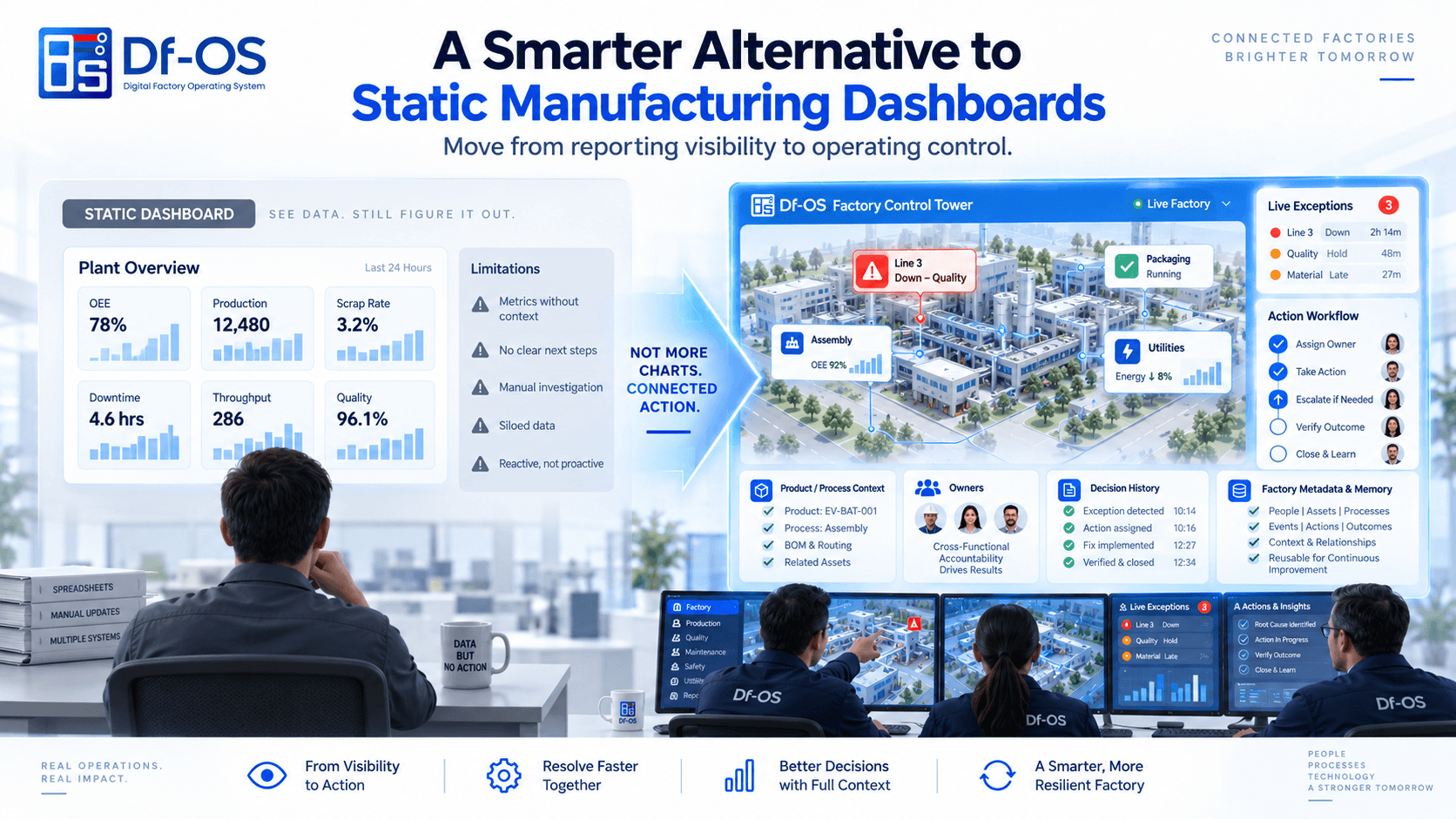
A Smarter Alternative to Static Manufacturing Dashboards
A comparison of static manufacturing dashboards and a connected Factory Control Tower that links metrics to live events, context, owners, workflows, escalation and verified closure.
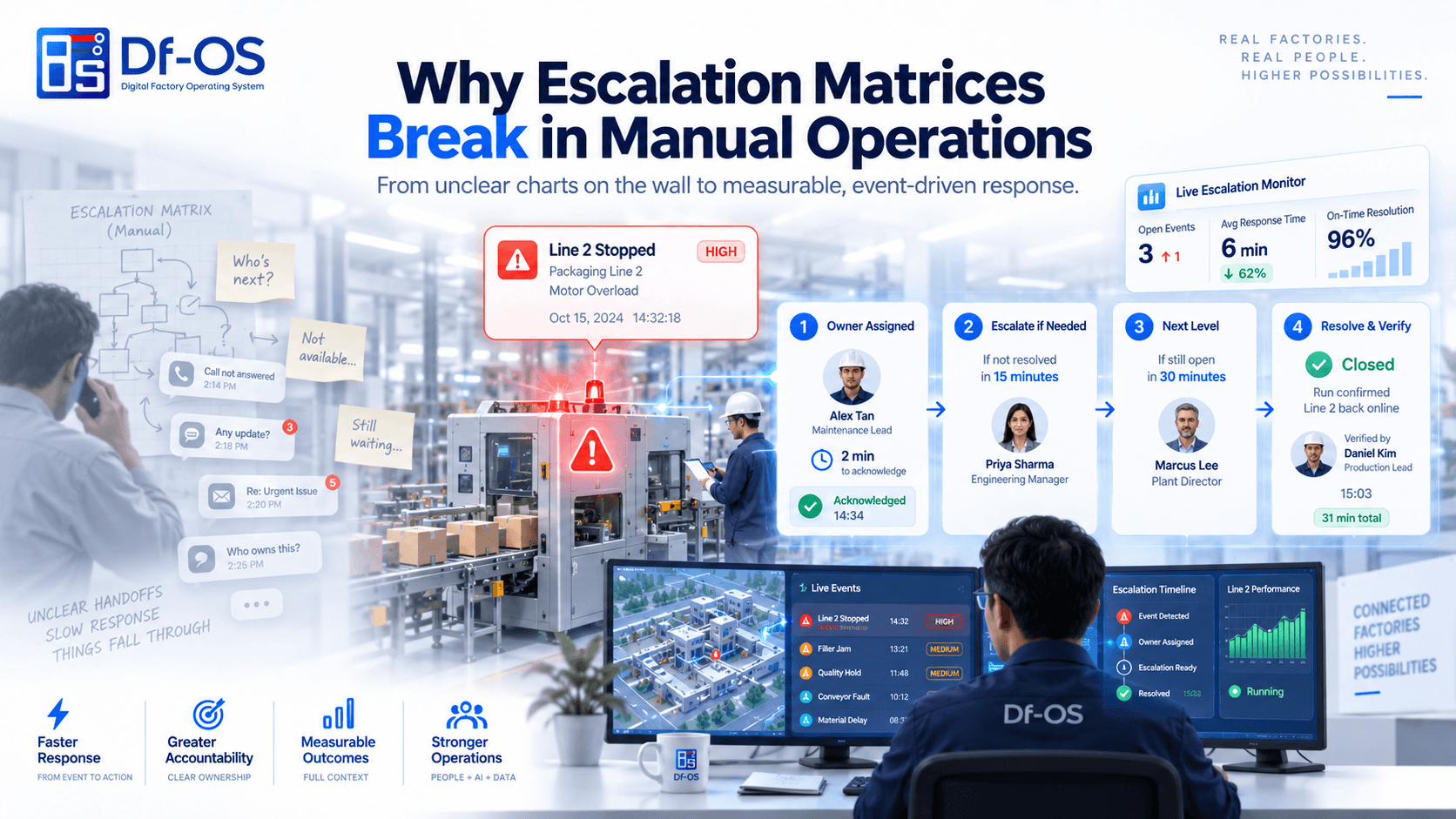
Why Escalation Matrices Break in Manual Operations
Why manual factory escalation matrices fail and how event-driven workflows connect measurable triggers, ownership, response time, escalation, closure evidence and learning.
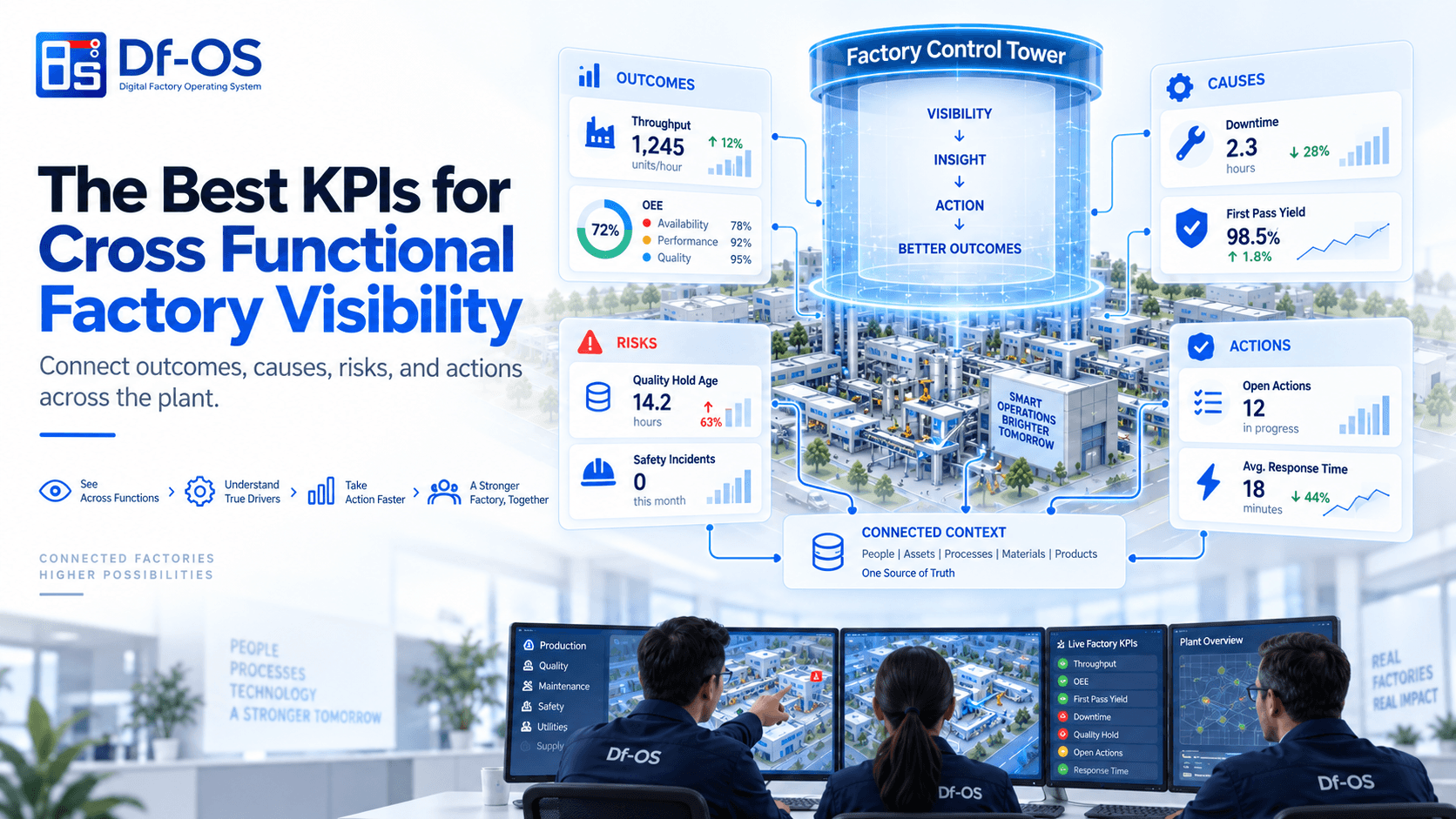
The Best KPIs for Cross Functional Factory Visibility
A four-level KPI framework connecting plant outcomes, operating causes, forward risks and action closure across production, quality, maintenance, safety and utilities.