
Why Raw Machine Data Is Not Enough

A machine can tell you that its speed dropped. It cannot tell you, by itself, why the drop mattered.
Was the line producing a difficult SKU? Had the team just completed a changeover? Was the material lot different? Did the operator respond? Was maintenance already working on a related issue? Did quality observe a deviation at the same time?
Raw machine data records values, states and alarms. It does not automatically explain the operating event.
That difference separates telemetry from factory intelligence.
What raw machine data can do well
Machine data is essential. It can provide:
- Run and stop states
- Cycle time
- Speed
- Counts
- Temperature
- Pressure
- Flow
- Vibration
- Current and power
- Alarm codes
- Setpoints and process values
This data can improve visibility, support condition monitoring and remove manual recording.
The problem begins when the organisation expects the signal to provide meaning that was never captured.
A high temperature may indicate a fault, a product requirement, a cleaning cycle or a planned process step. The value is real, but the interpretation depends on context.
Four levels from signal to learning
1. Signal
A value changes or an event occurs.
Example: the filler stops at 14:12.
2. Context
The event is connected to product, batch, line, shift, operator, process condition and recent history.
Example: the filler stopped during the first run after a pack size changeover.
3. Decision
The factory records who responded, what evidence was reviewed and which action was selected.
Example: the technician adjusted the guide setting after comparing the event with the previous changeover.
4. Learning
The factory verifies the result and makes the experience available for future events.
Example: the updated changeover check prevented the same stop during the next run.
Raw data covers the first level. Factory Metadata & Memory connects the remaining three.
Why dashboards often stop at the signal
A dashboard can display a large number of machine tags and still leave the plant with the same decision problem.

The screen may show:
- Which machine stopped
- How long it stopped
- Which alarm was active
- How performance changed
It may not show:
- What the line was producing
- What work had just been completed
- Who owns the response
- Which action is underway
- Whether the issue has happened before
- Whether the previous corrective action worked
This is why more telemetry does not always create faster action.
The operating context a machine event needs
A useful event record should connect several forms of context.
Product and order context
Product, SKU, batch, work order, pack size and routing can explain why the same machine behaves differently.
Process context
Process step, setpoint, control range, recent change and operating mode describe what the equipment was expected to do.
Material context
Material lot, supplier, incoming inspection and storage condition may be relevant to quality or performance.
People context
Shift, role, training status and operator action explain the human side of the event without reducing the analysis to blame.
Workflow context
Open maintenance tasks, changeover completion, inspection status, deviation and escalation show what work was active.
Decision context
The selected response, approval, evidence and outcome preserve what the plant learned.
A quality example
A process parameter begins to drift. The historian captures the trend. Quality later detects a defect.
If the systems remain separate, the investigation begins with data gathering.
If the event is contextualised, the quality team can see:
- The product and material lot
- The parameter change
- The operator observation
- The maintenance status
- The inspection result
- The affected quantity
- Similar prior deviations
- The corrective action and verification
The investigation starts with a connected timeline rather than a search across systems.
How X-Konnect and Df-OS work together
X-Konnect connects machines, sensors and PLCs to the Df-OS operating layer.
The signal can then become part of a workflow rather than remaining an isolated data point. A stop can create a downtime event. An abnormal condition can trigger an inspection. A count can update production status. An alarm can become part of the shift handover.
Df-OS adds workflow, role and decision context. The resulting Factory Metadata & Memory gives Vish AI a richer basis for explanation and recommendation.
Why context is required for autonomous operations
An autonomous action must be based on more than a raw threshold.
The system needs to know whether the condition is expected, whether the current product changes the rule, which action is permitted and when a person must intervene.
A safe autonomous loop requires:
- Reliable signal
- Current operating context
- Approved decision rule
- Defined action boundary
- Outcome verification
- Human override
Without context, the same signal can lead to the wrong action.
A machine context audit
Choose one important machine event and ask:
- Can we identify the exact product, batch and process step?
- Can we see what changed before the event?
- Can we connect the event to current workflows?
- Can we identify the response owner?
- Can we retrieve similar past events?
- Can we see which action worked?
- Can the same context be used by a different shift or plant?
If the answer is no, the plant may have strong data collection but weak operational context.
Final perspective
Raw machine data is necessary, but it is only the beginning.
Factories create value when they connect signals to the conditions, people, workflows, decisions and outcomes around them. This is the role of Factory Metadata & Memory.
The question is no longer how much data the factory can collect. It is how much of that data the factory can understand and act on.
Ready to Modernize Your Factory Operating Layer?
Discover how Df-OS digitizes shopfloor workflows, connects brownfield machines, and creates Factory Metadata & Memory without rip-and-replace disruption.
Frequently Asked Questions
No. It remains valuable for monitoring and control. Context makes it more useful for diagnosis, workflow action and learning.
Stay Ahead of Manufacturing AI
Join 15,000+ plant managers and industrial leaders receiving our bi-weekly reports on AI agents, shopfloor data operations, and the future of smart factories.
Df-OS Editorial Board
Industry experts mapping the future of connected digital factory operating systems and manufacturing intelligence.
Related Insights & Guides
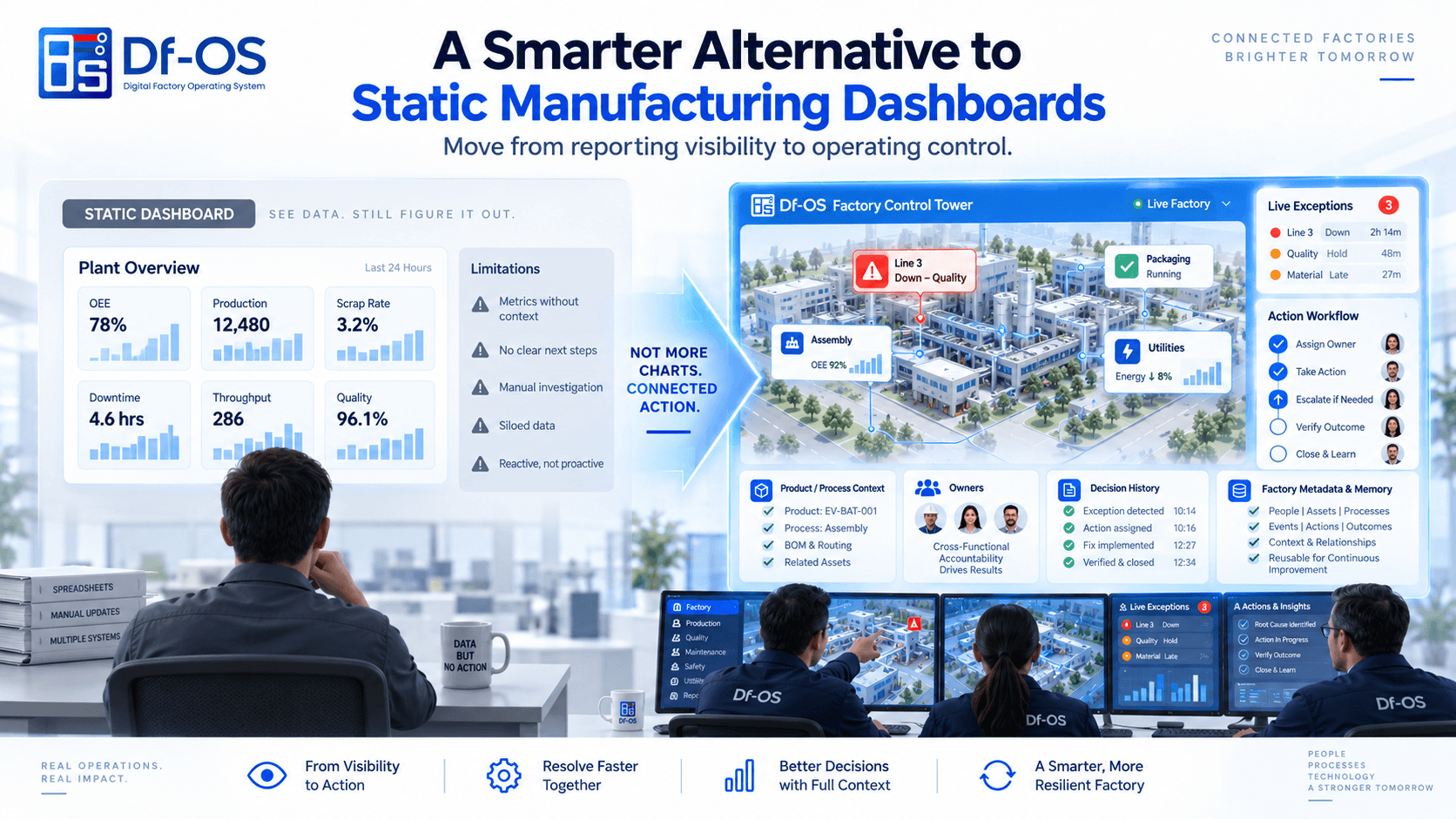
A Smarter Alternative to Static Manufacturing Dashboards
A comparison of static manufacturing dashboards and a connected Factory Control Tower that links metrics to live events, context, owners, workflows, escalation and verified closure.
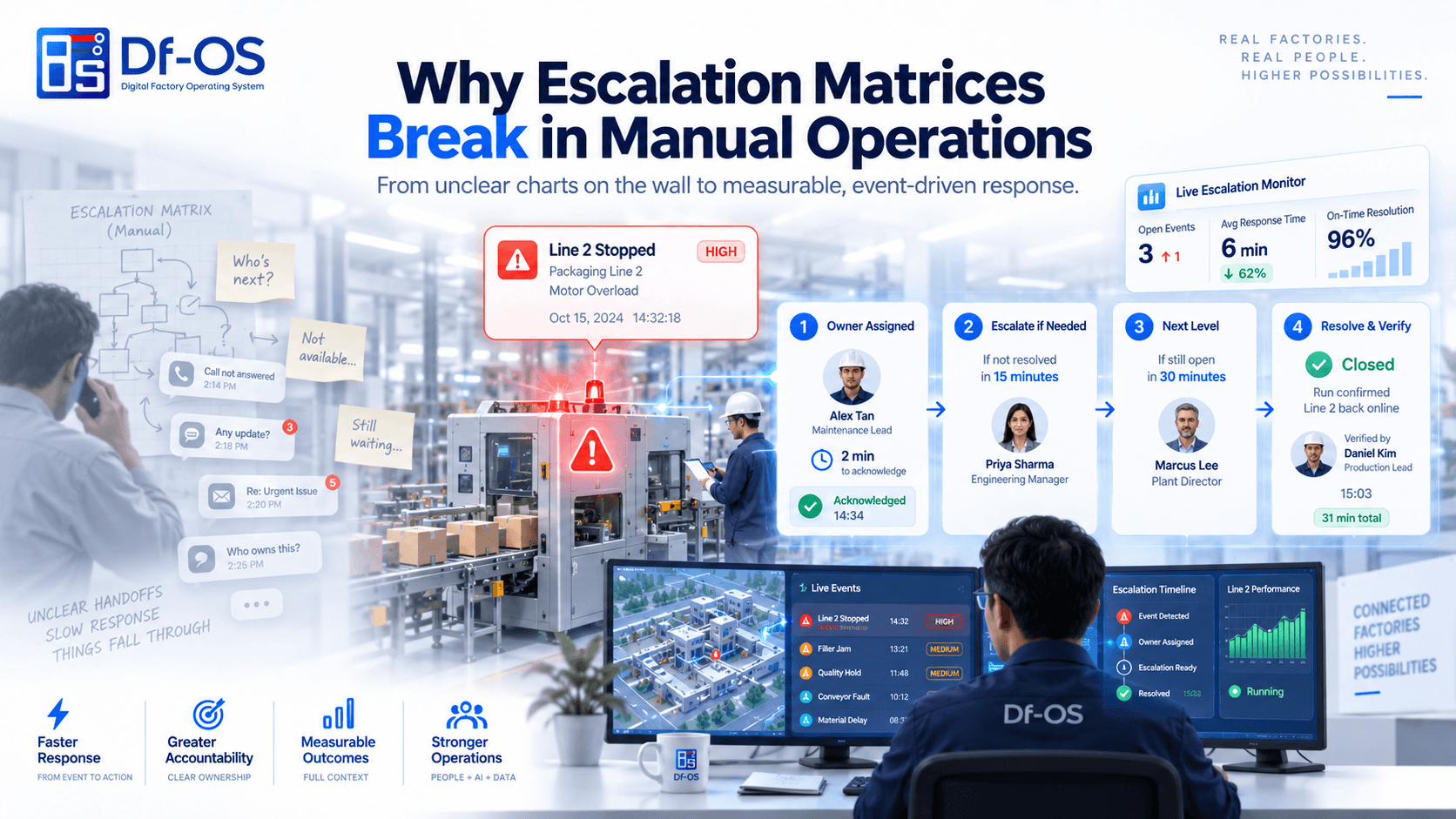
Why Escalation Matrices Break in Manual Operations
Why manual factory escalation matrices fail and how event-driven workflows connect measurable triggers, ownership, response time, escalation, closure evidence and learning.
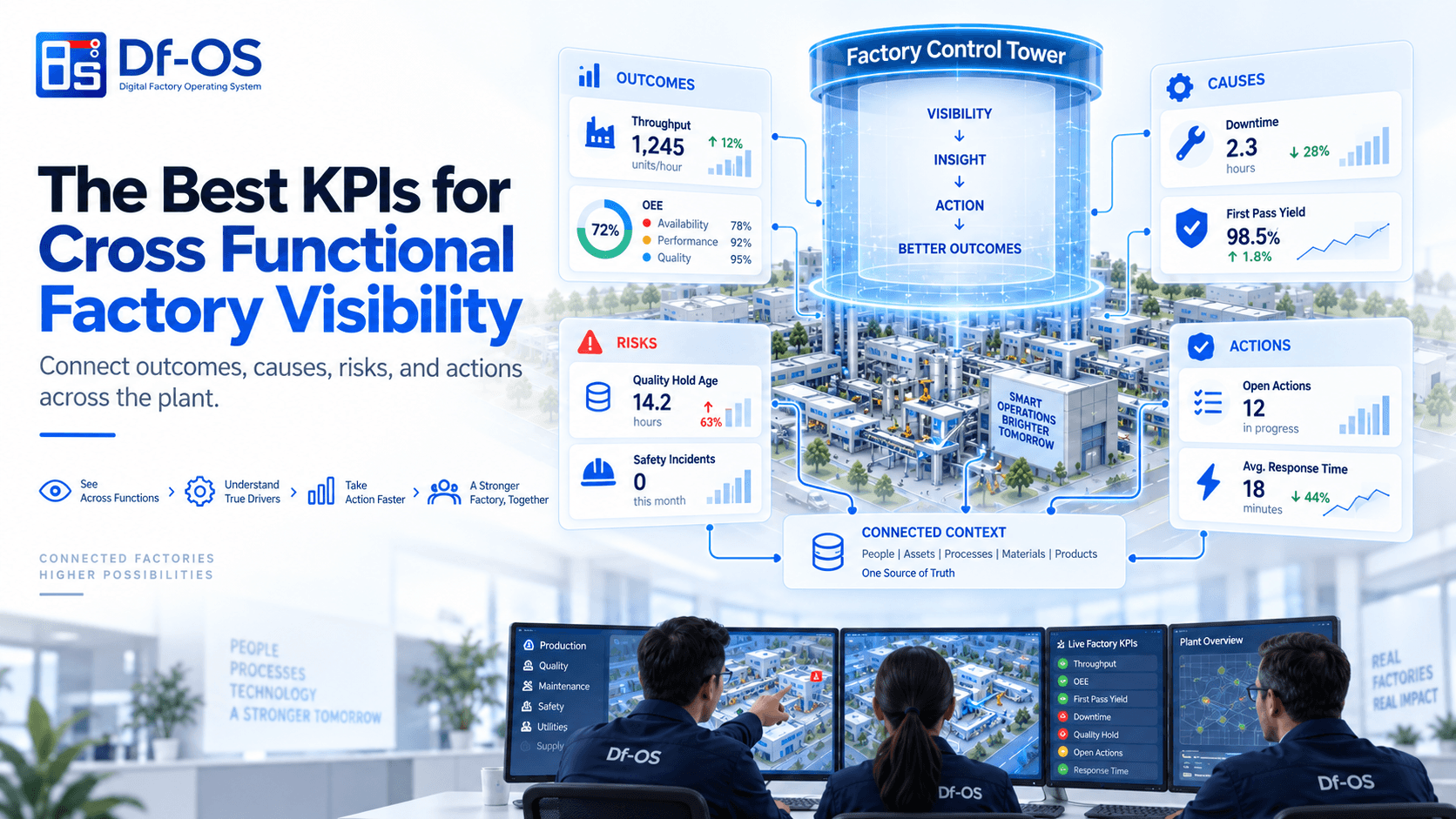
The Best KPIs for Cross Functional Factory Visibility
A four-level KPI framework connecting plant outcomes, operating causes, forward risks and action closure across production, quality, maintenance, safety and utilities.