
Why Brownfield Factories Need a Modern Operating Layer

Brownfield factories need a modern operating layer because their critical operations are spread across legacy machines, PLCs, SCADA, ERP, paper, spreadsheets and informal communication. An operating layer connects these assets and workflows without requiring a complete rip and replace programme.
Most factories were not designed as one digital system. They evolved.
A new machine was added to meet demand. A PLC was upgraded during a shutdown. ERP was introduced at the enterprise level. A historian captured process data. Quality retained its own records. Maintenance adopted a different tool. Supervisors continued to use spreadsheets because they were flexible and familiar.
The result is not necessarily bad technology. It is a fragmented operating environment built over time.
Brownfield factories need a modern operating layer because replacing everything that works is rarely practical. The more credible path is to connect existing assets, digitise critical workflows and improve one operating loop at a time.
The reality of a brownfield plant
A brownfield factory may contain:
- Machines from different generations and vendors
- Multiple PLC and control platforms
- Local HMIs and SCADA systems
- Historians that store signals but not workflow context
- ERP and MES systems with defined transaction boundaries
- Paper logbooks and checksheets
- Spreadsheet based daily reviews
- Informal communication for escalation
- Different practices across lines and plants
This environment creates two common mistakes.
The first is to assume that no meaningful progress is possible until all machines are modernised. The second is to design a large replacement programme that introduces cost, delay and operational risk.
A modern operating layer provides another option.
What an operating layer does
An operating layer connects the work around the existing technology estate.
It can:
- Digitise inspections, logbooks and shift handovers
- Connect machine events to owned workflows
- Integrate ERP, MES, PLC, SCADA and database context
- Standardise escalation and action closure
- Create cross-functional visibility
- Build Factory Metadata & Memory
- Provide context for Vish AI
The layer does not need to control every machine directly. It needs to connect the information and action required to run the factory better.
A practical five step pathway

1. Connect the priority problem
Begin with an operating loss that matters. It may be recurring downtime, delayed quality release, manual shift reporting or poor energy visibility.
The first scope should be measurable and cross-functional enough to prove the value of connection.
2. Digitise the workflow
Map how the work is done today. Identify the trigger, owner, approval, escalation and closure.
A digital workflow should improve the process, not simply reproduce the current form.
3. Add machine and system context
Connect the signals and records that explain the workflow. X-Konnect can bring PLC, sensor and machine data into Df-OS. ERP or MES can provide product, order and batch context.
4. Build Factory Metadata & Memory
Preserve the event, conditions, response and outcome. This creates a reusable operating record and prevents the learning from remaining inside individuals.
5. Improve and progressively automate
Once the loop is reliable, the plant can add alerts, recommendations, guided actions and selected bounded automation.
This sequence allows the factory to modernise without waiting for a perfect architecture.
Why workflow digitisation often comes first
Some plants delay transformation because machine connectivity is incomplete.
However, many operating problems can be improved before every asset is connected. Shift handovers, quality inspections, maintenance response, permit workflows, RCA, CAPA and daily reviews can be digitised using a mix of manual input and available system data.
This creates immediate structure and prepares the factory for deeper connectivity later.
The sequence should follow business value, not a technology checklist.
The role of X-Konnect
X-Konnect connects machines, sensors, PLCs and legacy assets to the Df-OS operating layer.
Its role is to take live machine signals and place them in operating context. A signal can then trigger a workflow, update a Control Tower, create an exception or contribute to Factory Metadata & Memory.
This is more useful than collecting additional telemetry without changing the response process.
How brownfield modernisation supports autonomy
Autonomous operations are possible in a brownfield plant when the scope is defined carefully.
A factory may not automate every decision, but it can create autonomous loops around selected areas:
- Automatic downtime detection and task routing
- Quality containment based on defined conditions
- Utility anomaly detection linked to operating schedules
- Preventive action based on repeat failure patterns
- Prioritised shift review based on unresolved exceptions
Each loop depends on connected signals, context, workflow ownership and verified outcomes.
Common brownfield mistakes
Starting with a full factory scope
Large scope increases integration complexity and makes value harder to prove. Start with a meaningful operating loop.
Collecting data without changing work
More data does not improve performance if the response remains manual and unclear.
Ignoring frontline adoption
A workflow that adds recording effort without helping the operator will fail.
Treating every legacy system as a problem
Some existing systems should remain. The task is to define their role and connect the gaps around them.
Designing without data ownership
The architecture should identify which system owns each object, event and decision.
A brownfield readiness checklist
Before beginning, confirm:
- The priority operating problem and business owner
- The current workflow and response delay
- The machine and system sources involved
- The minimum data required for context
- The roles responsible for action and approval
- The result that will prove value
- The integration and security boundaries
- The plan to expand after the first loop works
The Df-OS approach
Df-OS is designed around the principle of disrupt without disruption.
The platform can digitise factory workflows, connect machine context through X-Konnect and preserve Factory Metadata & Memory without forcing a complete replacement of ERP, MES, PLC or SCADA systems.
Vish AI can then use the connected operating record to support explanations, recommendations and guided decisions.
Final perspective
Brownfield factories are not a temporary stage on the way to a perfect greenfield future. They are the operating reality of global manufacturing.
The right transformation strategy respects that reality. It connects existing strengths, removes fragmentation and builds autonomy in controlled steps.
A modern operating layer makes that progression possible.
Discuss Your Brownfield Factory Architecture
Connect legacy PLCs, SCADA, and manual shift checksheets into one real-time operational layer with zero production downtime.
Frequently Asked Questions
No. Many improvements begin by digitising workflows and connecting available signals from existing assets.
Stay Ahead of Manufacturing AI
Join 15,000+ plant managers and industrial leaders receiving our bi-weekly reports on AI agents, shopfloor data operations, and the future of smart factories.
Df-OS Editorial Board
Industry experts mapping the future of connected digital factory operating systems and manufacturing intelligence.
Related Insights & Guides
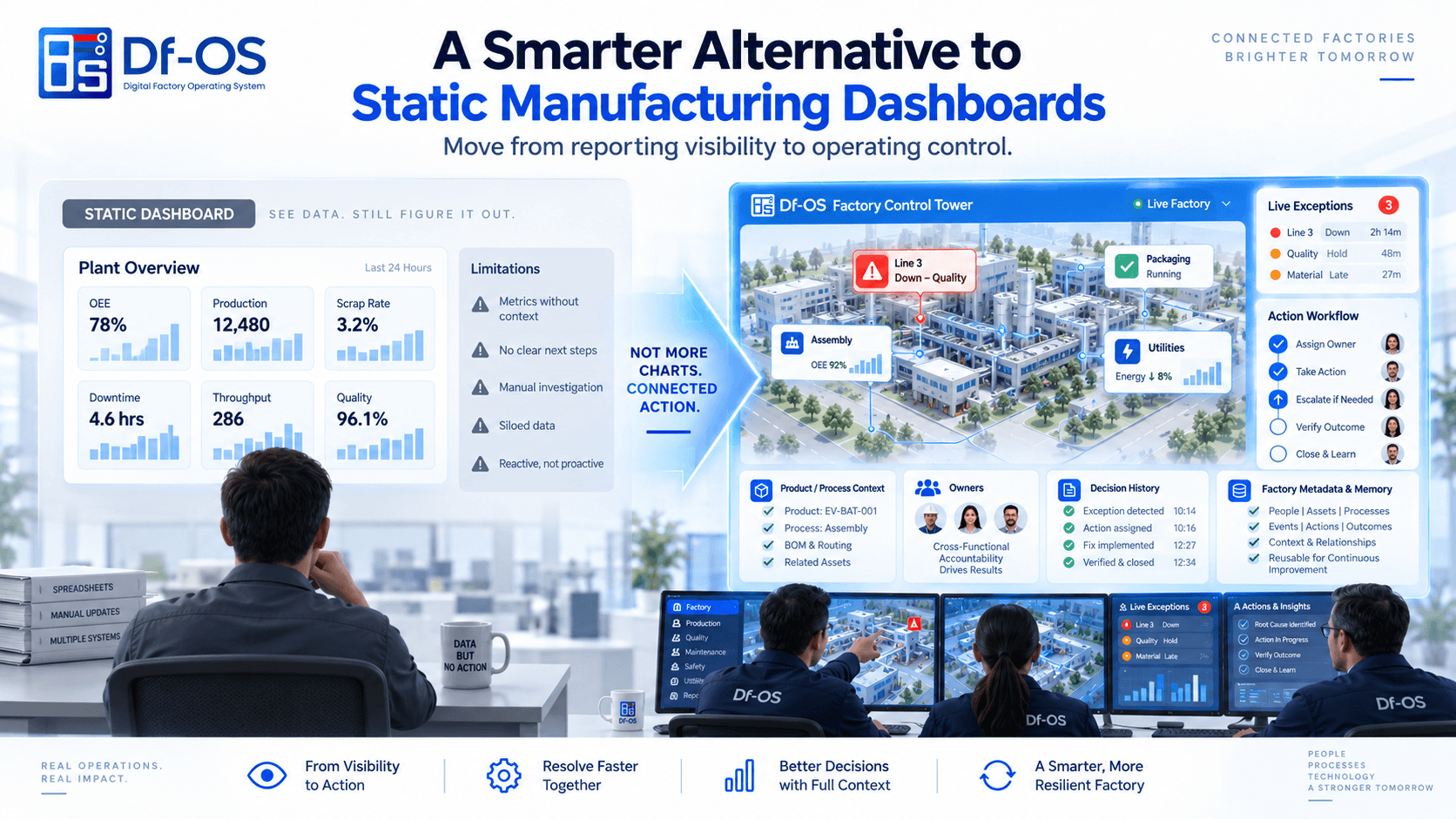
A Smarter Alternative to Static Manufacturing Dashboards
A comparison of static manufacturing dashboards and a connected Factory Control Tower that links metrics to live events, context, owners, workflows, escalation and verified closure.
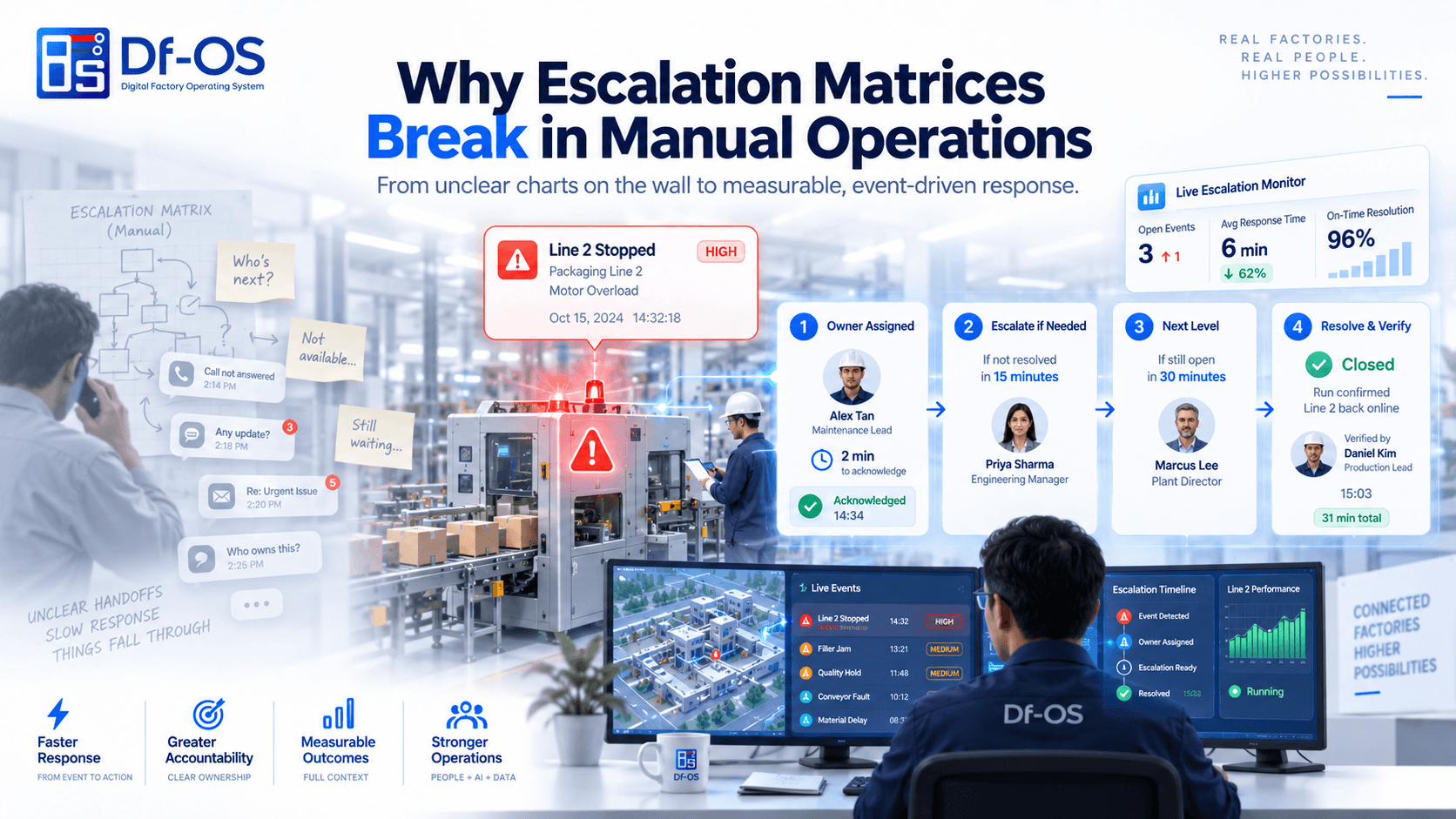
Why Escalation Matrices Break in Manual Operations
Why manual factory escalation matrices fail and how event-driven workflows connect measurable triggers, ownership, response time, escalation, closure evidence and learning.
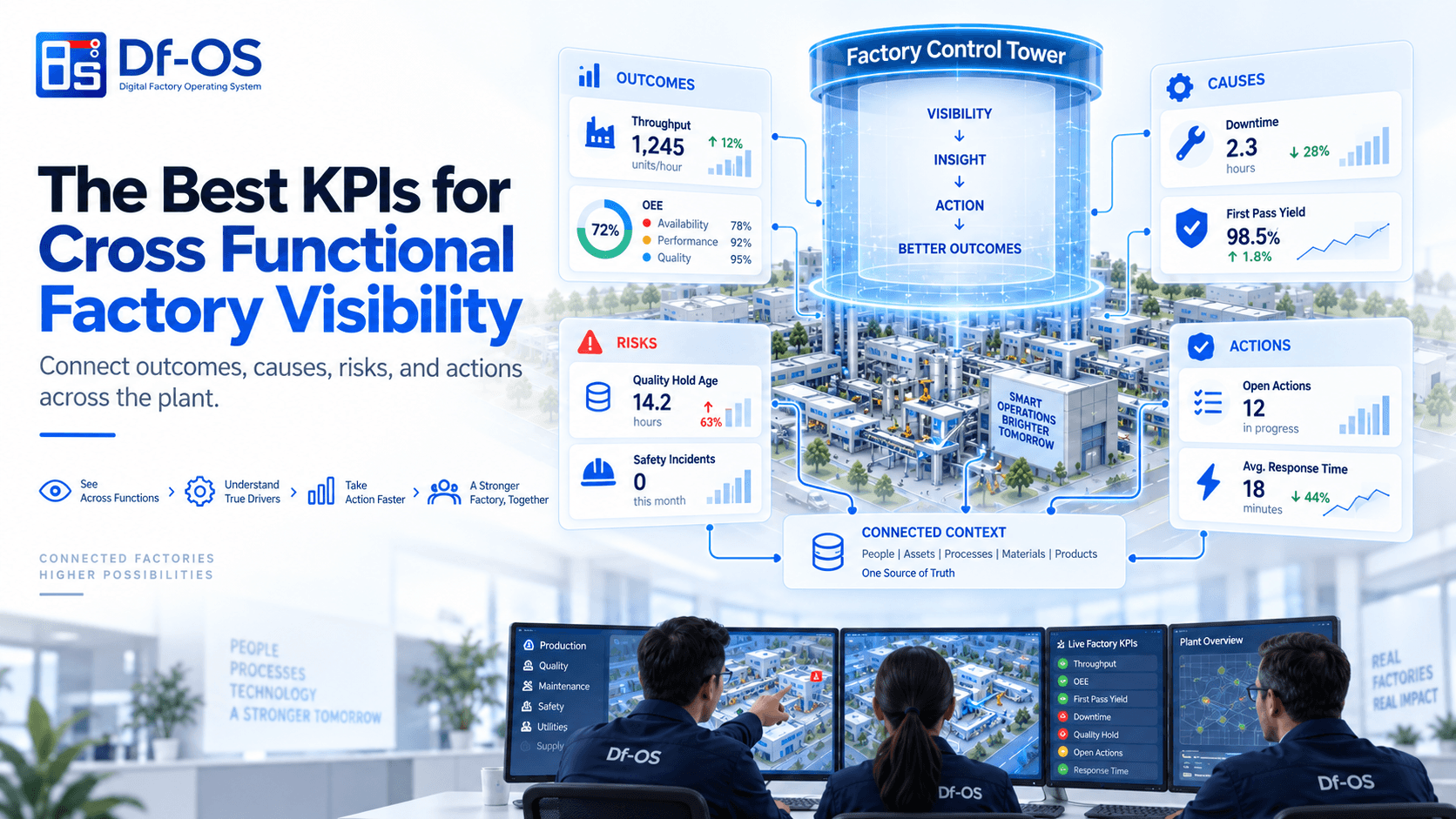
The Best KPIs for Cross Functional Factory Visibility
A four-level KPI framework connecting plant outcomes, operating causes, forward risks and action closure across production, quality, maintenance, safety and utilities.