
AI in Indian Manufacturing: Moving from Pilots to Operating Capability

Indian manufacturers can move from AI pilots to operating capability by standardising critical workflows, connecting brownfield machines and systems, creating Factory Metadata & Memory and embedding recommendations into owned decision processes. The priority is not the model alone. It is the operating context and adoption around it.
Indian manufacturing does not need more isolated demonstrations of intelligence. It needs operating capability.
A pilot can predict a failure, classify a defect or answer a question. Operating capability means the result is connected to the shift, the owner, the workflow, the approval and the next action. It works repeatedly, under real factory conditions, across changing products, people and priorities.
This is the gap many manufacturers now need to close.
Why pilots struggle to scale
The model is rarely the only problem.
A factory pilot may perform well in a controlled scope and still fail to become part of daily operations. Common reasons include:
- Machine data is available but operating context is missing
- Workflows differ across shifts or plants
- The recommendation sits outside the system where action is owned
- Operators do not trust or understand the output
- Maintenance, production and quality use different records
- There is no clear process for review, approval and override
- The result cannot be repeated on another line
These are operating system problems.
The Indian brownfield advantage and constraint
Indian manufacturing includes modern greenfield plants, global scale operations and a large brownfield base.
Brownfield reality creates constraints. Machines come from different generations. Connectivity varies. Paper and spreadsheets remain common. Digital maturity differs between plants.
It also creates an advantage.
A manufacturer that can connect this mixed environment without replacing everything can create value quickly. The opportunity is not to wait for the perfect plant. It is to build a digital operating layer around the plant that exists.
Five readiness conditions for scalable industrial intelligence
1. Standardised operating workflows
Before a system can recommend action, the factory needs to define how the action should be owned and completed.
Shift handover, downtime response, deviation management, RCA, CAPA and daily review should have clear triggers, roles and closure rules.
2. Connected machine and system context
A sensor signal must be linked to product, process, shift and operating condition. ERP, MES, PLC, SCADA and workflow data need defined integration roles.
3. Factory Metadata & Memory
The factory needs a connected record of events, actions and outcomes.
This allows the organisation to learn from recurring failures and gives Vish AI a reliable context for explanation and recommendation.
4. Human ownership and trust
The people who use the recommendation must understand what it means, when it applies and how to override it.
Industrial intelligence should support judgement before it attempts to replace judgement.
5. A path from insight to action
Every use case should define what happens after the insight.
Who receives it? What decision is expected? How quickly? What evidence is required? How will the result be verified?
Without this path, the use case remains a report.
Where Indian manufacturers can create value first
The strongest first use cases are often not the most dramatic. They are the ones where delay, variation and manual coordination create recurring loss.
Downtime response
Connect machine events with technician routing, operator context and repeat failure history.
Quality deviation
Link inspection, process conditions, material context, containment and CAPA.
Shift handover
Create one structured record of output, issues, risks and pending actions.
Utility loss
Compare energy, water or compressed air consumption with production schedules and equipment condition.
Daily factory review
Prepare the review around exceptions, owners and unresolved actions instead of manual report compilation.
These use cases create the operating discipline needed for more advanced intelligence later.
From connected operations to the Autonomous Factory
The Autonomous Factory should be understood as a maturity path.
Indian manufacturers can progress through:
- 1. Connected visibility
- 2. Contextual explanation
- 3. Decision support
- 4. Guided action
- 5. Bounded closed loop execution
A plant does not need to automate every decision. It can create selected autonomous operations around stable, high frequency processes while keeping people in control of complex and high consequence decisions.
The role of Df-OS
Df-OS provides the connected operating layer required to move beyond pilots.
Df-OS digitises factory workflows. X-Konnect connects legacy machines and signals. Factory Metadata & Memory preserves the operating context. Vish AI uses this context to answer questions, explain deviations and support action.
This approach fits the practical needs of Indian manufacturing because it can begin with existing assets and expand in phases.
A first programme design

A manufacturer can structure the first 90 days around one plant and one problem.
First 30 days
Map the workflow, data sources, ownership and baseline.
Next 30 days
Digitise the operating loop and connect the minimum machine and system context.
Final 30 days
Measure response, adoption and result. Identify what is required to repeat the use case on another line.
The output should be more than a working pilot. It should be a repeatable operating pattern.
Questions for leadership
- Which factory decisions are slow because context is fragmented?
- Which recurring losses depend on individual experience?
- Which reports arrive after the action window?
- Which use case can prove measurable value within one plant?
- Which system will own the action and closure?
- How will the learning be reused?
- What must be standardised before the second deployment?
Final perspective
The next phase of intelligence in Indian manufacturing will be defined by integration with daily operations.
The winners will not be the factories with the largest number of pilots. They will be the factories that turn operating events into Factory Metadata & Memory, connect recommendations to action and scale the learning across plants.
That is how a pilot becomes capability.
Move from Isolated AI Pilots to Operating Capability
See how Indian discrete and process manufacturers deploy Vish AI and X-Konnect across plants in under 90 days.
Frequently Asked Questions
The main barrier is often fragmented operating context and unclear workflow ownership, not the lack of algorithms.
Stay Ahead of Manufacturing AI
Join 15,000+ plant managers and industrial leaders receiving our bi-weekly reports on AI agents, shopfloor data operations, and the future of smart factories.
Df-OS Editorial Board
Industry experts mapping the future of connected digital factory operating systems and manufacturing intelligence.
Related Insights & Guides
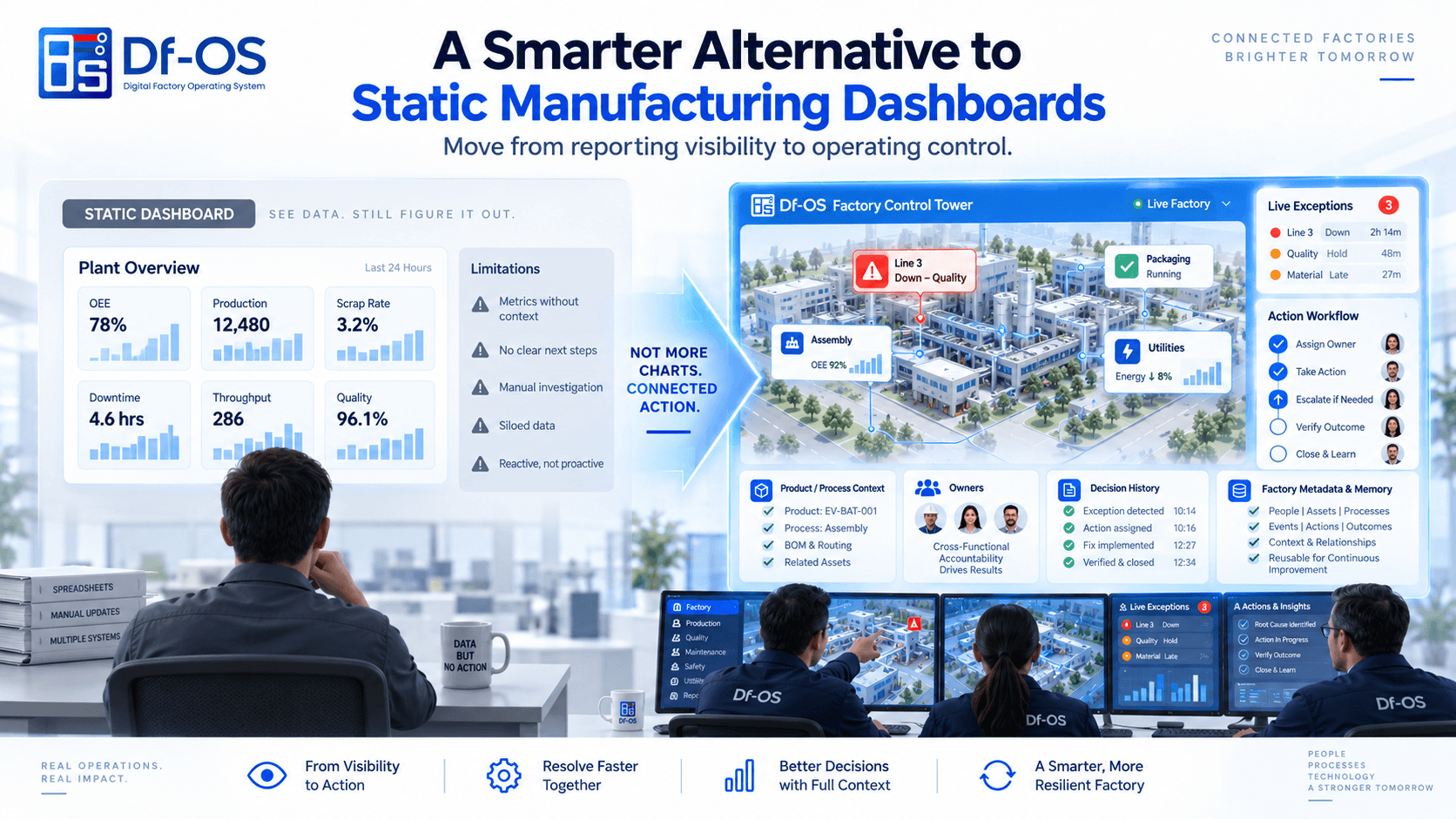
A Smarter Alternative to Static Manufacturing Dashboards
A comparison of static manufacturing dashboards and a connected Factory Control Tower that links metrics to live events, context, owners, workflows, escalation and verified closure.
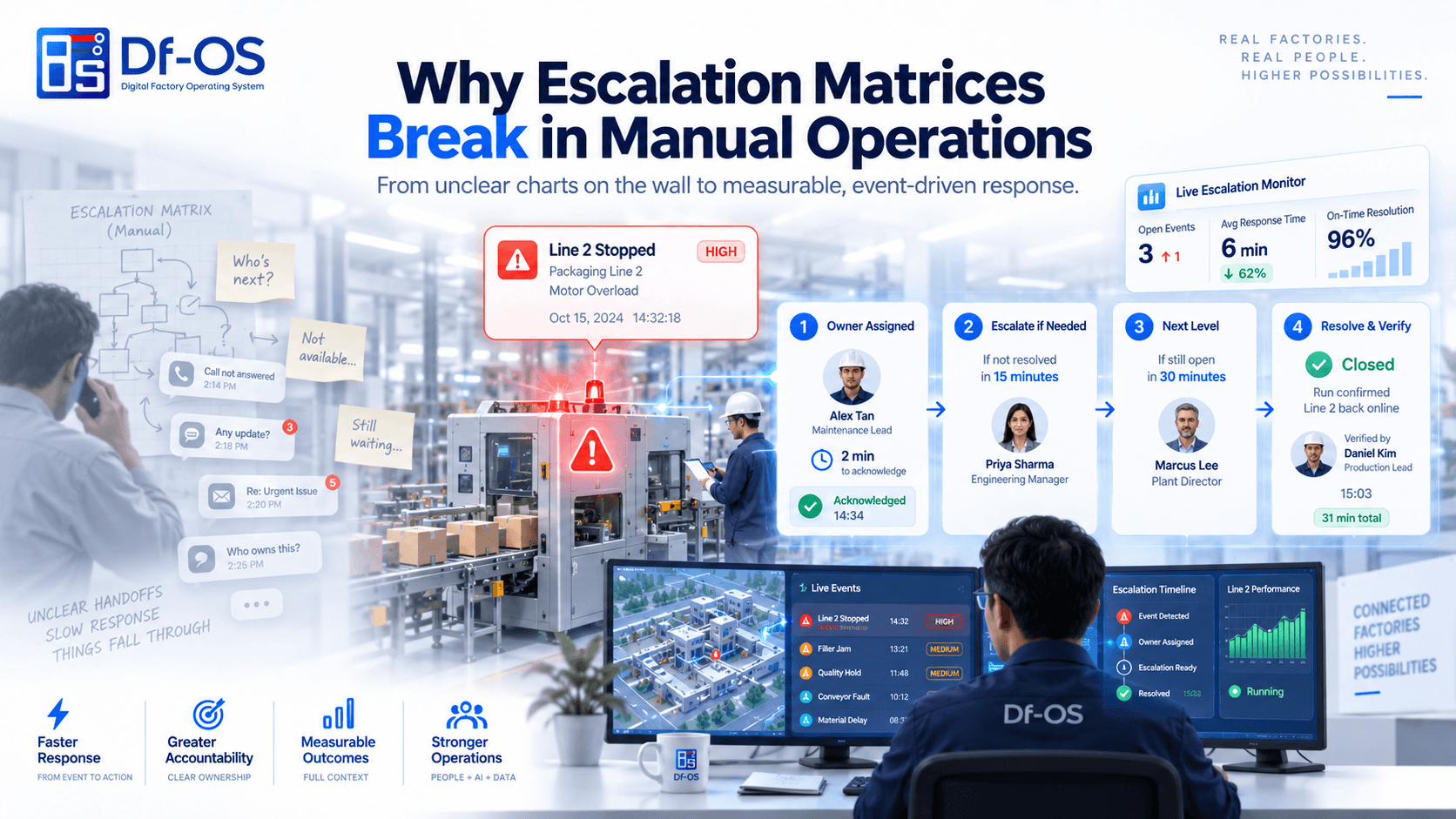
Why Escalation Matrices Break in Manual Operations
Why manual factory escalation matrices fail and how event-driven workflows connect measurable triggers, ownership, response time, escalation, closure evidence and learning.
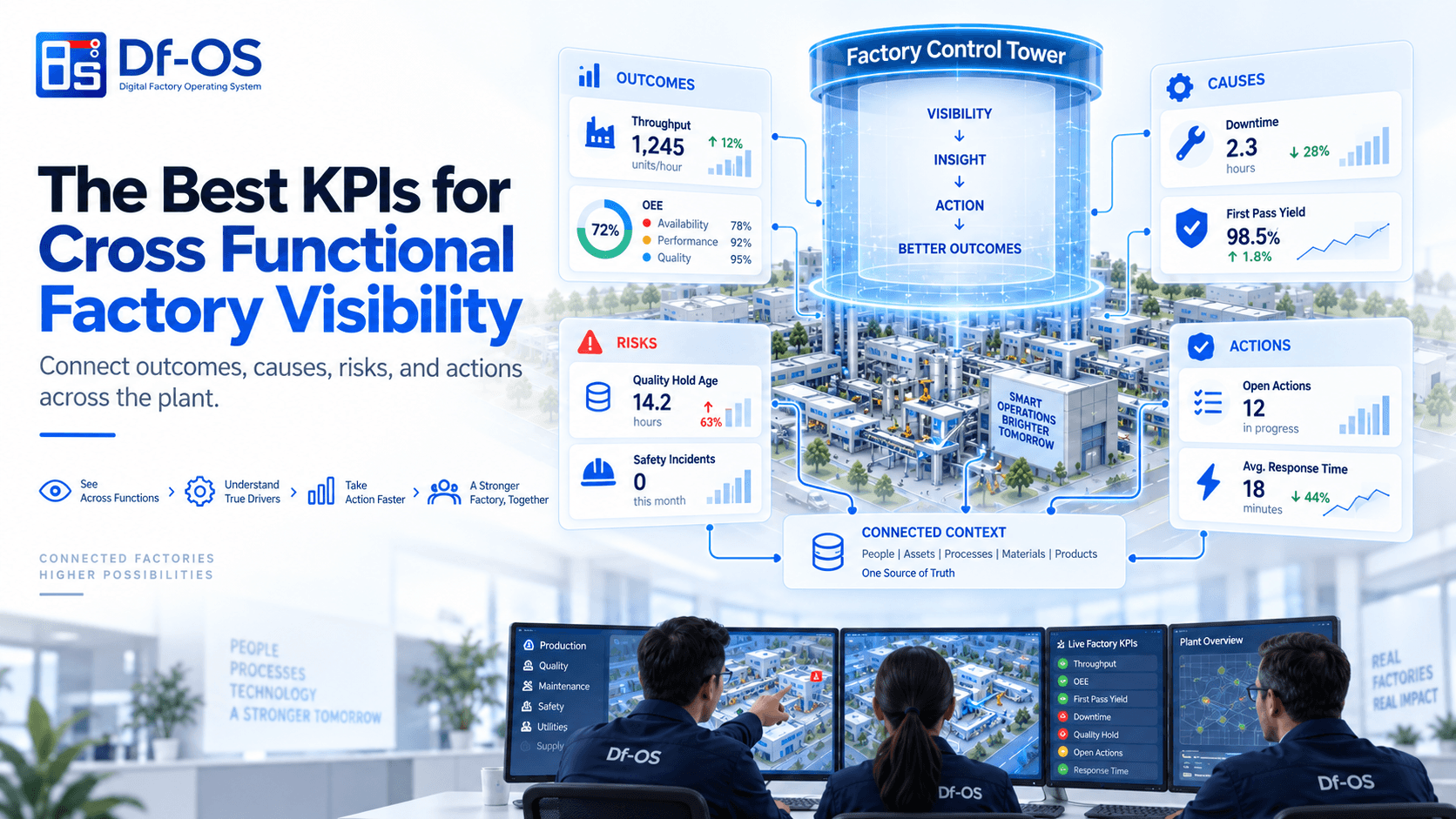
The Best KPIs for Cross Functional Factory Visibility
A four-level KPI framework connecting plant outcomes, operating causes, forward risks and action closure across production, quality, maintenance, safety and utilities.