
Industry 4.0 vs Industry 5.0: What Changes for Factory Leaders?

Industry 4.0 focuses on connected, automated and data driven manufacturing. Industry 5.0 builds on that foundation by placing human centricity, sustainability and resilience alongside productivity. For factory leaders, the change is not less technology. It is a broader definition of value and responsibility.
Industry 4.0 asked how factories could connect machines, automate processes and use data to improve performance. Industry 5.0 asks how those capabilities can create better work, stronger resilience and more sustainable operations while preserving human accountability.
Industry 5.0 does not replace Industry 4.0

Industry 5.0 is sometimes described as the next version of industrial technology. That interpretation is incomplete.
The European Commission describes Industry 5.0 as a complement to Industry 4.0. It adds three priorities:
Human centricity
Sustainability
Resilience
These priorities change how a factory evaluates transformation.
A project should not be judged only by whether it increases output. Leaders should also ask whether it improves work, reduces vulnerability, supports resource efficiency and creates a responsible operating model.
The practical difference
Dimension
Industry 4.0 emphasis
Industry 5.0 emphasis
Technology
Connectivity, automation, cyber physical systems and data
Trustworthy collaboration between people and intelligent systems
Primary outcome
Productivity and efficiency
Productivity with human, environmental and resilience outcomes
Workforce
User and operator of digital systems
Central participant whose skills, safety and judgement shape the system
Sustainability
Often a use case or programme
A core operating objective
Resilience
Improved through visibility and automation
Designed explicitly into operations and supply networks
Decision model
More automated and data driven
Human governed, explainable and accountable
Industry 4.0 provides much of the technical foundation. Industry 5.0 changes the operating design around it.
What human centricity means on the shopfloor
Human centricity is not a statement that every decision must remain manual.
It means technology should be designed around the capabilities, safety and responsibilities of the people who use it.
A human centred factory should:
- Reduce avoidable recording and report preparation
- Give operators useful context at the point of work
- Make system recommendations understandable
- Preserve the ability to stop or override an action
- Support reskilling as roles change
- Use automation to remove delay and risk, not simply headcount
- Measure whether frontline adoption improves the process
This matters as factories progress toward autonomous operations. The more a system can recommend or execute, the more clearly the organisation must define responsibility.
Sustainability becomes an operating issue
Sustainability cannot remain separate from factory execution.
Energy, water, waste, yield and emissions are created through operating decisions. A plant may have a sustainability report, but the actual performance depends on machine settings, schedules, maintenance conditions, product mix, process variation and daily behaviour.
An AI-Native Digital Factory Operating System can connect these operating factors. A Factory Control Tower can show resource loss in relation to output and process conditions. Factory Metadata & Memory can preserve what changed and whether the action improved the result.
The objective is to move from reporting sustainability to operating it.
Resilience is the ability to sense and respond
A resilient factory is not one that avoids every disruption. It is one that detects change early, understands the impact and responds without losing control.
This requires:
- Reliable operating visibility
- Clear decision rights
- Flexible workflows
- Connected supplier and material context
- Standard escalation
- Cross-functional action
- A history of how similar disruptions were handled
The same operating foundations that support autonomy also support resilience.
Industry 5.0 and the Autonomous Factory
The Autonomous Factory should not be designed as a technology first destination.
A credible model combines:
- Connected sensing
- Factory Metadata & Memory
- Explainable decision support
- Guided and bounded autonomous action
- Human governance
- Sustainability objectives
- Resilience controls
This produces a factory that can act faster without becoming less accountable.
What factory leaders should change
Review transformation goals
Do current programmes focus only on efficiency, or do they also address work design, resilience and resource performance?
Define the human role
For each intelligence or automation use case, clarify who reviews, approves, overrides and owns the outcome.
Connect operating and sustainability data
Resource performance should be linked to production context, not viewed only as monthly totals.
Build skills into deployment
Training should be designed around new decisions and workflows, not limited to software navigation.
Measure adoption as an operating result
A digital process that operators avoid is not a successful transformation.
How Df-OS supports the transition
Df-OS provides a connected operating layer across people, machines, workflows and systems. X-Konnect brings machine context into that layer. Vish AI uses Factory Metadata & Memory to explain conditions and support decisions.
This architecture allows manufacturers to pursue greater autonomy while keeping people, safety, accountability and operating outcomes in view.
Final perspective
Industry 4.0 built the foundation for connected manufacturing. Industry 5.0 broadens the purpose of that foundation.
The next factory is not simply more automated. It is more aware of people, resources and risk. It can sense, understand and act with greater speed while keeping human judgement and responsibility at the centre.
Ready to Modernize Your Factory Operating Layer?
Discover how Df-OS digitizes shopfloor workflows, connects brownfield machines, and creates Factory Metadata & Memory without rip-and-replace disruption.
Frequently Asked Questions
No. It complements Industry 4.0 by adding human centricity, sustainability and resilience to the technology and productivity agenda.
Stay Ahead of Manufacturing AI
Join 15,000+ plant managers and industrial leaders receiving our bi-weekly reports on AI agents, shopfloor data operations, and the future of smart factories.
Df-OS Editorial Board
Industry experts mapping the future of connected digital factory operating systems and manufacturing intelligence.
Related Insights & Guides
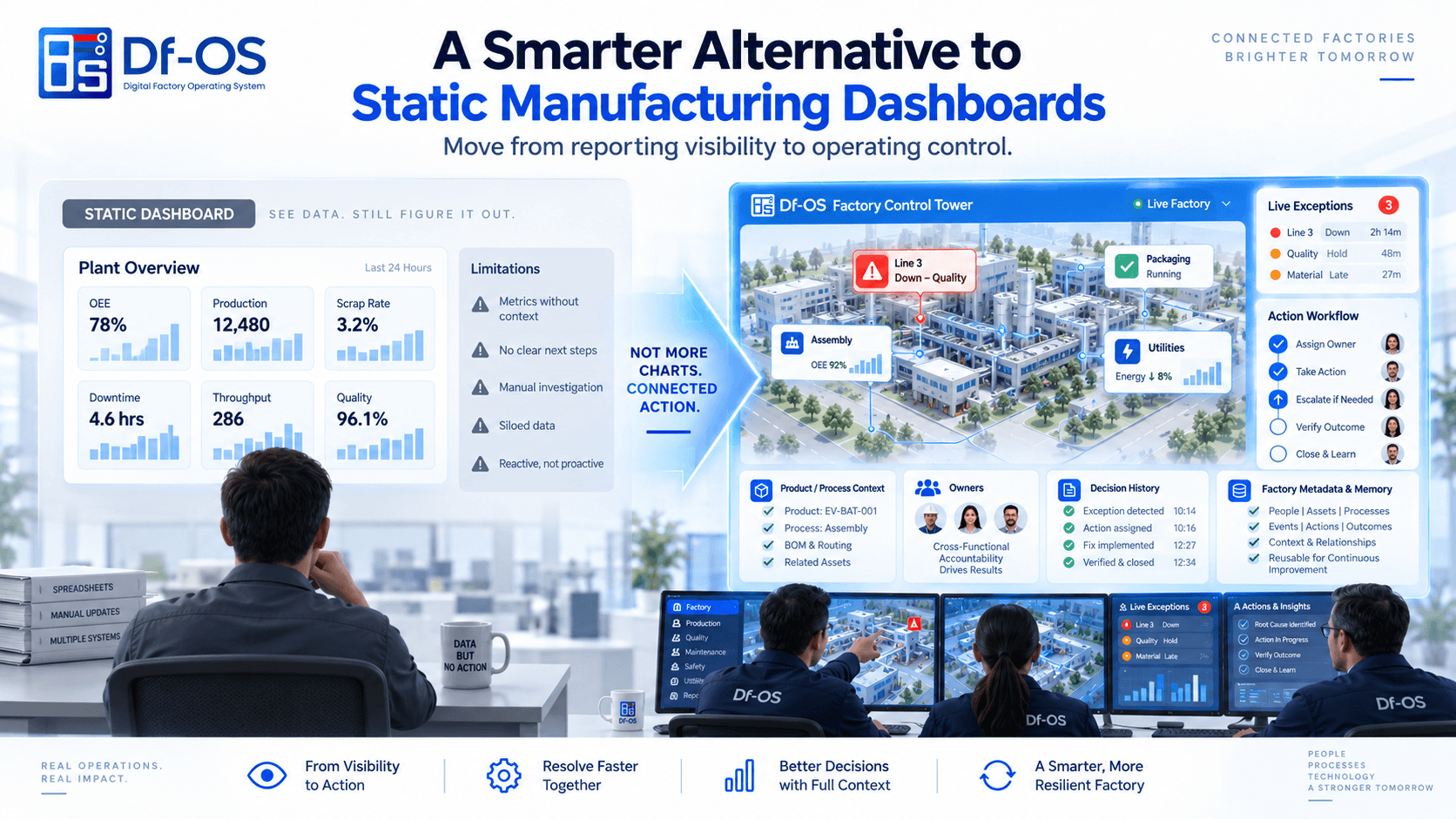
A Smarter Alternative to Static Manufacturing Dashboards
A comparison of static manufacturing dashboards and a connected Factory Control Tower that links metrics to live events, context, owners, workflows, escalation and verified closure.
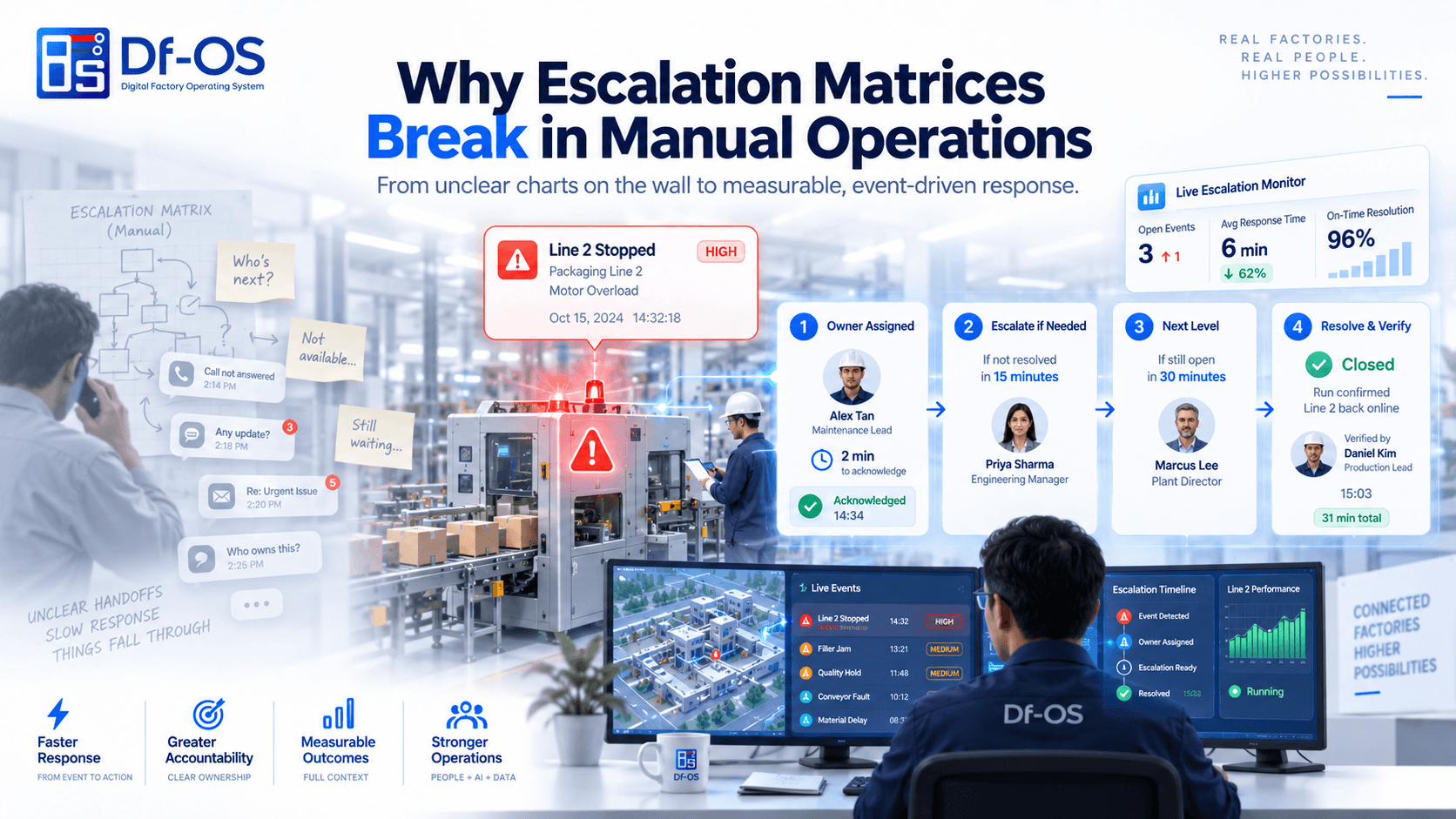
Why Escalation Matrices Break in Manual Operations
Why manual factory escalation matrices fail and how event-driven workflows connect measurable triggers, ownership, response time, escalation, closure evidence and learning.
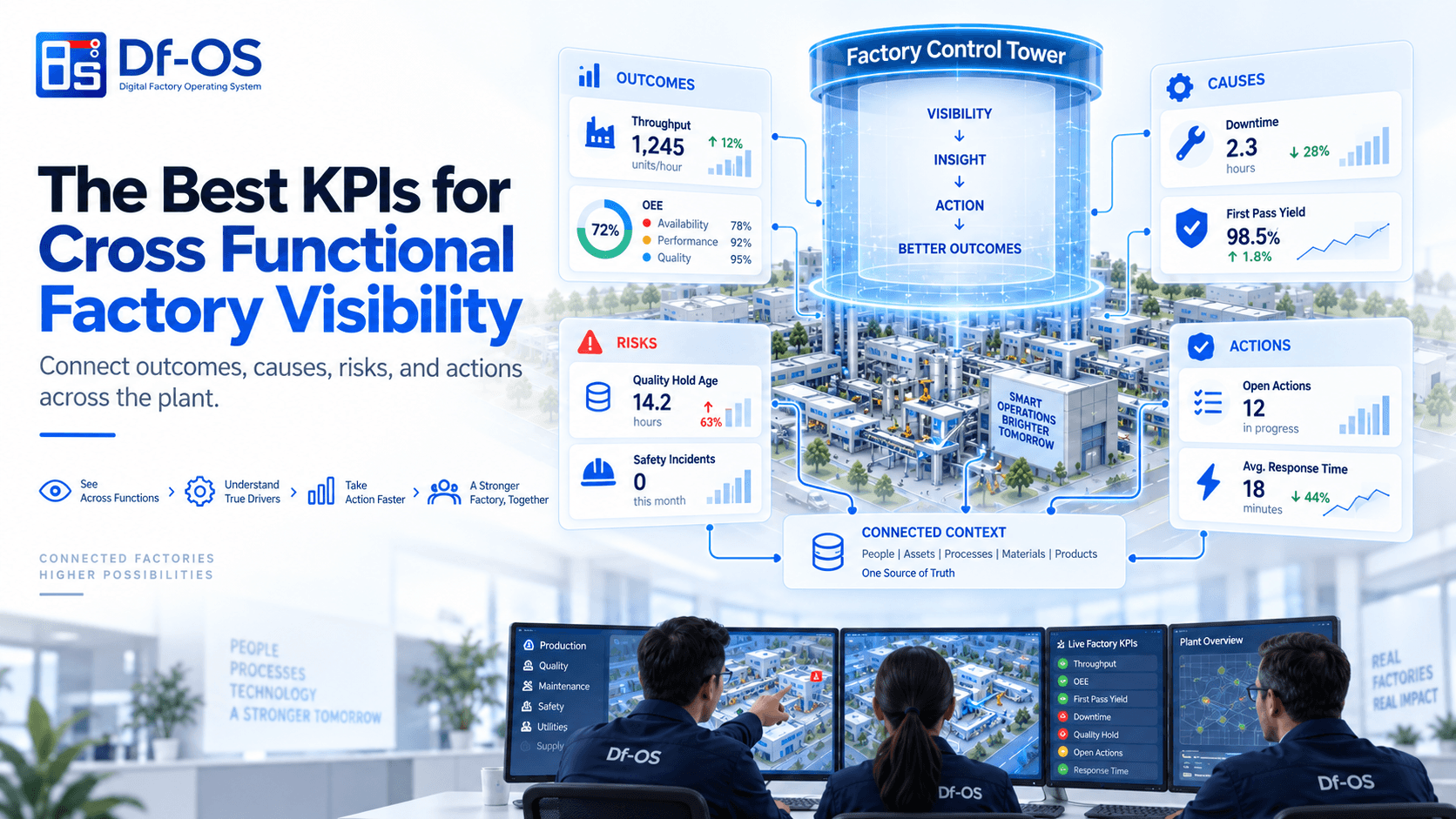
The Best KPIs for Cross Functional Factory Visibility
A four-level KPI framework connecting plant outcomes, operating causes, forward risks and action closure across production, quality, maintenance, safety and utilities.