
What WEF Lighthouse Factories Teach Mid-Market Manufacturers

WEF Lighthouse factories show that digital transformation creates value when manufacturers solve important operating problems, embed intelligence into daily work, involve the workforce and scale successful use cases. Mid-market manufacturers can apply these principles without copying the size or investment level of global leaders.
The most useful lesson from the World Economic Forum Global Lighthouse Network is not that every manufacturer needs the same technology stack.
The lesson is that transformation works when technology is tied to a clear operating problem, embedded in daily work and scaled with discipline.
In June 2026, the World Economic Forum reported that the Global Lighthouse Network had reached 238 recognised sites. The latest cohort highlighted three shifts: intelligence moving into core operations, deeper human and machine collaboration, and sustainability becoming part of operating strategy.
These signals matter to mid-market manufacturers, but they should be interpreted carefully. A plant does not become more competitive by copying a Lighthouse roadmap line by line. It becomes more competitive by adapting the underlying principles to its own constraints.
Lesson 1: Start with a business problem, not a technology theme
Lighthouse transformations are usually described through technology, but the programmes are anchored in business outcomes.
The problem may be high changeover loss, quality variation, energy intensity, service lead time, workforce constraints or supply risk.
This changes the first question from which technology should we deploy to which operating loss should we remove.
For a mid-market plant, this is an advantage. A focused problem can often be solved without an enterprise wide programme.
A strong first use case has:
- A measurable operational baseline
- A clear business owner
- A repeatable process
- Enough data or workflow context
- A result that can be verified within a practical period
Lesson 2: Scale the operating model, not only the pilot
Many manufacturers can demonstrate a pilot. Fewer can repeat it across lines and plants.
The difference is usually not the model or dashboard. It is the operating system around the use case.
Scaling requires common definitions, workflow ownership, integration patterns, training, governance and a way to preserve learning. This is where Factory Metadata & Memory becomes important.
When the first use case captures the event, context, action and outcome consistently, the organisation creates a reusable pattern rather than a one-off demonstration.
Lesson 3: Intelligence must sit inside daily work
A good insight that arrives outside the decision window has limited value.
Lighthouse sites increasingly embed intelligence into the fabric of operations. This means the recommendation appears where the work is performed and where the decision is owned.
Examples include:
- An alert connected to a maintenance task
- A quality risk connected to containment
- A production exception connected to shift review
- A utility anomaly connected to the operating schedule
- A workforce recommendation connected to planning
The lesson is simple. Intelligence must change the workflow, not only the report.
Lesson 4: People are part of the system design
The 2026 Lighthouse narrative places greater emphasis on human and machine collaboration.
This matters because transformation fails when workers experience the digital system as additional recording work rather than operational support.
A plant should involve frontline users in:
- Workflow design
- Exception definitions
- Alert thresholds
- Responsibility mapping
- Training and adoption
- Review of recommendations
The strongest use cases make work clearer and faster. They do not hide the process behind technology.
Lesson 5: Sustainability and resilience are operating outcomes
The Lighthouse Network now recognises performance across productivity, resilience, sustainability, customer centricity and talent.
This wider view is relevant to mid-market manufacturers because energy, waste, water, yield and supply disruption are not separate from plant operations. They are created through the same schedules, machines, process conditions and decisions that affect cost and output.
A connected operating layer allows the factory to examine these outcomes together.
Five principles for a mid-market transformation

A practical mid-market programme can follow five principles.
1. Choose one important operating loop
Do not begin with a long list of technologies. Select one recurring loss where action can improve the result.
2. Connect the people and data around the loop
Map the machine signals, workflows, roles, approvals and systems that influence the decision.
3. Create Factory Metadata & Memory
Preserve the conditions, action and verified outcome so the factory can learn and repeat.
4. Build adoption into the process
The use case should reduce friction for the people who operate it.
5. Design the second deployment before celebrating the first
A pilot proves possibility. The second deployment proves repeatability.
What not to copy
Mid-market manufacturers should avoid copying:
- Large technology estates without a clear use case
- Global templates that ignore local process reality
- Advanced intelligence before basic workflow discipline
- Dashboards that do not change ownership or action
- Ambitious autonomy claims without governance
The objective is not to look like a Lighthouse. It is to apply the same discipline to a scale that fits the business.
The Df-OS perspective
Df-OS helps manufacturers build a connected operating layer around existing factory systems and assets.
Df-OS digitises workflows. X-Konnect connects machines and signals. Factory Metadata & Memory preserves operating context. Vish AI uses that context to support decisions and progressive autonomous operations.
This architecture allows manufacturers to begin with a priority use case and scale the operating pattern without forcing a complete replacement programme.
A readiness checklist
Before selecting the first transformation use case, ask:
- Is the problem financially and operationally important?
- Is the current response process understood?
- Can the plant capture the event in time to act?
- Is ownership clear?
- Can the result be measured?
- Can the design be repeated on another line or plant?
- Will the use case improve work for the people involved?
- Is there a path from visibility to action?
Final perspective
Lighthouse factories are valuable because they show what disciplined industrial transformation can achieve at scale.
The right response for a mid-market manufacturer is not imitation. It is translation.
Translate the lessons into a focused operating problem. Connect the workflow and data. Preserve the learning. Prove the result. Then scale.
Translate World Economic Forum Lighthouse Lessons
Apply disciplined transformation principles to your mid-market manufacturing operations without massive enterprise overhead.
Frequently Asked Questions
It is a World Economic Forum initiative that recognises advanced manufacturing and supply chain sites that have achieved strong operational impact through scaled transformation.
Stay Ahead of Manufacturing AI
Join 15,000+ plant managers and industrial leaders receiving our bi-weekly reports on AI agents, shopfloor data operations, and the future of smart factories.
Df-OS Editorial Board
Industry experts mapping the future of connected digital factory operating systems and manufacturing intelligence.
Related Insights & Guides
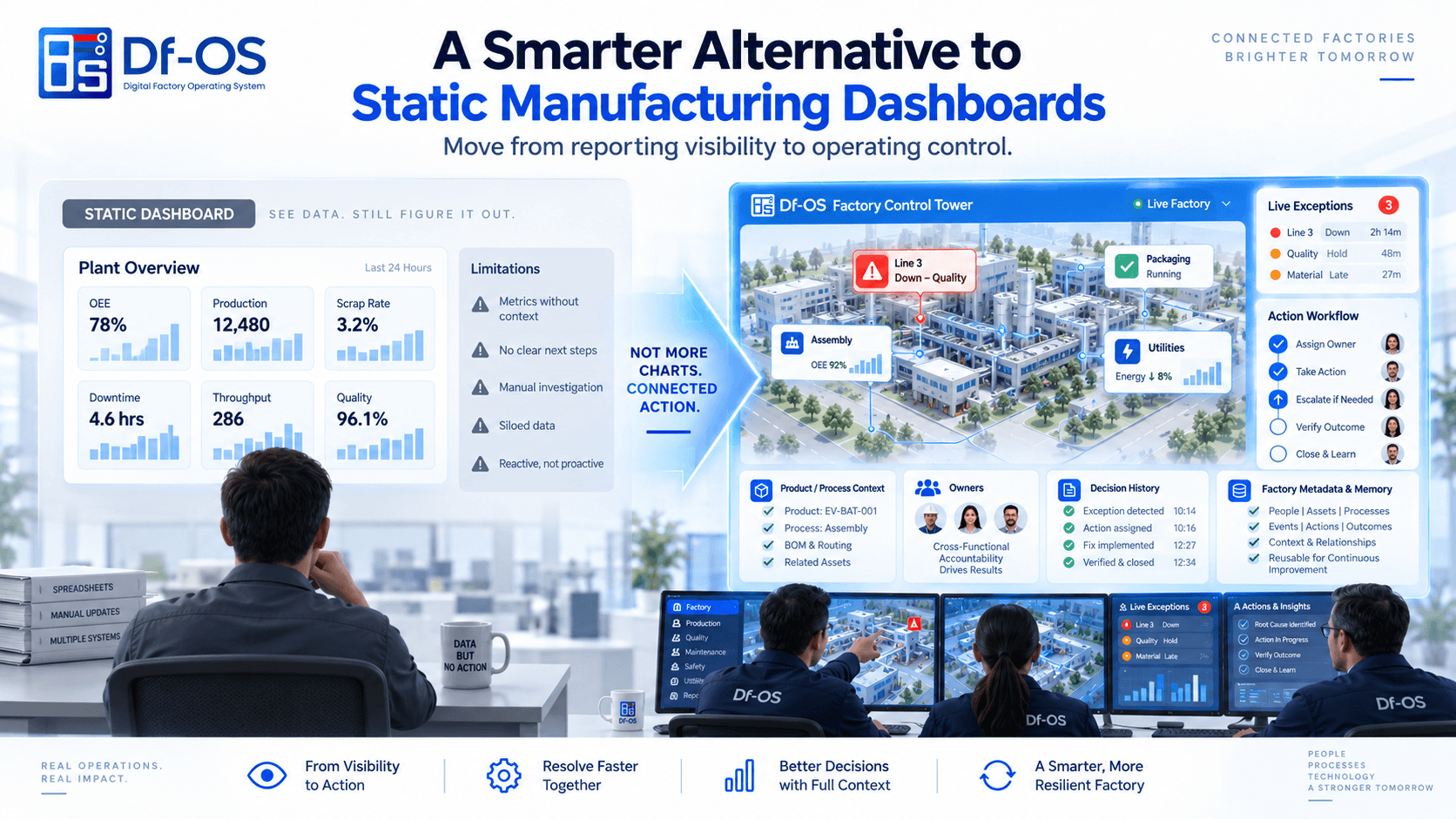
A Smarter Alternative to Static Manufacturing Dashboards
A comparison of static manufacturing dashboards and a connected Factory Control Tower that links metrics to live events, context, owners, workflows, escalation and verified closure.
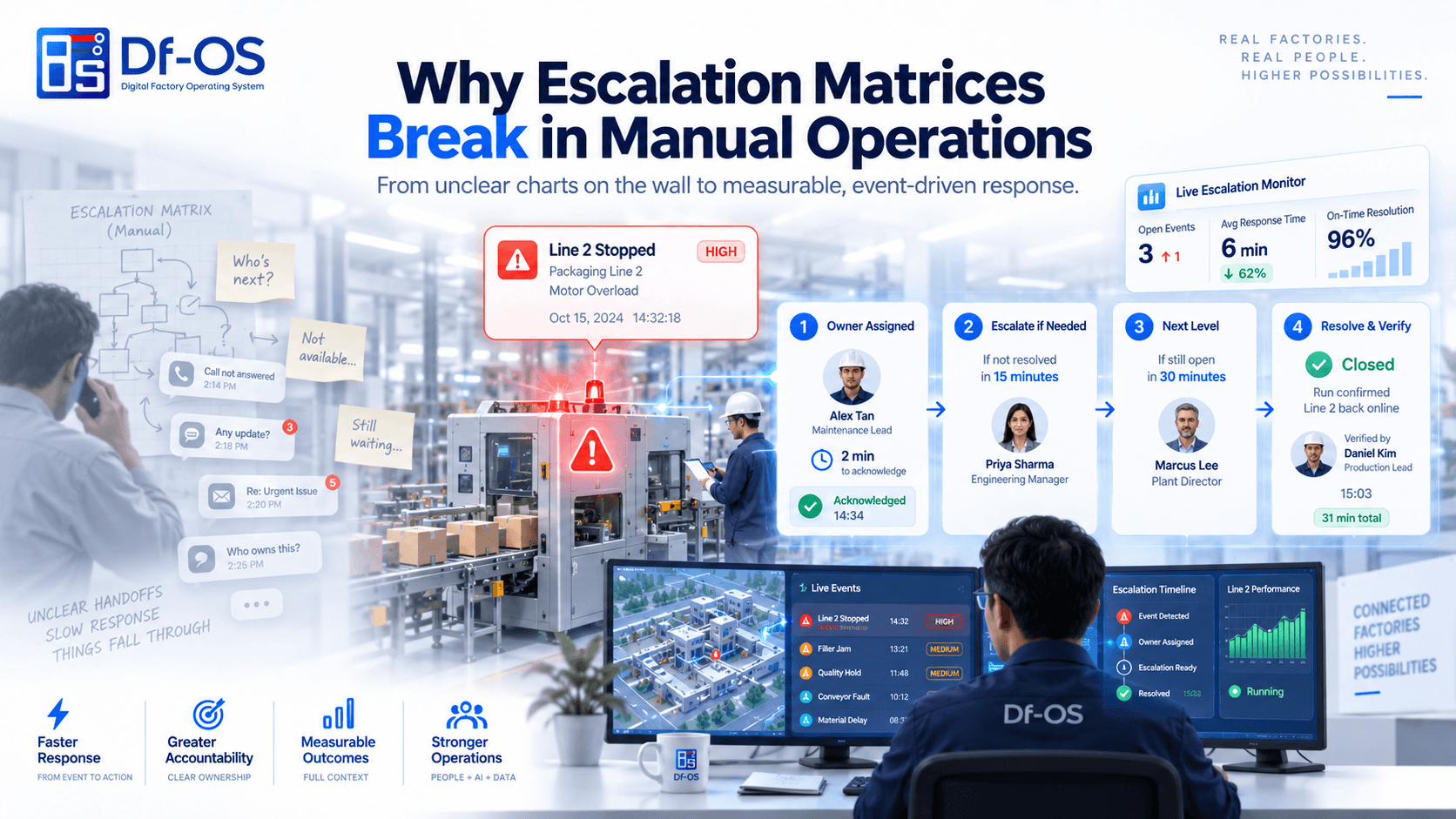
Why Escalation Matrices Break in Manual Operations
Why manual factory escalation matrices fail and how event-driven workflows connect measurable triggers, ownership, response time, escalation, closure evidence and learning.
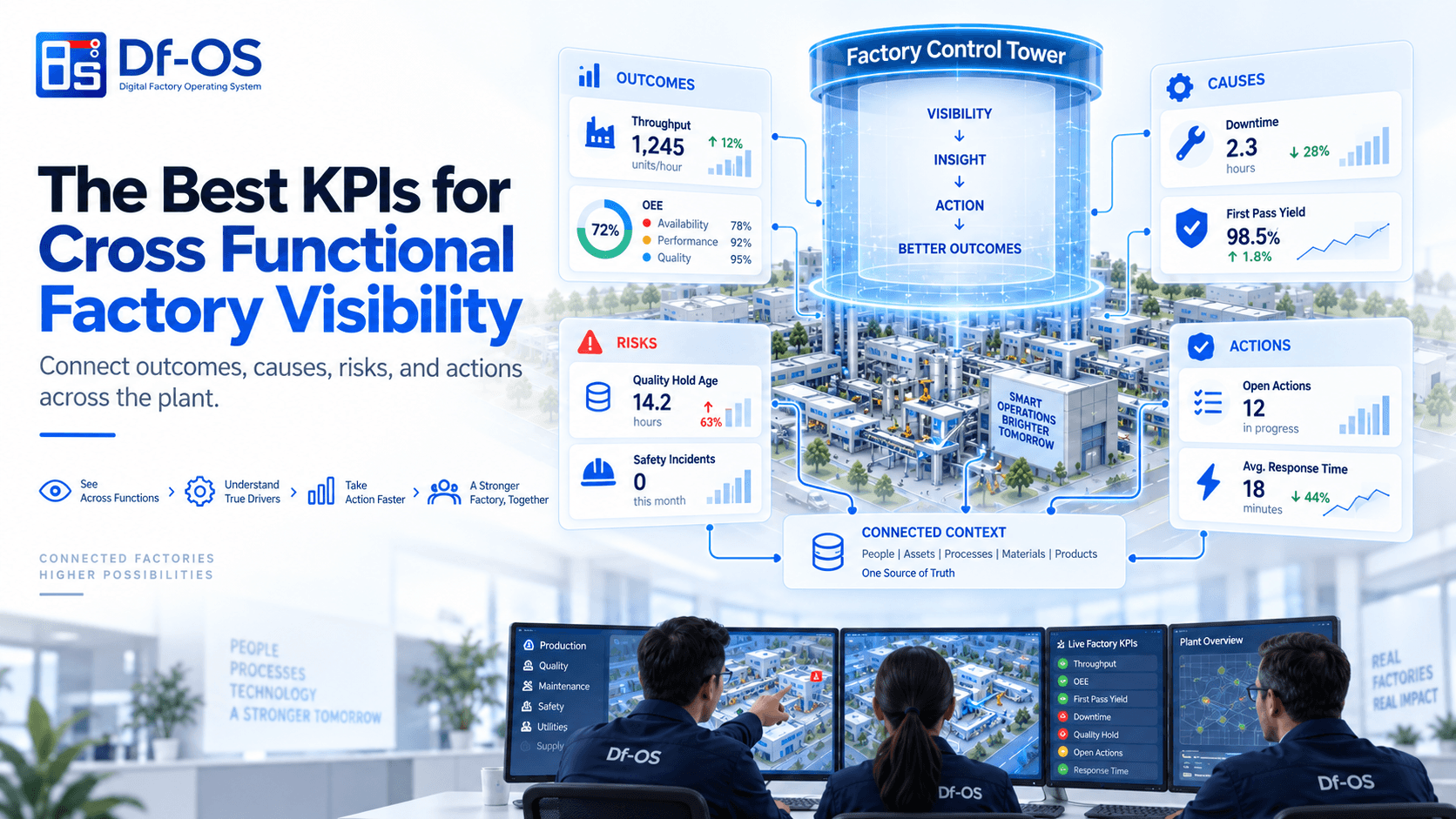
The Best KPIs for Cross Functional Factory Visibility
A four-level KPI framework connecting plant outcomes, operating causes, forward risks and action closure across production, quality, maintenance, safety and utilities.