
The Hidden Cost of Spreadsheet Operations in Factories
The spreadsheet is not the problem.
Spreadsheets are useful for analysis, planning and quick problem solving. The problem begins when a spreadsheet becomes the operating system of the plant.
A live factory process needs triggers, ownership, validation, escalation, access control and traceable closure. A spreadsheet can imitate some of these functions, but it rarely connects them reliably across people, machines and systems.
The hidden cost appears in the work around the file.
Cost 1: Repeated manual entry
A supervisor copies production counts from a machine or local screen. Quality copies inspection results. Maintenance enters breakdown time. Another person consolidates the information for the daily review.
The same event is recorded several times, often with different definitions and timestamps.
The cost is not only labour. It is the delay between the event and the decision.
Cost 2: Version conflict
A shared file can still create multiple versions through downloads, email attachments, local copies and manual changes.
Teams begin asking which file is correct. Leaders spend time reconciling information rather than resolving the operating issue.
Cost 3: Weak ownership
A cell can contain an action, but it does not always behave like an owned workflow.
There may be no automatic assignment, due time, escalation, acknowledgement or evidence of closure.
The action appears in the sheet, but the operating responsibility remains informal.
Cost 4: Late visibility
Many spreadsheets are updated at the end of the shift or before the review meeting.
By the time the loss is visible, the decision window has passed. The plant analyses yesterday instead of acting today.
Cost 5: Lost context
A spreadsheet often records the result but not the operating history.
It may show 35 minutes of downtime without the alarm sequence, product, shift observation, maintenance action and verification.
When the issue repeats, the factory begins the investigation again.
Cost 6: Fragile dependence on individuals
Complex files often depend on one person who understands the formulas, macros, naming and update routine.
When that person changes role or leaves, the process becomes difficult to maintain.
Cost 7: Audit and traceability effort
Spreadsheets can support an audit, but proving who changed what, when it changed and which approval applied can become difficult.
The team may need to gather emails, signatures and attachments to reconstruct the record.
When spreadsheets remain useful
The answer is not to ban spreadsheets.
They remain useful for:
- One-time analysis
- Scenario modelling
- Ad hoc calculations
- Personal exploration
- Early process design
- Temporary data review
They become risky when they are used for:
- Critical production records
- Quality approval
- Safety permits
- Maintenance response
- Shift handover
- Deviations and CAPA
- Real time escalation
- Multi-user action tracking
The question is whether the file is analysing the process or running the process.
A four part cost model
Time
Manual entry, consolidation, reconciliation and report preparation.
Quality
Errors, inconsistent definitions, missing fields and uncontrolled changes.
Accountability
Unclear ownership, weak escalation and incomplete closure evidence.
Decision delay
Information arrives after the plant could have acted.
These costs are often distributed across departments, which makes them difficult to see in one budget line.
How to identify the critical spreadsheets
Ask each department to list the files that would disrupt operations if they were unavailable tomorrow.
Then score each file against:
- Number of users
- Frequency of update
- Business impact
- Manual entry effort
- Approval requirement
- Need for real time action
- Audit importance
- Number of dependent reports
The highest scoring files are candidates for workflow digitisation.
From spreadsheet to operating workflow
The replacement should not simply move the same columns into a form.
A digital operating workflow should define:
- Trigger
- Required context
- Validation
- Owner
- Approval
- Escalation
- Evidence
- Closure
- Reporting
- Link to machine and system data
This is how the factory moves from a digital file to a digital process.
The Df-OS approach
Df-OS digitises factory workflows and connects them to machine and enterprise context. X-Konnect can remove manual machine data entry. The completed process becomes part of Factory Metadata & Memory.
The Factory Control Tower then provides live visibility into exceptions and actions. Vish AI can use the connected history to explain recurring issues and support decisions.
A spreadsheet transition checklist
- Identify the business owner
- Define the process, not just the file
- Remove duplicate fields
- Connect existing sources
- Assign ownership and escalation
- Preserve required calculations
- Plan historical migration carefully
- Run adoption with frontline users
- Measure time saved and decision improvement
Final perspective
A spreadsheet can be an excellent tool. It becomes an expensive operating model when the factory depends on people to keep information current, connected and actionable.
The goal is not to eliminate Excel. It is to stop using it where the plant needs a real operating system.
Ready to Modernize Your Factory Operating Layer?
Discover how Df-OS digitizes shopfloor workflows, connects brownfield machines, and creates Factory Metadata & Memory without rip-and-replace disruption.
Frequently Asked Questions
No. Focus on files that run critical, repeated and multi-user operating processes.
Stay Ahead of Manufacturing AI
Join 15,000+ plant managers and industrial leaders receiving our bi-weekly reports on AI agents, shopfloor data operations, and the future of smart factories.
Df-OS Editorial Board
Industry experts mapping the future of connected digital factory operating systems and manufacturing intelligence.
Related Insights & Guides
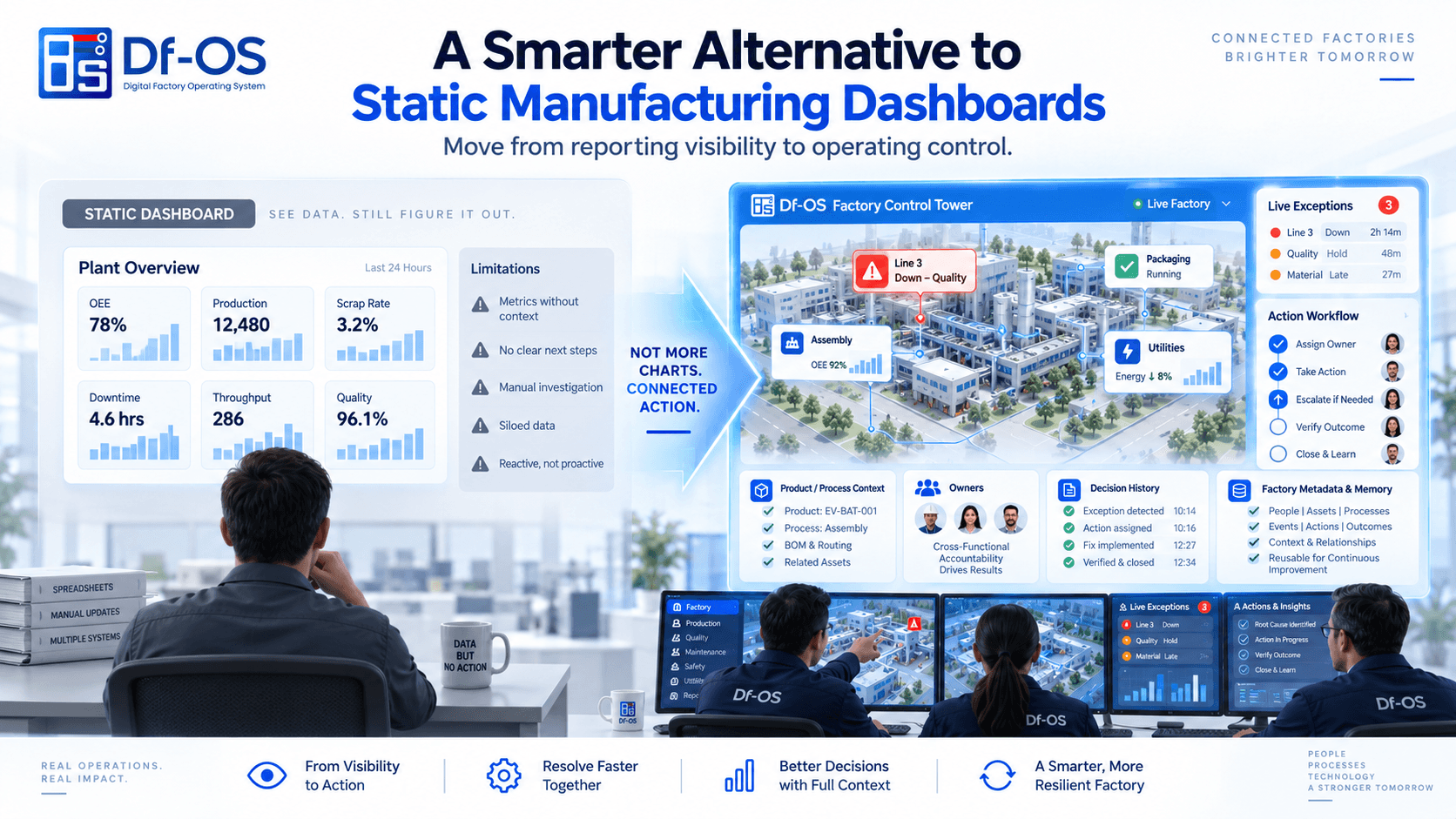
A Smarter Alternative to Static Manufacturing Dashboards
A comparison of static manufacturing dashboards and a connected Factory Control Tower that links metrics to live events, context, owners, workflows, escalation and verified closure.
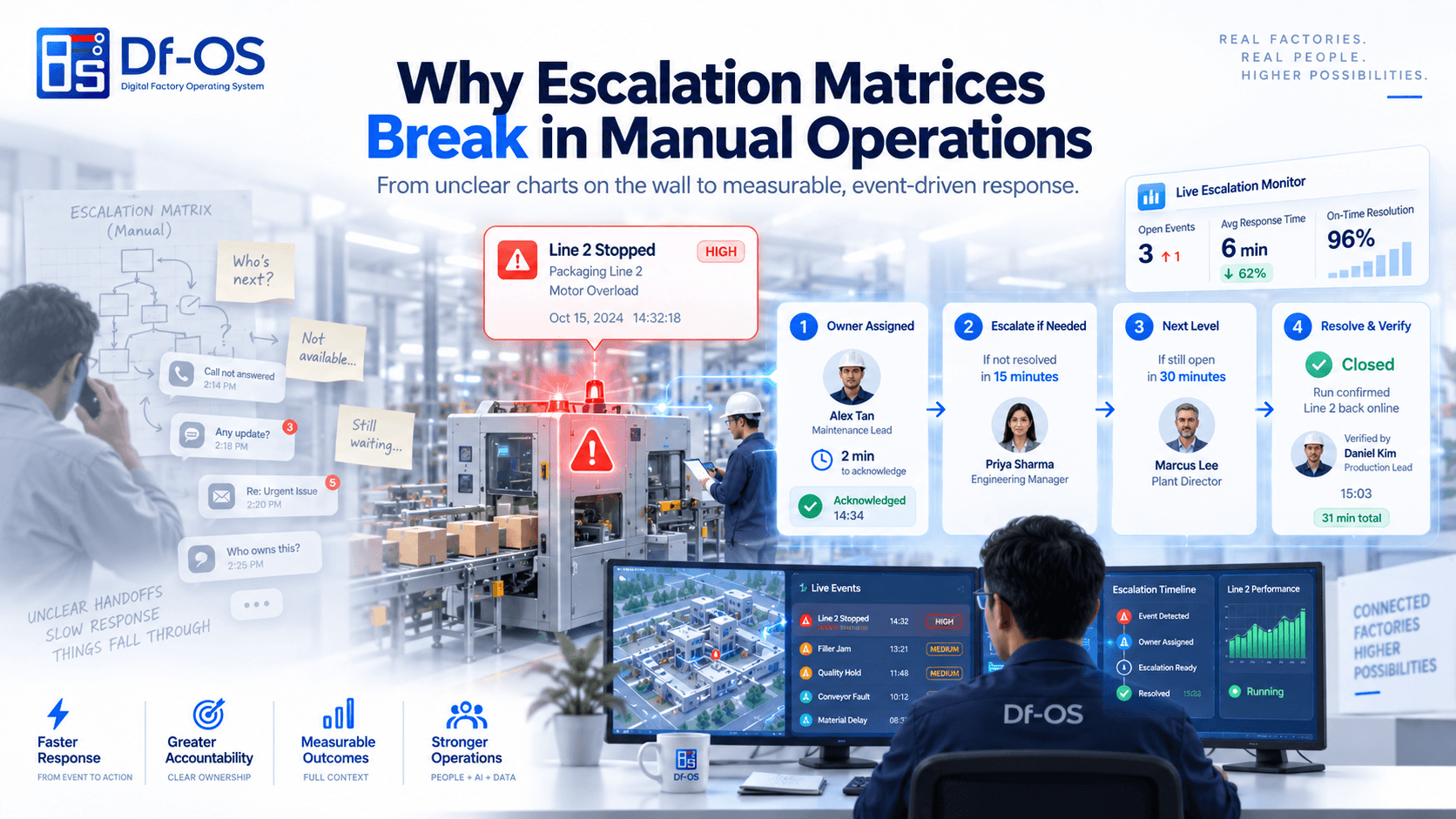
Why Escalation Matrices Break in Manual Operations
Why manual factory escalation matrices fail and how event-driven workflows connect measurable triggers, ownership, response time, escalation, closure evidence and learning.
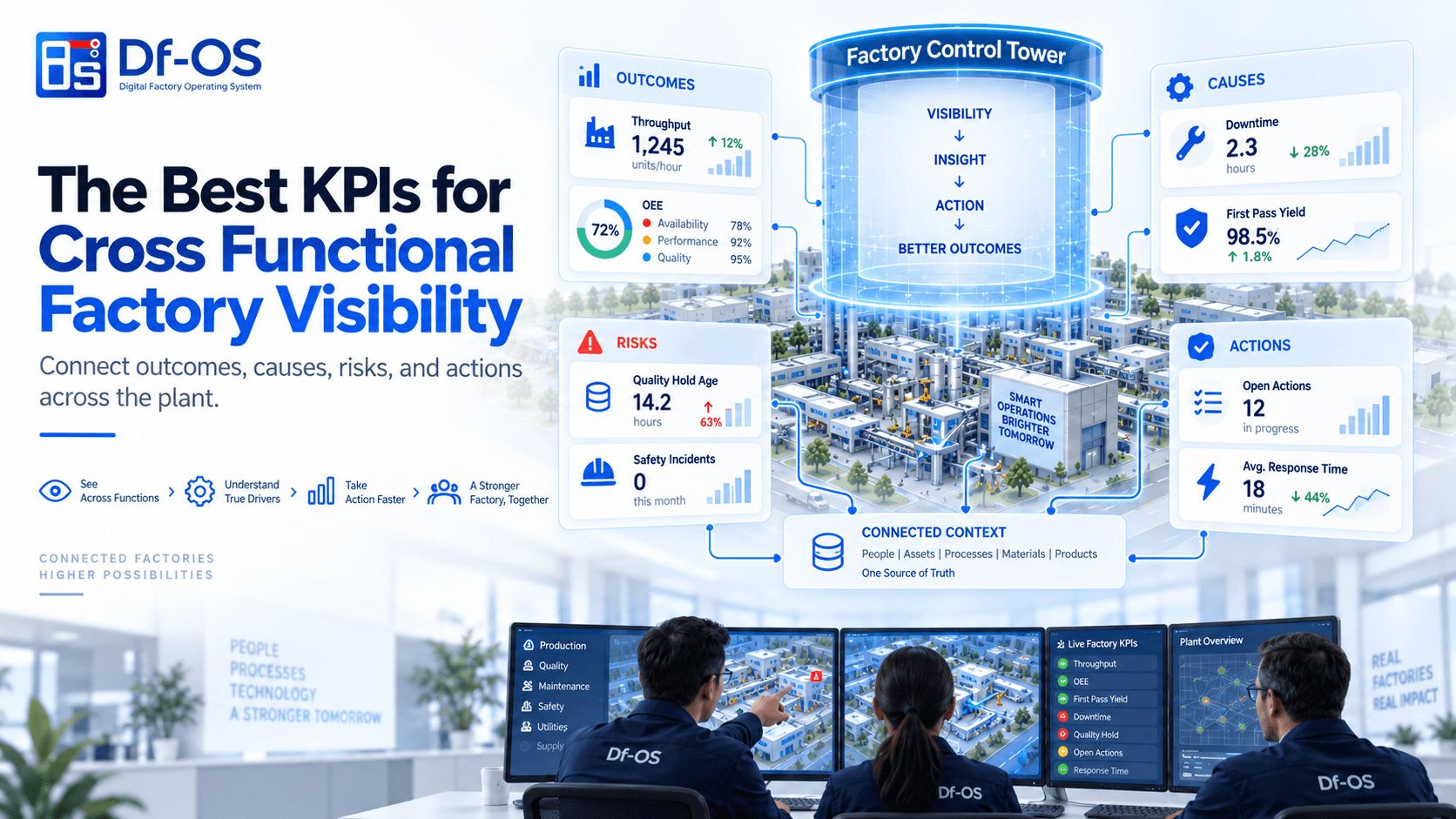
The Best KPIs for Cross Functional Factory Visibility
A four-level KPI framework connecting plant outcomes, operating causes, forward risks and action closure across production, quality, maintenance, safety and utilities.